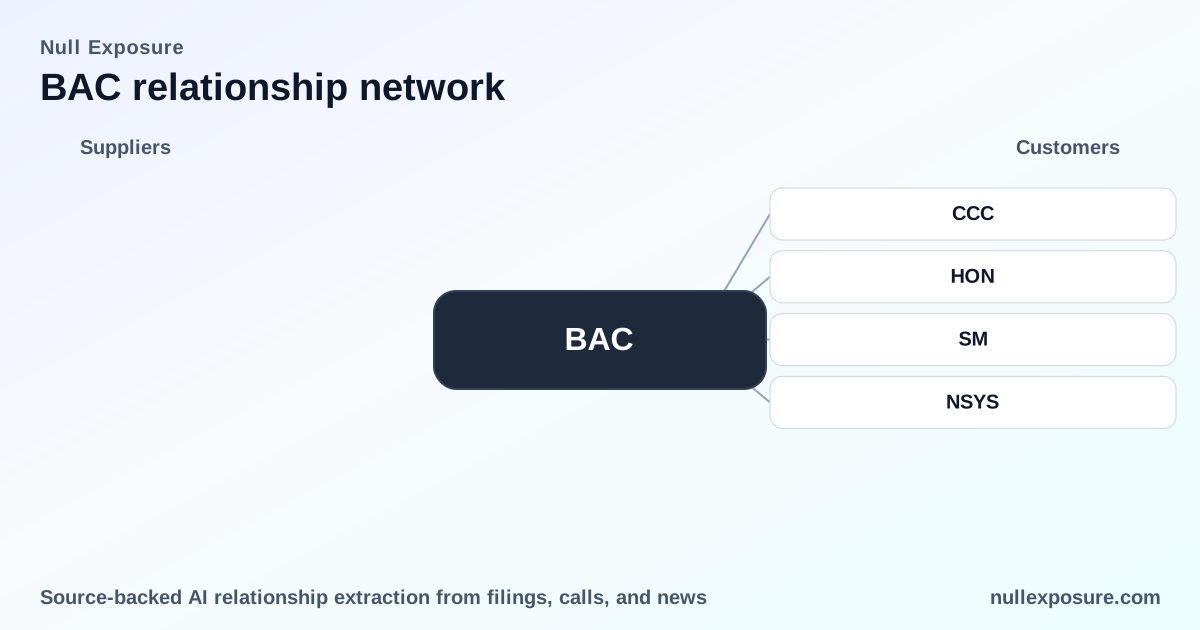
Bank of America (BAC): the client franchise that sells balance-sheet and advisory everywhere
Thesis — Bank of America monetizes a broad, diversified set of client relationships by combining deposit-taking and consumer lending with large-scale institutional lending, syndicated credit and investment-banking fees. Revenue flows from net interest on consumer and commercial lending, recurring servicing and interchange, and transactional and advisory fees generated by BofA Securities and commercial banking; that mix makes BAC’s customer footprint both deep and strategically central to corporate capital markets activity.
If you evaluate BAC as a counterparty or platform provider, focus on three practical takeaways: scale and diversification of client types, recurring fee streams from capital markets and servicing, and localized credit exposures where BAC acts as administrative agent or lender. For a deeper look at the raw relationship evidence and source material, visit our research hub: https://nullexposure.com/.
Overview: how relationships drive the business
- BofA operates as lender, administrative agent, underwriter, dealer manager and financial advisor across clients spanning small business, mid‑market and large corporates and governments. These roles produce interest income, fee income and financing-commitment capital.
- Its contracting posture is syndicated: BAC often leads facilities as administrative agent or bookrunner, reducing single‑name concentration risk while keeping fee economics and structural control.
- Geographic reach is global but U.S.-centric, with heavy exposure to North American commercial lending and consumer deposits; client relationships range from active credit facilities to one‑off advisory mandates.
A review of relationship signals (selected coverage) Below I summarize primary customer relationships captured in recent filings and press reporting. Each item is a plain‑English capsule with the source citation provided.
- ALLY — BofA Securities acted as one of the underwriting representatives on Ally Financial’s prospectus supplement (FY2026). (StockTitan SEC filing, 2026-05-02)
- MLI (Mueller Industries) — Mueller Industries secured a $100m five‑year revolver with Bank of America named as counterparty/agent (FY2026). (TradingView/SEC filing, 2026-05-03)
- CWST (Casella Waste Systems) — Casella entered a $550m credit facility with Bank of America, N.A. as administrative agent, together with other lead arrangers (FY2018 filing noted). (WilmerHale news release, 2018)
- WTTR (Select Water Solutions) — BofA Securities purchased placement allocations noted in a 424B5 filing (3,558,462 shares cited) (FY2026). (StreetInsider SEC filing, 2026-05-04)
- ARI (Apollo Commercial Real Estate Finance) — BofA Securities served as independent financial advisor to ARI’s special committee in a loan-portfolio sale process (FY2026). (The Globe and Mail / press release, 2026-03-09 / 2026-05-02)
- GEF (Greif) — Greif entered a $75m accelerated share repurchase agreement with Bank of America, N.A. (FY2022 press release). (PR Newswire, 2026-03-09)
- BCAX (Bicara Therapeutics) — BofA Securities was allocated pre‑funded warrants and shares in a prospectus supplement (FY2026). (StockTitan SEC filing, 2026-03-09)
- AAL (American Airlines) — Bank of America Securities listed among joint bookrunners for a financing tied to a 32‑aircraft deal (FY2026). (FlightGlobal coverage, 2026-04)
- AS (Amer Sports) — BofA acted as bookrunner, co‑lead arranger and lender on term and revolver facilities tied to the company’s financing package (FY2026). (StockTitan filing, 2026-03-09)
- BGC — Bank of America served as financial advisor to BGC on a sale of its insurance brokerage business (FY2021). (PR Newswire, 2026-03-09)
- SAFX (XCF Global) — XCF engaged Bank of America, N.A. to structure potential debt financing, including export-credit-agency eligible options (FY2026). (Des Moines Register / multiple press releases, 2026-03-10)
- TBCH (Turtle Beach/The Brand House Collective) — New $150m senior secured facility with Bank of America including revolver and term loan components (FY2025). (The Globe and Mail, 2026-03-10)
- ATAT (Atour Lifestyle) — Meǐn: Bank of America listed as joint sponsor/manager on an SEC filing for a proposed Nasdaq listing (FY2021 filing referenced). (Sohu PR, 2026-03-09)
- BSBR (Santander Brasil) — Bank of America acted as underwriter on a securities filing for Santander Brasil’s unit offering (FY2017). (Qatar Tribune coverage)
- RGA (Reinsurance Group of America) — BofA Securities served as joint book-running manager on subordinated debenture pricing (FY2026). (AIJourn, 2026-03-10)
- AFGC (American Financial Group) — Bank of America, N.A. served as Administrative Agent on an amended credit agreement (FY2026 exhibit reference). (StockTitan 10‑K, 2026)
- ALK (Alaska Air Group) — Multi‑year co‑brand credit card extension and issuer role with Bank of America; management describes BofA as “an amazing partner” (FY2026). (Alaska Air press release and earnings comments, Apr–May 2026)
- DRS (Leonardo DRS) — Company terminated a senior unsecured credit agreement with Bank of America and replaced it with a new facility (FY2026). (TradingView / 10‑K summary, 2026-03-09)
- TBHC (Brand House Collective) — Prior to closing with Bed Bath & Beyond, parties agreed to amend/refinance the existing BofA credit line (FY2025). (Bed Bath & Beyond / PR Newswire announcements, 2025–2026)
- CDR‑P‑B (Cedar Realty Trust) — BofA Securities acted as Cedar’s financial advisor for governance and strategic matters (FY2021 press coverage). (CityBiz, 2026-03-09)
- AMRC (Ameresco) — BofA acted as representative of the underwriters on a $140m public offering (FY2021 filing/counsel note). (WilmerHale / CityBiz, 2021/2026 references)
- HURC (Hurco Companies) — New secured revolving credit and L/C facility up to $20m with Bank of America replacing prior arrangements (FY2026). (The Globe and Mail / TradingView, 2026-05-03)
- GEL (Genesis Energy) — BofA Securities retained as Dealer Manager for a tender offer and leading related debt offerings (FY2026). (AIJourn / multiple press releases, 2026-03/05)
- AKUS (Akouos) — BofA served as joint book‑runner on the company IPO (FY2020 reported in filings). (GlobeNewswire / SEC filings)
- AHT‑P‑F (Ashford Hospitality Trust) — $580m debt package for hotel refinancing led by Bank of America and partner lenders (FY2025). (Commercial Observer, 2025)
- WSR (Whitestone REIT) — BofA acted as financial advisor and provided a fairness opinion amid a sale process ultimately leading to an Ares acquisition (FY2026). (GlobeNewswire, Reuters coverage, May 2026)
- GSBD (Goldman Sachs BDC) — BofA Securities listed among joint book‑running managers on a public offering (FY2026). (MarketScreener, 2026)
- EEX (Emerald Holding) — BofA Merrill Lynch served as an underwriter on the IPO (FY2026). (MarketBeat / filings)
- ALH (Alliance Laundry) — BofA as joint lead book‑runner on IPO activity (FY2025 filings and press). (StockTitan / Investing, 2025–2026)
- NSYS (Nortech Systems) — Waiver and amendment to a credit agreement with Bank of America after covenant issues (FY2026). (Investing.com / SEC filings, 2026-02/05)
- RDIB / RDI (Reading International) — Multiple amendments and maturity extensions on a Bank of America/Bank of Hawaii loan with updated repayment schedules in 2025–2026. (GlobeNewswire and regional filings, 2025–2026)
- WLFC (Willis Lease Finance) — Revolving credit and warehouse facilities supported by Bank of America and later amendments/terminations reflecting active liquidity management (FY2025–FY2026). (TradingView / GlobeNewswire filings)
- UP (Wheels Up) — Commitment letter for a five‑year, up‑to‑$332m senior secured revolver with Bank of America (FY2024–FY2025 activity). (SkiesMag, 2026)
- PLTK (Playtika) — Refinanced $550m revolver with Bank of America as administrative agent among syndicate lenders (FY2026). (TradingView / press, 2026-03)
- GLDD (Great Lakes Dredge & Dock via buyer Saltchuk) — Transaction financing backed by fully committed financing from Bank of America among other banks (FY2026). (gCaptain, 2026)
- INN‑P‑E / INN / PEB / PEB‑P‑E (Summit Hotel Properties / Pebblebrook) — Multiple credit amendments, delayed‑draw loans and administrative agent roles where Bank of America served as administrative agent and joint arranger for term loans and revolvers (FY2022–FY2026 filings/press). (PR Newswire / CityBiz / Investing coverage)
Constraints and what they signal about BAC’s client model
- Client mix is broad and multi‑segment: evidence supports consumer, small business, mid‑market and large corporate engagements across credit, advisory and capital markets. (Company disclosures, 2024–2026)
- Contracting posture is largely syndicated and agency‑led: BofA commonly appears as administrative agent or joint bookrunner, moderating single‑name balance‑sheet concentration while sustaining fee capture. (Multiple credit agreements and underwriting filings, 2025–2026)
- Geographic concentration is North America with global coverage: domestic retail footprint and international corporate capabilities co‑exist, with NA exposures emphasized in filings. (2024 annual disclosures)
- Relationship maturity varies: some are long‑running (co‑brand cards, facility agent roles) while others are transactional (deal advisory, deal‑by‑deal underwriting). This creates a hybrid revenue profile—recurring plus episodic fees. (Earnings and transaction announcements, 2024–2026)
Conclusion and next steps Bank of America’s customer evidence shows a repeatable capital‑markets and lending playbook: lead or agent roles on syndicated credit and placements; issuer and dealer‑manager activity supporting advisory and underwriting fees; and consumer/small‑business relationships that underpin NII and deposit stability. For investors and operators, the core questions are execution on credit underwriting cycles and sustaining fee volumes in competitive capital‑markets conditions.
Explore the full relationship index and underlying documents at https://nullexposure.com/ for transaction‑level detail and the raw source links that support the summaries above.