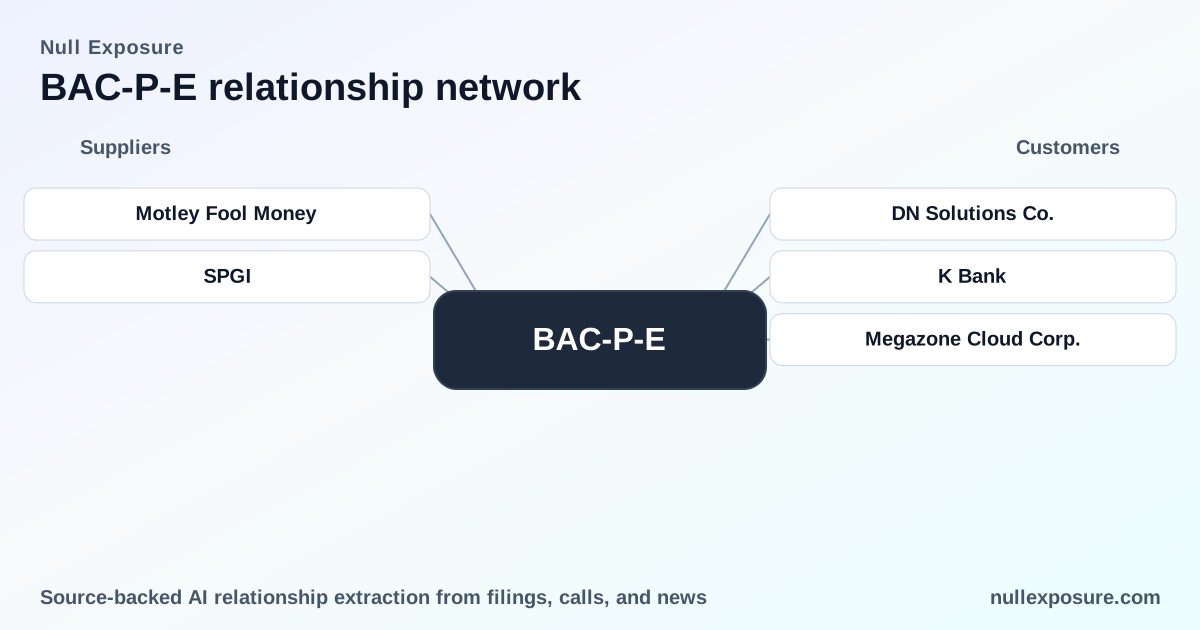
Bank of America (BAC-P-E) — Customer Relationships That Matter to Investors
Bank of America (represented here by its Depositary Share, Series E preferred) monetizes through a diversified financial-services platform: net interest income from lending and deposits, fee income from wealth management and payments, and capital-markets revenue from underwriting and trading. For investors assessing counterparty and client exposure, the relationships captured here underscore Bank of America’s role as a global investment bank and risk manager — executing IPO mandates in Asia-Pacific while also enforcing trading controls with high-frequency counterparties when required.
For a concise operator view of these client flows and risk signals, visit https://nullexposure.com/ for further context and tracking.
How these customer links map to Bank of America's business model
Bank of America’s client list in this sample demonstrates two consistent commercial behaviors:
- Mandated underwriting and syndication in capital markets — the bank obtains fee income and relationship value by leading and co-leading equity listings, particularly in the Korea market as documented below.
- Active trading counterparty management — the bank monitors and, when necessary, suspends trading relationships to protect market integrity and its balance-sheet exposure.
These behaviors imply a contracting posture oriented toward fee-driven mandates and high operational controls, with a broad counterparty base that reduces revenue concentration risk while requiring robust compliance and liquidity controls.
A quick scan of the relationships in the record
Below are the relationships captured in the available coverage, each summarized in plain language with source attribution.
Segantii Capital Management — trading suspension on equity activity
Bank of America suspended equity trading with hedge fund Segantii because of concerns about the fund’s large stock-sale activity and the market effects of those block trades. This action reflects the bank’s willingness to cut or pause trading access to preserve market integrity and protect its execution and compliance exposure. According to Bloomberg’s reporting on May 25, 2022, the suspension was tied to questions about the mechanics and risk of the hedge fund’s trades. (Bloomberg, May 2022)
K Bank — lead manager appointment for listing
Bank of America was appointed lead manager for K Bank’s listing, a mandate that positions the firm to capture underwriting fees, syndication economics, and follow-on banking relationship opportunities in Korea’s competitive IPO market. The role was reported in KED Global on July 16, 2024 and signals continued emphasis on cross-border equity origination. (KED Global, July 2024)
Megazone Cloud Corp. — co-lead manager on IPO
Bank of America acted as a co-lead manager for Megazone Cloud’s IPO, participating in the syndicate that distributed shares and priced the equity offering. That engagement, also documented by KED Global in July 2024, reflects the bank’s focus on technology-sector underwritings in Asia and its positioning to win recurring mandates with cloud and software clients. (KED Global, July 2024)
DN Solutions Co. — co-lead manager on IPO
Bank of America served as a co-lead manager for DN Solutions’ IPO, sharing underwriting responsibilities and fees with other syndicate banks. KED Global’s July 16, 2024 coverage lists this mandate alongside the K Bank and Megazone Cloud assignments, illustrating a concentrated set of Korea-focused originations within the same period. (KED Global, July 2024)
What these relationships collectively reveal about risk and opportunity
- Underwriting depth and geographic reach: The KED Global mandates show Bank of America executing lead and co-lead roles on Korean listings, highlighting its capability to source and distribute equity in non-U.S. markets and to monetize deal flow through fees and syndication.
- Sector focus and client pipeline: Engagements with Megazone Cloud and DN Solutions underline a tilt toward technology and cloud services issuers — sectors that generate recurring capital-markets needs and potential advisory revenue.
- Trading controls and counterparty risk posture: The Bloomberg report on Segantii demonstrates active enforcement of trading limits and selective counterparty suspensions to safeguard execution quality and compliance, which protects the bank’s trading revenue and balance-sheet exposure.
Key takeaway: Bank of America leverages its global origination platform for fee income while exercising strict trading governance to limit trading counterparties that pose execution or regulatory risk.
Constraints and operating-model signals
The relationship feed supplied contains no explicit contractual constraints or administrative flags for these customer entries. At the company level, that absence translates to two actionable signals:
- Low captured contractual friction: No recorded constraints means the capture does not show restrictive contractual terms or lingering vendor-style encumbrances tied to these client engagements.
- Maturity and diversification of engagement types: The mix of underwriting mandates and trading enforcement indicates a mature client-management model that balances fee-generating origination with active risk controls.
From an operational viewpoint, Bank of America’s posture is transactional and scalable — underwriting mandates are negotiated on a deal-by-deal basis (reducing long-term lock-ins) while trading relationships are governed by compliance rules and credit lines that can be adjusted dynamically. This combination supports steady fee capture without creating undue counterparty concentration.
Investment implications and risk checklist
- Revenue upside: Underwriting mandates in Asia diversify fee pools away from domestic U.S. issuance cycles and create cross-sell opportunities in corporate banking and wealth management.
- Operational risk: Active suspensions of trading relationships (as with Segantii) reduce potential short-term revenue but enhance long-term franchise protection; investors should view this as a risk-mitigation rather than a profit headwind.
- Concentration: The sample shows multiple Korea-focused mandates concentrated in the same period; monitor whether such regional batches persist, as cyclical concentration could introduce episodic volatility in fee income.
- Compliance and reputation: Enforcement actions reinforce a compliance-first brand, which supports client trust but can temporarily disrupt trading revenues.
Bottom line
Bank of America’s captured customer relationships highlight a dual commercial model: capture of capital-markets fees through cross-border underwriting, and active counterparty governance in trading. Both drivers support the bank’s premium franchise value for holders of its preferred shares, with the underwriting pipeline delivering fee diversification and trading controls preserving balance-sheet resilience.
For ongoing tracking of Bank of America’s client-level exposures and how they shift with market cycles, see the monitoring tools and briefings available at https://nullexposure.com/.