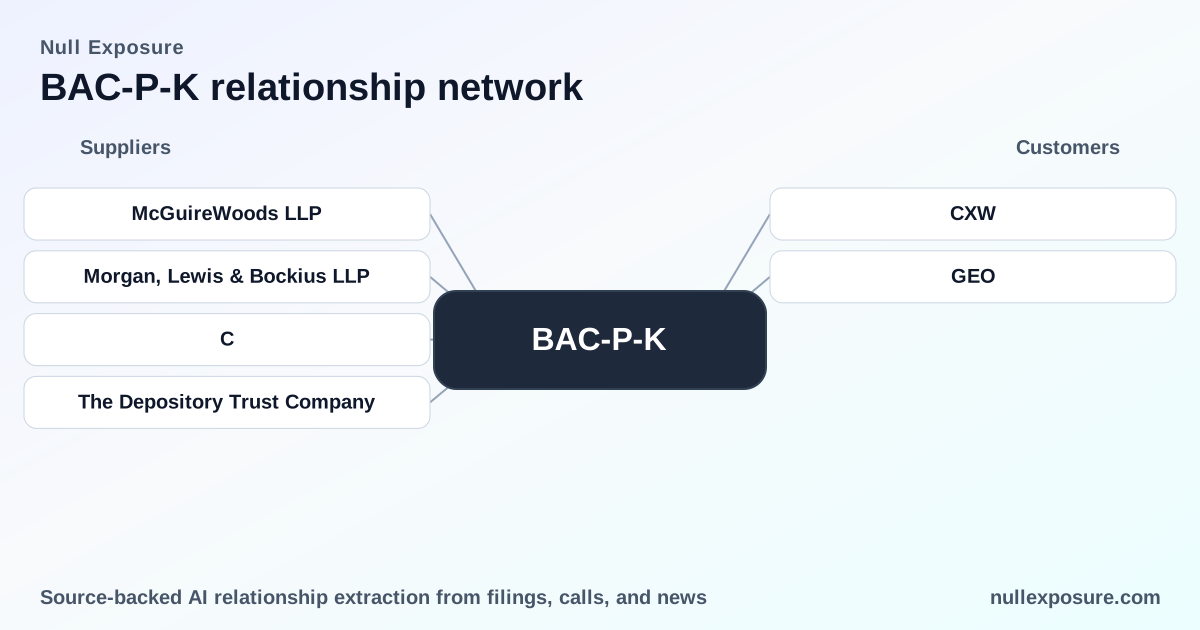
BAC‑P‑K (Bank of America Depositary Shares Series H): Customer Relationship Brief — Underwriting Links to CoreCivic and GEO
Bank of America operates as a diversified, systemically important financial services franchise that monetizes through commercial lending, underwriting, wealth management fees, trading and investment banking. The bank’s returns on capital derive from fee income on syndicated loans and bond underwriting, interest margin from lending, and large-scale deposit flows that fund its credit franchises — a model that concentrates both revenue scale and reputational exposure when high-profile counterparties are involved.
For a compact, actionable read on how these customer links affect counterparty and reputational risk, see Null Exposure’s intelligence hub: https://nullexposure.com/
Why these customer links matter to investors
Bank of America’s relationships with non‑bank corporate borrowers and bond issuers are routine revenue drivers for its investment banking and corporate lending businesses, but engagements with controversial sectors produce asymmetric reputational and regulatory tail risk. The March 2026 reporting captured below documents two such counterparties — CoreCivic (CXW) and GEO Group (GEO) — where underwriting and lending activity intersect with ongoing public scrutiny over private prison operators. For holders of BAC‑P‑K (preferred equity-style exposure to Bank of America), the operational implication is not direct cashflow volatility from a single borrower but heightened reputational and compliance risk that can influence regulatory capital, franchise valuation, and cost of funding.
If you want to track relationship signals across the bank’s counterparties, Null Exposure maintains consolidated reporting: https://nullexposure.com/
Relationship snapshots — what the sources report
The following items capture every relationship result returned for BAC‑P‑K in the provided set. Each entry is presented exactly as recorded and cited to the originating article.
CoreCivic Inc (CoreCivic / CXW) — entry 1
Bank of America underwrote bonds or participated in syndicated loans for CoreCivic Inc, according to reporting cited in the NLPC Corporate Integrity Project; Reuters was the original source cited by the NLPC piece (March 2026). Source: NLPC Corporate Integrity Project article referencing Reuters reporting (first seen 2026‑03‑09).
CXW — entry 2
The dataset duplicate lists the ticker CXW and reiterates that Bank of America extended underwriting or syndicated loan activity to CoreCivic, reinforcing the same exposure noted above in the March 2026 reporting. Source: NLPC Corporate Integrity Project article (citing Reuters, 2026‑03‑09).
GEO — entry 3
Reporting indicates Bank of America previously stopped providing banking services to GEO Group but has nonetheless been linked to underwriting or loan activity in the sector, as described by insiders and cited in the NLPC piece (March 2026). Source: NLPC Corporate Integrity Project article (first seen 2026‑03‑09).
GEO Group Inc — entry 4
NLPC’s write‑up repeats the GEO Group linkage, noting that BofA at times ceased banking GEO Group while its role in underwriting/private-credit remained part of the public record, per the March 2026 reporting. Source: NLPC Corporate Integrity Project article (citing Reuters, 2026‑03‑09).
What the relationships mean in plain terms
- These are commercial banking and capital markets engagements, not equity investments — Bank of America earns fees and interest via underwriting and syndicated lending rather than operating or managing the related businesses.
- The core risk is reputational and regulatory, not immediate credit impairment for the bank’s capital base; however, reputational incidents can translate into regulatory scrutiny and second‑order effects on funding costs and franchise value.
- Duplicate entries reflect source-level matching rather than additional counterparty exposure. The reporting indicates multiple mentions across news and advocacy channels, which amplifies public visibility.
Operational and business model signals (company‑level)
No explicit contractual constraints were returned in the source set for BAC‑P‑K; therefore the following are company‑level signals derived from Bank of America’s operating model and the nature of the reported relationships:
- Contracting posture: BofA holds a dominant, counterparty‑favorable position in many institutional transactions, allowing it to structure syndicated deals and fee arrangements at scale. That posture creates optionality but also concentrates accountability for client selection and reputational outcomes.
- Concentration: The bank’s revenue base is broad across business lines, reducing single‑counterparty revenue concentration, but exposure to high‑visibility counterparties introduces concentrated reputational risk that is not captured by traditional credit metrics.
- Criticality: As one of the Big Four U.S. banks, Bank of America is systemically critical, meaning regulatory reaction to controversy is more likely and potentially more consequential for capital, conduct oversight, and operational focus.
- Maturity: The bank’s franchises are highly mature with entrenched client relationships; operational decisions to engage or disengage from sectors reflect long‑term strategic and compliance trade‑offs rather than short‑term revenue swings.
Investor implications and risk checklist
- Reputational exposure can accelerate regulatory scrutiny, particularly when advocacy groups and mainstream media amplify connections to controversial sectors; that can affect future underwriting mandates and internal compliance costs.
- Fee income from underwriting and syndicated lending is incremental but not core to preferred‑share servicing, so direct payout pressure on BAC‑P‑K is unlikely absent a systemic capital shock to the bank.
- Watch for governance signals — board statements, policy changes on client selection, and public commitments to ESG screening will be material to franchise risk management and investor sentiment.
- Legal and political risk: Litigation, state or municipal divestment campaigns, and legislative action targeting private prison financing pathways could alter the economics of future deals.
Key takeaway: these relationships are important for assessing reputational and regulatory dimensions of Bank of America’s capital markets activity, but they do not represent direct balance‑sheet shocks to preferred share payouts in isolation.
Bottom line and next steps for analysts
For BAC‑P‑K stakeholders, the immediate action is to monitor public filings and investor communications for any shift in underwriting policies, compliance budgets, or litigation disclosures that reference these counterparties. Maintain focus on:
- public statements and policy changes from Bank of America about client eligibility;
- regulatory filings and enforcement actions referencing underwriting or syndicated loans;
- media and advocacy coverage that could force reputational remediation costs.
For ongoing coverage and consolidated relationship signals across Bank of America’s counterparties, Null Exposure provides a centralized view: https://nullexposure.com/
By tracking both the transactional footprint (underwriting, syndicated loans) and the evolving public reaction, investors get a complete read on how commercial revenue drivers can create asymmetric reputational risk for a large, systemically important bank.