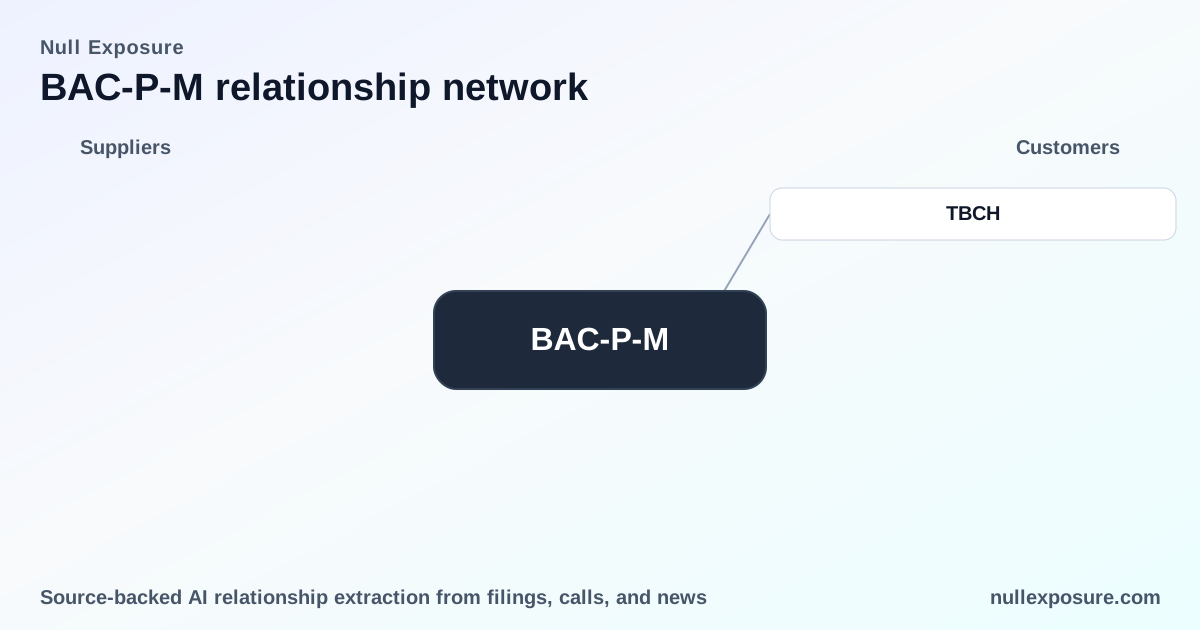
BAC-P-M: Bank of America’s customer-side credit footprint — the Turtle Beach amendment
Thesis: Bank of America operates as a universal bank that monetizes through net interest margin on lending, recurring fees from commercial and treasury services, and transaction/wealth-management fees; the relationships captured here are lender counterparty actions that generate fee and spread income while managing credit risk exposure. For investors in BAC-P-M, these customer interactions are material because they illustrate Bank of America’s role as a core corporate lender and the way it supports clients through covenant work and syndicated facilities. For further institutional coverage and relationship intelligence, visit https://nullexposure.com/.
What a single credit amendment tells us about the bank’s business model
Bank of America’s economics depend on originating and maintaining large-scale corporate credit facilities and ancillary fee income from structuring and amending those facilities. The uncovered relationship shows the bank executing a First Amendment to an existing credit agreement, which is a routine but profitable activity: amendments preserve interest-bearing principal on the balance sheet while generating amendment fees and protecting covenant structure that limits loss outcomes. The action reflects a lender posture that balances strict covenant maintenance with commercial flexibility for clients it deems strategically or economically valuable.
Relationship snapshots: every customer interaction found in the record
TBCH (inferred symbol TBCH) — First Amendment to Credit Agreement (FY2025)
Turtle Beach (TBCH) entered into a First Amendment to its Credit Agreement with Bank of America and other lenders to allow exclusion of up to $10 million of restricted payments from the denominator of its Consolidated Fixed Charge Coverage Ratio for specified trailing twelve-month periods, while all other material terms and the facility term remain unchanged. According to a TradingView news report (first seen March 9, 2026) that cites the agreement signed on December 29, 2025, the amendment was designed to increase covenant flexibility and support liquidity while preserving the original facility’s termination schedule.
Source: TradingView coverage of the credit amendment noted on March 9, 2026 (agreement effective December 29, 2025).
Turtle Beach Corp (inferred symbol TBCH) — same credit amendment record (FY2025)
The same item appears a second time under the full corporate name, confirming the counterparty identity: Bank of America acted as a negotiating lender in a syndicated amendment that explicitly permits up to $10 million of restricted payments to be excluded from the fixed-charge coverage ratio denominator for the trailing periods ending March 31, 2026 and June 30, 2026, with the facility’s overall term unchanged. This duplicate reporting reinforces that the bank retained its lender role and governance position through the modification process.
Source: TradingView report (March 9, 2026) documenting the December 29, 2025 amendment for FY2025 filings.
What the (absence of) constraints signals about the operating model
The dataset contains no explicit constraints entries tied to BAC-P-M relationships. That absence functions as a company-level signal: no flagged contractual constraints, vendor concentration flags, or explicit restrictive covenants were surfaced beyond the single amendment described. In practical terms, the lack of constraint entries complements the amendment narrative — Bank of America is executing standard credit-management activity without publicly flagged structural limits in this record set.
Operationally, these observations imply:
- Contracting posture: active lender role with flexibility to renegotiate covenants when it preserves credit economics and client liquidity.
- Concentration: the captured sample is narrow (single borrower), so no systemic counterparty concentration signal can be inferred from this feed alone.
- Criticality and maturity: the unchanged term and limited scope of the amendment indicate a mature lender-borrower relationship being managed rather than a distressed reset.
Investment implications — how to read this for BAC-P-M holders
- Revenue mechanics are reinforced: fee generation and spread retention on amended loans are core to Bank of America’s fixed-income economics, which supports preferred-share credit profiles that rely on stable earnings and interest income.
- Credit discipline with commercial pragmatism: allowing modest covenant carve-outs while keeping the overall facility term intact signals credit-management discipline that prioritizes recovery pathways over wholesale covenant concessions.
- Single-name visibility limits inference: the record shows one corporate borrower (Turtle Beach) and a single amendment; investors should not extrapolate broad portfolio risk or concentration without additional relationship data.
Bold takeaway: this is a routine lender amendment that preserves interest-earning exposure while offering limited covenant relief — a net-positive for current shareholders of Bank of America’s preferred issuances, including BAC-P-M, because it protects credit flows without materially extending maturity risk.
Practical risk checklist for portfolio managers
- Monitor covenant leakage: quantify how common restricted-payment carve-outs are across the bank’s commercial lending book, because repeated carve-outs can erode covenant protections.
- Track amendment frequency and fee capture: amendments are revenue events but can be a proxy for borrower stress; an increasing amendment cadence warrants closer credit monitoring.
- Demand broader counterparty visibility: one relationship is insufficient to judge concentration risk; seek the next tranche of relationship-level disclosures for a fuller picture.
Where to go next for deeper relationship intelligence
For more granular coverage and ongoing tracking of Bank of America’s counterparty and covenant activity, explore our relationship analytics and reporting at https://nullexposure.com/. If you want curated alerts on lender-borrower amendments and covenant changes relevant to preferred-note investors, Null Exposure provides tailored briefs and trend screens.
Final note: the evidence here is specific — a December 29, 2025 First Amendment with Turtle Beach that leaves the loan term intact while carving limited restricted-payment relief — and it fits a broader pattern of a major bank managing corporate credit relationships to preserve yield and client continuity.