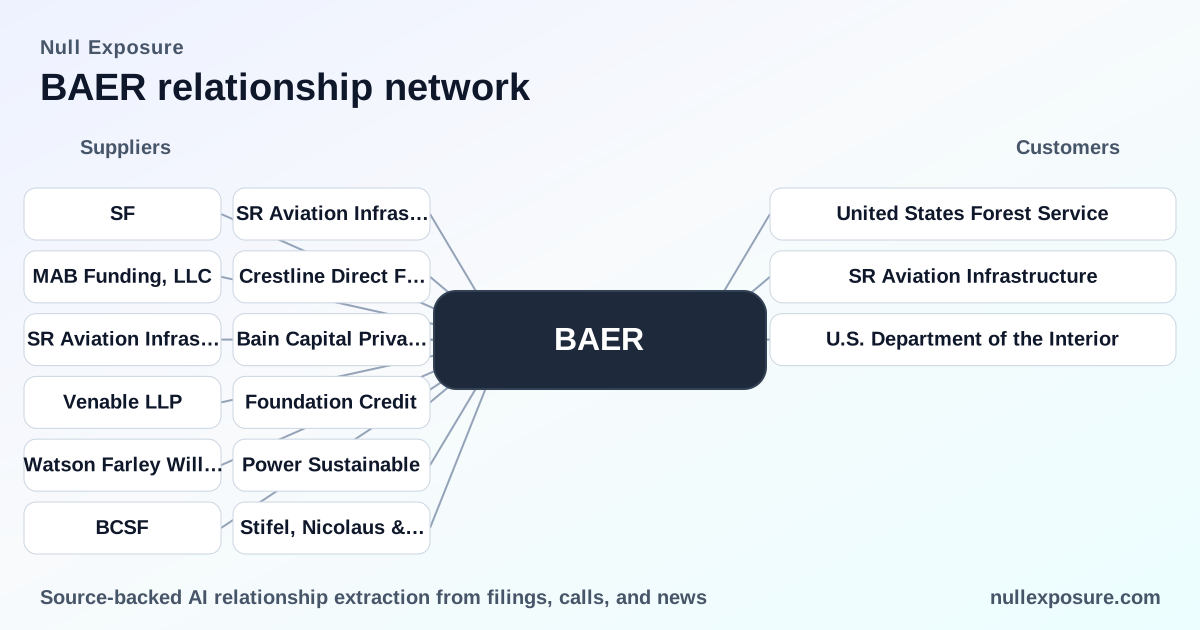
Bridger Aerospace (BAER) — Customer Map and Strategic Implications for Investors
Bridger Aerospace operates and monetizes by providing aerial wildfire management, suppression and specialty aviation services under contracts with federal and state governments and select commercial customers; revenue derives primarily from seasonally timed task orders, IDIQ vehicles and short-to-medium duration mission work, with real-estate monetization used opportunistically to fund fleet growth. This profile makes Bridger a government-facing services business with high revenue concentration, seasonal cashflow dynamics, and a capital strategy that includes sale‑leaseback transactions to prioritize aircraft expansion. For a concise hub of related company intelligence, visit https://nullexposure.com/.
Why the customer list matters to valuation and risk
Bridger’s customer footprint is dominated by U.S. government agencies, which drives both stability and concentration risk. Company disclosures show that approximately two‑thirds of revenue in 2024 came from U.S. government contracts, and historically the business operates with a mix of short, medium and long‑term contracts tied to firefighting seasons. That mix produces strong renewal economics — the firm reports a 100% renewal rate on federal and state contracts — while leaving revenue timing tightly coupled to annual wildfire seasons and federal procurement cycles. The company’s decision to complete a $49 million sale‑leaseback of headquarters and hangars demonstrates an active capital-leveraging strategy to accelerate fleet investment rather than hold real estate on the balance sheet.
How that operating model shapes investor exposure
- Concentration: Bridger reported two customers that together accounted for a majority of revenue in 2024 (61% and 12% respectively), making customer concentration a first-order valuation risk.
- Counterparty profile: The firm’s customers are predominantly government entities, which reduces receivables credit risk but increases dependency on public budgets and procurement schedules.
- Contracting posture and seasonality: The business runs short‑to‑medium duration engagements within a year alongside longer IDIQ vehicles; revenue recognition and cashflow are therefore seasonal and linked to wildfire activity and agency tasking.
- Capital strategy: Use of sale‑leaseback transactions indicates management preference for asset-light liquidity to scale aircraft operations quickly.
These characteristics warrant a valuation framework that weights recurring government tasking highly but applies a material concentration discount and sensitivity to seasonality in cashflow forecasts.
Relationship-by-relationship: what each counterparty means for BAER
Below are every counterpart recorded in the available relationship results and the concrete commercial signal each provides.
United States Forest Service (USFS) — core federal customer (FY2025–FY2026)
Bridger provides aerial firefighting, wildfire management and related services to the USFS across the nation, a relationship cited repeatedly in company press releases and investor communications for FY2025–FY2026. According to multiple company announcements and press coverage in FY2025–FY2026, the USFS is a principal buyer of Bridger’s core Super Scooper and surveillance services, underpinning the company’s government revenue base.
Source: company press releases and media coverage referencing Bridger’s USFS engagements (FY2025–FY2026).
U.S. Department of the Interior (DOI) — multi‑year IDIQ work (FY2025–FY2026)
Bridger secured an IDIQ contract with the Department of the Interior for air attack and surveillance aircraft supporting the Bureau of Land Management’s Alaska Fire Service; one announcement cited a five‑year $20.1 million IDIQ vehicle in FY2025 and later reporting referenced a separate Alaska contract in FY2026 valued in the mid‑teens millions. These IDIQ awards illustrate Bridger’s strategy of combining longer‑dated federal vehicles with seasonal task orders.
Source: AerialFireMag reporting (Jan 14, 2025) and subsequent contract announcements through FY2026.
Bureau of Land Management — Alaska Fire Service (BLM Alaska) — regional mission specialization (FY2025)
Bridger’s DOI IDIQ explicitly supports the BLM Alaska Fire Service with two air attack and surveillance aircraft, signaling specialized regional mission capability in remote and harsh environments that the firm highlights as differentiating its Alaskan operations.
Source: AerialFireMag contract coverage (FY2025).
State of Alaska — state‑level purchaser for remote logistics and support (FY2026)
Bridger’s light fixed‑wing fleet and expanded aircraft profile were referenced in FY2026 communications as suited to meet the needs of the DOI and the State of Alaska, indicating both federal and state tasking in Alaska that extend beyond suppression to personnel and cargo support to remote locations.
Source: StockTwits/contract reporting (FY2026).
SR Aviation Infrastructure (SRAI) — real‑estate counterparty and sale‑leaseback partner (FY2025–FY2026)
Bridger completed an approximately $49 million sale of its headquarters and hangar facilities to SR Aviation Infrastructure, coupled with a ten‑year leaseback, a deliberate capital reallocation to accelerate fleet growth while retaining operational access to its base. This transaction changes the asset base and reduces property ownership while preserving operational continuity.
Source: GlobeNewswire press release and subsequent Yahoo Finance coverage (Oct 28, 2025 / FY2026).
EVEX — mismatched mention with no substantive customer link (FY2025)
One result in the set references EVEX in a Q3 2025 earnings transcript discussing battery supply and BAE; that entry does not document a customer relationship between Bridger and EVEX and is a clear indexing mismatch in the search results. There is no evidence in the available records that EVEX is a counterparty to Bridger.
Source: InsiderMonkey transcript excerpt (Q3 2025) showing unrelated content.
Investment implications and near‑term watch items
- Revenue concentration and dependency on government spend are the primary valuation levers; with roughly two‑thirds of revenue tied to U.S. government contracts in 2024, any procurement or budget delays will materially affect topline timing and margins. Company disclosures show the government share at ~67% (2024).
- Contract mix hedges seasonality: IDIQs and multi‑year vehicles (e.g., DOI awards) provide a floor to demand, while short‑term task orders generate upside during intense fire seasons. Management reports a historical 100% renewal rate on federal and state contracts, supporting predictability of repeat tasking.
- Operational leverage and capital strategy: The sale‑leaseback to SRAI frees capital for fleet growth but shifts real‑estate risk to a landlord model and introduces a long‑dated lease commitment; evaluate lease terms when modeling free cash flow and fixed obligations.
- Geographic exposure is primarily North America, with emerging EMEA revenue (notably Spain in 2024) providing early diversification signals that require monitoring for scale.
For investors and operators, the primary monitoring items over the next 12 months are federal task order awards and discretionary budget developments, the cadence of seasonal tasking, and the company’s execution on fleet growth funded by the sale‑leaseback.
If you want a consolidated view of BAER’s counterparty signals and evolving customer exposures, explore the company profile at https://nullexposure.com/ or contact the team for a tailored briefing.