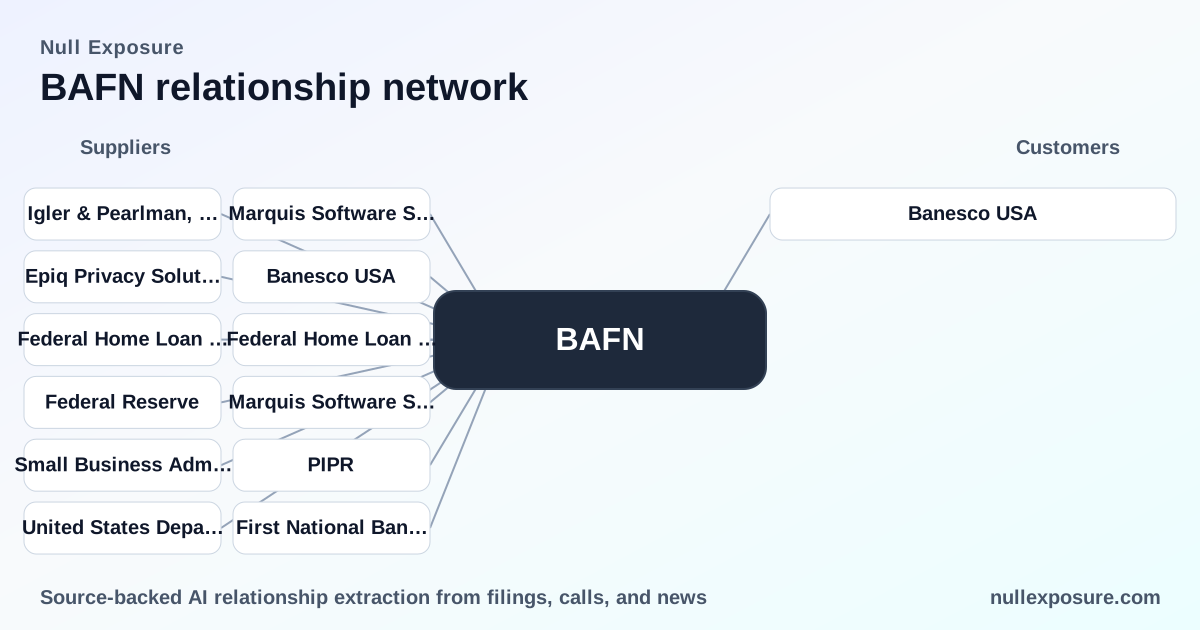
BayFirst Financial (BAFN): Loan-sales, SBA exit and what the Banesco deal tells investors
BayFirst Financial Corp operates as a regional community bank headquartered in Saint Petersburg, Florida, monetizing through net interest margin on originated loans, fee income from retail and commercial banking services, and historically through a national government‑guaranteed SBA 7(a) lending program that the bank has recently exited. The company has executed a controlled derisking of its balance sheet by selling a substantial portion of its SBA 7(a) portfolio to Banesco USA, converting illiquid, government‑guaranteed assets into cash and improving capital headroom while accepting a modest near‑term loss. For a concise institutional view of these customer relationships, visit https://nullexposure.com/.
Operationally BayFirst runs a dual model: community banking concentrated in the Tampa Bay/Sarasota region for deposits and retail lending, plus a once‑large SBA lending footprint that extended nationwide. The bank recently pivoted away from the national SBA strategy and executed loan sales into the $90–103 million range, signaling a shift in management focus back toward local deposit gathering and core commercial banking services.
Why the Banesco transaction is important to investors
- Immediate capital relief and balance‑sheet derisking. Selling guaranteed SBA loans shrinks assets that had higher administrative overhead and compressed returns, and the company disclosed a specific net loss connected to the sale in its restructuring commentary.
- Execution risk traded for certainty. Rather than retain residual credit exposure, BayFirst elected to realize liquidity now at roughly high‑90s cents on balance, accepting a one‑time earnings impact to strengthen capital ratios and reposition strategy.
- Strategic repositioning toward core markets. The bank will concentrate deposit originations and community banking services in its primary Florida footprint while reducing national SBA exposure that historically drove volatility.
A mid‑report action point: if you’re tracking counterparty flows and buyer appetite for government‑guaranteed loans, review the full relationship log below or visit https://nullexposure.com/ for consolidated monitoring.
How BayFirst’s operating model and constraints shape commercial relationships
- Contracting posture — short‑term commitments for unfunded facilities. The bank’s unfunded loan commitments are typically short duration (generally 90 days or less), which disciplines funding and reduces long‑tail contingent exposure.
- Counterparty mix — small business and retail heavy. BayFirst’s loan book is built around consumers, small businesses and mid‑market commercial customers, with a national footprint for government‑guaranteed lending but a local deposit base concentrated in Pinellas, Hillsborough, Manatee, Pasco and Sarasota counties.
- Relationship role — active seller and multi‑service provider. The bank both originates and, when appropriate, sells government‑guaranteed loans, while continuing to provide traditional community banking services (cash management, remote deposit capture, wire services).
- Segment focus — services and community banking. Revenue is primarily banking‑based rather than from transactional merchant services or capital markets, reinforcing sensitivity to interest rate margins and credit cycles.
- Spend and scale signals. Reported transactional sizes and related insider loans fall in low‑to‑mid single‑digit millions, while the Banesco loan sale sits firmly in the $10m–$100m spend band, indicating BayFirst can aggregate larger pools for strategic disposition.
Complete relationship log: every reported interaction with Banesco USA
- BayFirst announced it had signed a definitive agreement to sell $103 million in SBA 7(a) loans to Banesco USA, framing the move as an exit from its SBA 7(a) business (GlobeNewswire press release, Sep 29, 2025).
- A CityBiz report repeated the company’s plan to exit SBA 7(a) lending and sell $103 million of balances to Banesco USA as the strategic centerpiece of its restructuring (CityBiz, Sep/Oct 2025).
- In a Q1 2026 corporate release BayFirst stated the decrease in loans from the prior year reflected the sale of $97.4 million of government‑guaranteed loans to Banesco USA as part of discontinuing SBA lending (GlobeNewswire press release, Apr 30, 2026).
- Investing.com reported BayFirst completed a planned sale of $94.6 million in loans to Banesco USA, noting the closure was first disclosed in late September 2025 (Investing.com, article dated Dec 2025 / reported May 2026).
- TradingView carried a bulletin that BayFirst closed on a $94.6 million loan sale to Banesco USA on December 15, 2025, recording the transaction as completed (TradingView news, Dec 15, 2025).
- In its Q3 2025 results, BayFirst disclosed the definitive agreement with Banesco USA and disclosed the transaction economics as 97% of retained loan balances, implying a net loss of roughly $5.1 million tied to the sale (GlobeNewswire, Oct 30, 2025).
- BayFirst’s Jan 29, 2026 press release reiterated that the sale activity reduced government‑guaranteed loans and improved capital ratios, referencing Banesco USA as the counterparty to the disposals (GlobeNewswire, Jan 29, 2026).
- StockTitan’s coverage of BayFirst’s fourth‑quarter 2025 results reported the company closed $94.6 million in loans to Banesco USA and framed it as a milestone in the derisking plan (StockTitan, Q4 2025 release).
- Yahoo Finance summarized BayFirst’s press release headline: “BayFirst Closes $94.6 Million Loan Sale to Banesco USA,” highlighting the completion and public announcement (Yahoo Finance, Dec 2025).
- A regional Investing.com outlet (Nigeria mirror) repeated the completion of the $94.6 million sale to Banesco USA, echoing the December transaction close (Investing.com international, late 2025).
- CityBiz also ran a closure notice confirming $94.6 million closed to Banesco USA and noted executive commentary about the strategic impact (CityBiz, Dec 2025).
- GlobeNewswire’s Jan 29, 2026 financial release reiterated year‑end closings and cited the Banesco transactions as material to the quarterly and year‑end loan‑held‑for‑sale reductions (GlobeNewswire, Jan 29, 2026).
- The earlier GlobeNewswire announcement of Sep 29, 2025 publicized the definitive agreement for $103 million in SBA loans to Banesco USA that initiated the program of sales (GlobeNewswire, Sep 29, 2025).
- StockTitan’s SEC‑filing summary of BayFirst’s 8‑K recorded the material event: closure of the sale to Banesco USA and the company’s filing disclosure of terms (StockTitan SEC‑filings synopsis, Oct/Nov 2025).
- GlobeNewswire’s Dec 15, 2025 release provided a direct company statement: “I am pleased to announce BayFirst has closed on the sale of $94.6 million of loans to Banesco USA,” confirming execution (GlobeNewswire, Dec 15, 2025).
- A StockTitan item promoting the fourth‑quarter conference call repeated the capital‑and‑loan‑sale language referencing Banesco USA and the strategic plan (StockTitan, Dec 2025).
- A TradingView/Zacks summary highlighted that the $96.6 million figure was referenced in some commentary as an aggregate year‑end total of sales to Banesco USA, describing the transaction as key to derisking the portfolio (TradingView / Zacks summarization, Q4/Q1 2026).
- An Investing.com transcript of the earnings call noted loans held for sale decreased by $94.1 million during the quarter, reflecting the Banesco USA transaction and related accounting adjustments (Investing.com earnings transcript, Q1 2026).
What investors should take away
- The Banesco USA relationship is a deliberate balance‑sheet management tool: BayFirst sold high‑volume SBA 7(a) loans to realize liquidity, improve capital, and reduce operating complexity tied to national guaranteed lending.
- Reported amounts vary across disclosures (agreement announced at $103M, closed transactions reported at $94.6M and referenced aggregates near $96–97M), but all public releases consistently show a major sale program with Banesco USA across Q4 2025 and Q1 2026 (company press releases and financial news coverage, Sep–Apr 2026).
- This is a positive tactical move for capital and focus, but investors should track BayFirst’s redeployment strategy for proceeds and monitor core margin and deposit trends as the bank refocuses on its Florida community franchise.
For ongoing tracking and to integrate this relationship into a broader counterparty map, visit https://nullexposure.com/ for consolidated signals and time‑series coverage.