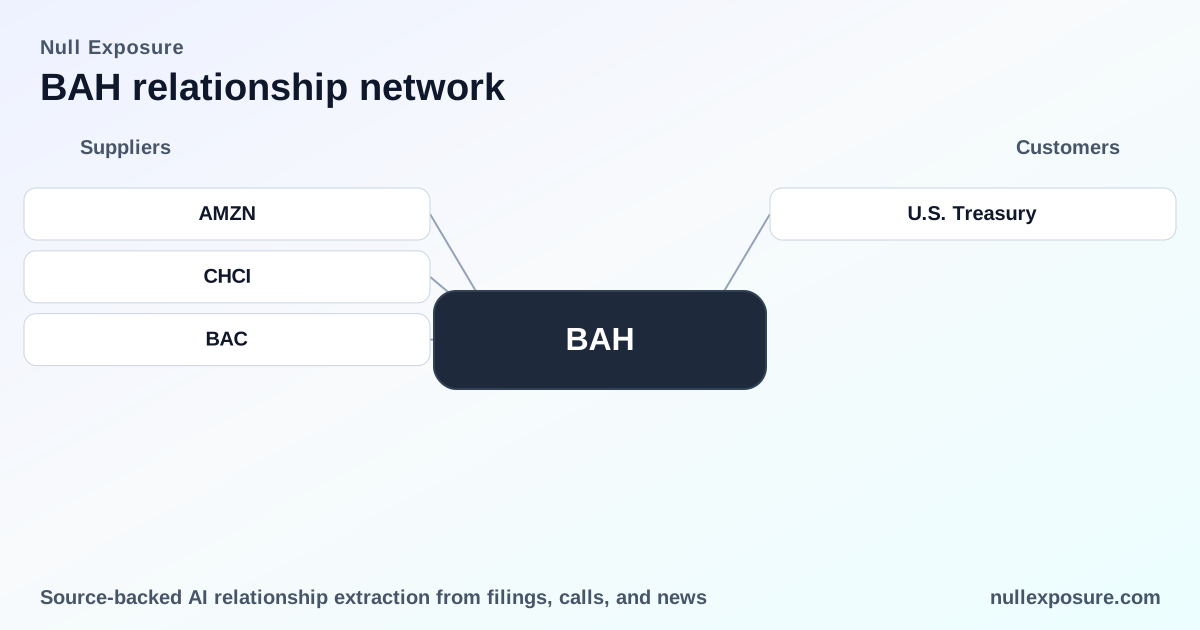
Booz Allen Hamilton: What recent customer signals mean for investors
Booz Allen Hamilton (NYSE: BAH) monetizes deep, mission-critical professional services by delivering consulting, technology and engineering work under predominantly government contract vehicles. The company operates as a prime services contractor on IDIQ/framework arrangements, generating recurring task-order revenue concentrated in the U.S. federal market, with commercial work as a meaningful but secondary revenue stream. For investors, the key questions are contract durability, customer concentration risk, and the short-term earnings impact of recent contract actions.
Explore more detailed relationship analytics at https://nullexposure.com/.
The short narrative investors need first
BAH runs a high-volume services model: large scale task-orders under IDIQs and framework agreements that translate to predictable backlog and steady cash flow, but very high counterparty concentration in U.S. government customers. That business model supports strong margins on recurring authorized work while creating sensitivity to contract cancellations, oversight changes, and audit outcomes. Recent headlines about the Treasury are therefore material to near-term revenue and reputation risk.
What the headlines actually show — Treasury contract cancellations
U.S. Treasury (Intellectia report, March 9, 2026): A report dated March 9, 2026 states the U.S. Treasury Secretary canceled 31 Booz Allen contracts, removing roughly $21 million of obligations and cutting about $4.8 million per year in expected spending as part of tightened oversight of contractors. This is a direct contract-level cancellation with immediate dollar impact on the affected task orders. (Intellectia news, 2026-03-09)
U.S. Department of the Treasury (Investing.com summary, May 2, 2026): An Investing.com article summarized Booz Allen’s disclosure that the Department of the Treasury had canceled contracts with the company, reiterating the company’s public filing and signaling regulatory follow-through. The public disclosure frames the cancellations as part of formal government action reflected in BAH’s SEC communications. (Investing.com, 2026-05-02)
Treasury (BizJournal, January 26, 2026): Local reporting in the Washington Business Journal reported that Treasury canceled all Booz Allen contracts after a data lapse, emphasizing the reputational and operational dimensions of the decision and the Treasury’s stated motive to restore public trust. The piece situates the cancellations in a broader governance-driven response. (Washington Business Journal, 2026-01-26)
- Takeaway: Multiple independent news outlets and the company’s own filings document Treasury contract cancellations across early 2026, collectively representing several dozen task orders and a low-to-mid tens-of-millions revenue impact on an annualized basis. The cancellations are operationally minor in absolute dollars versus BAH’s $11.4 billion in revenue, but highly visible given the Treasury’s profile.
A partnership mention from an earnings call — Booz Allen in the cloud ecosystem
AI (earnings call, 2025 Q4): In a 2025 Q4 earnings call transcript, a speaker referenced forming partnerships with cloud providers and “as we're doing with Booz Allen in the federal space,” highlighting Booz Allen’s role as a federal integrator and partner for major cloud vendors in government engagements. This underscores Booz Allen’s positioning as a systems integrator and channel partner for cloud and platform providers in federal programs. (AI earnings call transcript, 2026-03-07)
- Takeaway: BAH is actively positioned as a federal integrator with strategic partnerships across top cloud platforms, reinforcing the company’s role in modernization programs that drive higher-margin digital services.
How the operating model shapes risk and upside
BAH’s documented constraints outline a coherent operating posture that explains both resilience and vulnerability:
-
Framework / IDIQ-oriented contracting posture. The company reported that roughly 85% of revenue in fiscal 2025 derived from task orders under IDIQ vehicles, which produces stable recurring work but reduces visibility into specific future task award timing. This structure favors backlog stability but concentrates negotiation and compliance risk at the task-order level.
-
Extreme counterparty concentration in government customers. Management states that U.S. government agencies accounted for 98% of revenue in fiscal 2025, which is a structural concentration that amplifies policy, oversight, and budget-cycle risk.
-
Domestic geographic focus with selected international exposure. The business is primarily North America-focused, supporting critical federal missions domestically while maintaining limited international operations where required.
-
Service-led, single-segment operating model. Booz Allen manages as one reporting segment and acts primarily as the prime contractor on 95% of engagements, indicating integrated delivery but also single-lever exposure to sector cyclicality.
-
Materiality and spend profile. Defense and intelligence customers generate large revenue pools (defense ~$5.9B and intelligence ~$1.9B in fiscal 2025), confirming 100M+ spend bands that make Booz Allen a strategic supplier on sizable programs.
Collectively, these characteristics create a company that is operationally mature and cash-generative but whose valuation is sensitive to federal oversight events and discrete contract cancellations.
Investment implications — risk calibrated against scale
-
Earnings sensitivity: The Treasury cancellations documented in early 2026 remove tens of millions in obligations but are small relative to $11.4 billion in revenue; expect near-term quarterly volatility in affected bookings and modest headwinds to growth rather than an existential earnings shock.
-
Reputational and procurement risk: Cancellation by a high-profile customer like Treasury increases the probability of enhanced compliance costs, more conservative task-award decisions across agencies, and potential short-term pipeline delays.
-
Offsetting demand drivers: Booz Allen’s strategic partnerships with major cloud providers and its dominant prime-contractor posture preserve access to modernization budgets and higher-margin digital transformation work that supports medium-term margin resilience.
-
Balance of probability: Given the company’s heavy government concentration and IDIQ framework reliance, investors should value BAH with a premium for predictable cash flows but discount for policy and audit tail risks that can accelerate contract churn.
Quick, actionable checklist for analysts
- Revisit FY2026 guidance and backlog disclosures in the next 10-Q/8-K to quantify the net revenue and booking impact from Treasury cancellations.
- Monitor pipeline and task-order award timing for cloud modernization programs where Booz Allen acts as an integrator.
- Track developments in government oversight or audit outcomes that would materially increase compliance reserves or contingent liabilities.
If you want more consolidated relationship intelligence and time-series tracking for BAH customers, see https://nullexposure.com/ for coverage and alerts.
Closing assessment
Booz Allen’s business model remains service-dominant, government-centric, and structurally resilient thanks to IDIQ-driven backlog and strong positioning as a federal integrator. However, high counterparty concentration and recent Treasury contract cancellations raise the probability of short-term revenue and reputational headwinds. For investors, the appropriate stance is a balanced one: value the predictable cash flow and strategic partnerships while pricing in elevated oversight risk until government procurement signals stabilize.