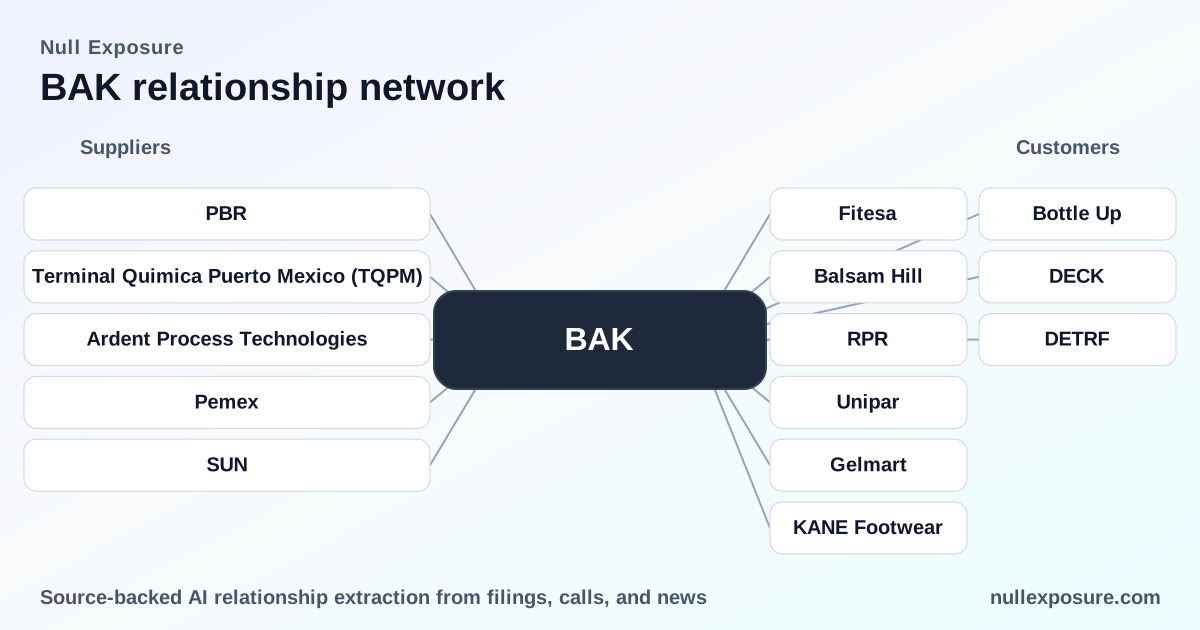
Braskem (BAK) — Customer Map and Commercial Readout for Investors
Braskem monetizes a global chemicals franchise by producing and selling polyolefins, thermoplastic resins, and bio‑based polyethylene to industrial and branded customers, capturing margins through vertical feedstock-to-product operations and differentiated bio-based offerings. With trailing revenue of roughly 70.7 billion and EBITDA near 4.0 billion (latest TTM), Braskem’s cash generation depends on industrial volumes, integrated feedstock economics and the commercial traction of its “I’m green” bio‑based PE product line. For investors and operators, the customer map reveals a dual commercial posture: large industrial commodity transactions combined with targeted brand partnerships around sustainability products that drive higher value per ton.
Explore the underlying relationship signals and transactional evidence at NullExposure: https://nullexposure.com/
What investors should watch in Braskem’s customer footprint
Braskem’s customer list in public disclosures and press activity shows two consistent commercial themes. First, commodity and feedstock sales to refiners and regional petrochemical players underpin volume and working‑capital dynamics. Second, strategic partnerships with end‑users and consumer brands for bio‑based polyethylene underpin premium positioning and product differentiation. Those themes translate into observable investment implications:
- Concentration and counterparty risk: Large, single transactions (for example the gasoil sale) highlight episodic exposures to major counterparties that can swing near‑term cash flow.
- Contracting posture: The record includes explicit supplier agreements, press releases and commercial announcements rather than public long‑term take‑or‑pay disclosures, suggesting a mix of spot/term arrangements rather than exclusively long‑dated fixed contracts.
- Criticality and maturity: Braskem is a critical upstream supplier for brand customers using its bio‑based PE, while industrial counterparties show transactional behavior consistent with commodity supply relationships.
If you want continuous monitoring of Braskem’s counterparty readouts and extraction of transaction-level signals, see the research hub: https://nullexposure.com/
Customer relationships — detailed list
BIRD (inferred ticker: BIRD)
BIRD’s FY2024 10‑K explicitly states that the company “has a supplier agreement with Braskem S.A.,” documenting a contractual supply relationship between the two firms. This is a direct supplier‑counterparty disclosure from BIRD’s regulatory filing (FY2024 10‑K, filed February 2026).
UBS
An AdvisorHub report dated May 4, 2026, references a study carried out by an economic research firm called BAK in the context of UBS’s lobbying on Swiss capital rules. The mention connects the BAK name to commissioned economic work cited by UBS in public commentary (AdvisorHub, May 2026).
Fitesa
A Braskem press release (March 9, 2026) announces that Fitesa will use Braskem’s “I’m green” bio‑based HDPE for nonwoven applications, signaling a brand/industrial partnership where Braskem supplies differentiated, higher‑value bio‑based resin to a major nonwoven manufacturer (Braskem press release, Mar 9, 2026).
Balsam Hill
Braskem’s March 9, 2026 communication highlights that Balsam Hill’s plant‑based decorative trees are made using Braskem’s “I’m green” bio‑based polyethylene, establishing Braskem as the resin supplier for a consumer product application and a visible proof point for its bio‑based positioning (Braskem press release, Mar 9, 2026).
Refinaria de Petróleo Riograndense S.A.
Braskem announced on November 18, 2025 a gasoil sale to Refinaria de Petróleo Riograndense S.A. (RPR) totaling R$398 million, reflecting a material commodity transaction with a regional refiner and a meaningful cash flow event recorded in press channels (Braskem press release / Globe and Mail syndication, Nov 18, 2025).
RPR (duplicate entry)
The same November 18, 2025 transaction—gasoil sale amounting to R$398 million—appears again in the public press record under the RPR shorthand, reinforcing that the R$398 million transaction is a discrete, documented industrial sale to the refining counterparty (Globe and Mail press release, Nov 18, 2025).
Unipar
Industry coverage in March 2026 reported that Braskem is in talks to sell three U.S. polypropylene plants to Unipar, indicating a potential asset disposition and a commercial negotiation with a regional chemicals peer that could alter Braskem’s North American supply footprint (Plastics News, Mar 2026).
Gelmart
Braskem’s sustainable‑brands communications (March 9, 2026) list Gelmart among client participants in sessions demonstrating real‑world uses of Braskem’s bio‑based portfolio, identifying Gelmart as a commercial user of Braskem’s differentiated resins in branded applications (Braskem press release, Mar 9, 2026).
KANE Footwear
KANE Footwear was announced as a breakout session participant at Braskem’s Sustainable Brands presentation, describing its experience using I’m green™ bio‑based materials, which positions the footwear maker as an adopter and reference customer for Braskem’s bio‑based product line (Braskem press release, Mar 9, 2026).
Bottle Up
Braskem’s event materials identify Bottle Up as one of several clients showcased for practical applications of bio‑based solutions, showing uptake of Braskem resins among firms pursuing sustainable packaging and product innovation (Braskem press release, Mar 9, 2026).
DECK (inferred ticker: DECK)
Braskem listed Deckers (DECK) in materials highlighting customer case studies; Deckers is showcased as a client using Braskem’s bio‑based solutions in commercial applications, placing Deckers among Braskem’s enterprise brand references (Braskem press release, Mar 9, 2026).
Deckers (duplicate entry)
The duplicate Deckers entry reiterates that Deckers/DECK was included in Braskem’s client showcase, confirming the company’s role as a branded end‑user of Braskem’s bio‑based polyethylene (Braskem press release, Mar 9, 2026).
DeTerra (inferred ticker: DETRF)
DeTerra is listed alongside other clients in Braskem’s sustainable brands communications, indicating commercial engagement with another brand customer adopting Braskem’s bio‑based portfolio (Braskem press release, Mar 9, 2026).
Operating‑model constraints and what the public record implies
There are no discrete contract constraint extractions in the relationship feed—no explicit term lengths, price collars or exclusivity clauses were captured. As a company‑level signal, that absence implies limited public visibility into contract maturity and pricing structure from the relationship extraction alone. Investors should therefore treat the disclosed relationships as transactional confirmations and marketing/customer references rather than definitive evidence of long‑dated take‑or‑pay contracts or guaranteed future volumes.
Investment implications — key takeaways
- Bio‑based PE is a strategic, higher‑margin vector: multiple brand partnerships (Fitesa, Balsam Hill, Deckers, KANE, Bottle Up, Gelmart, DeTerra) validate the commercial pathway for premium product placement and margin expansion.
- Industrial commodity exposure remains material: the R$398 million gasoil sale to RPR and supplier agreements with industrial customers demonstrate ongoing volumetric, feedstock and commodity counterparty risk.
- Public contract visibility is limited: the absence of extracted contract constraints requires investors to seek direct filings or counterparty disclosures to quantify concentration, term maturity and counterparty credit exposure.
For continuous tracking of Braskem’s counterparty events and commercial disclosures, visit NullExposure’s research portal: https://nullexposure.com/
Conclusions: Braskem balances a commodity industrial sales base with a growing roster of high‑visibility brand customers for its bio‑based product line; investors should focus on the sustainability of margin capture from bio‑based adoption and the magnitude and recurrence of large industrial transactions when sizing risk and upside.