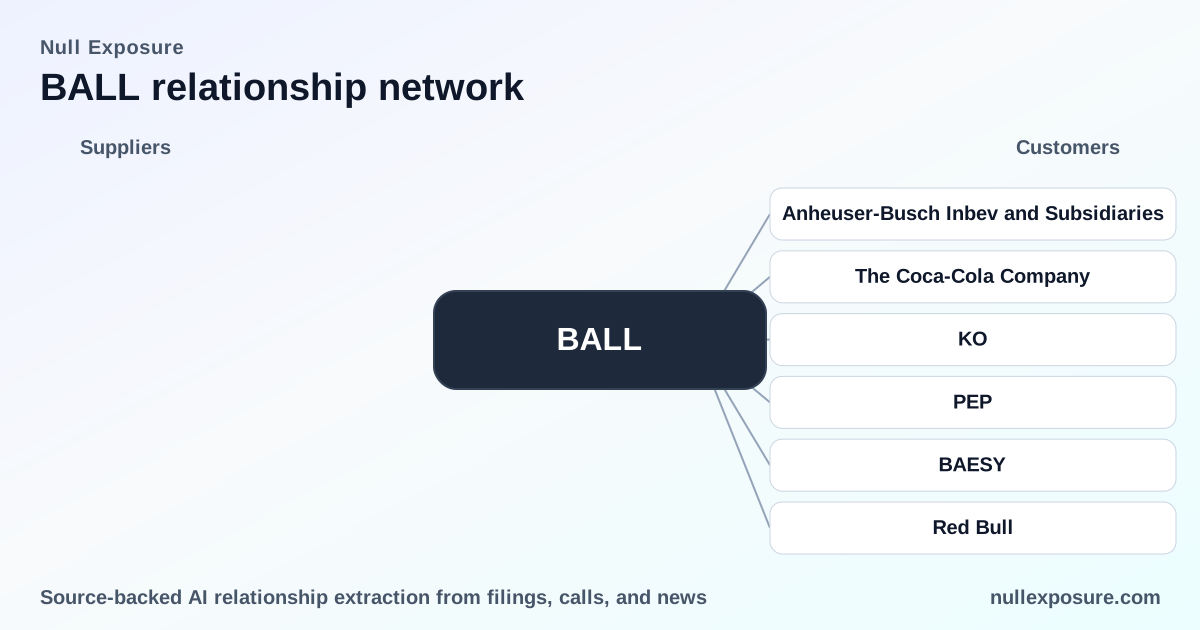
Ball Corporation (BALL) — Customer Relationships and Commercial Footprint
Ball Corporation manufactures and sells aluminum packaging principally to global beverage and consumer goods brands, monetizing through high-volume, margin-accretive supply contracts and ancillary services tied to production and logistics. The company’s economics are driven by scale in beverage can manufacturing, long-standing master agreements with large customers, and geographic diversification across North America, EMEA and South America, creating durable revenue streams even as the company executes portfolio moves such as the sale of its aerospace business. For investors and operators, the relevant commercial facts are simple: Ball is a large-cap industrial-supplier whose profitability depends on concentrated, enterprise-grade customers and multi-year supply arrangements that underpin manufacturing utilization and pricing power.
Explore structured customer intelligence and relationship overlays at https://nullexposure.com/.
How Ball actually sells: contracts, concentration and geography
Ball operates as a manufacturer-seller of aluminum packaging. This is reflected in its contracting posture: a mix of short-term enforceable contracts, master (framework) agreements that set terms for follow-on orders, and multi-year supply contracts for core beverage customers. These contracting patterns support rapid order cadence while locking in volume and pricing for large fillers.
- Concentration and counterparty profile: Ball sells to a relatively small number of global and large regional customers—enterprise-grade counterparties—which makes individual customer wins and losses material to utilization and revenue (company-level signal; FY2024 10‑K).
- Geographic footprint: Reporting segments cover North & Central America, EMEA and South America, indicating globally diversified customer exposure rather than outsized dependence on a single market (company-level signal; FY2024 10‑K).
- Relationship maturity and role: Ball’s customer base is characterized by mature, long-term supplier relationships with high retention; the company is primarily the seller of packaging products that are integral to customers’ finished goods (company-level signal; FY2024 10‑K).
If you want comprehensive dashboards and contract-level tags for these relationships, visit https://nullexposure.com/ for more.
Customer relationship map — what the filings and press disclose
Below I cover every relationship cited in the available results and the concrete public evidence for each.
Anheuser-Busch InBev and Subsidiaries
Ball lists Anheuser-Busch InBev among its significant customers, indicating direct supply relationships to one of the world’s largest beer producers—this underscores Ball’s exposure to large brewing OEM demand and seasonal volume cycles (Ball FY2024 10‑K).
The Coca-Cola Company
The Coca‑Cola Company is explicitly cited in Ball’s FY2024 10‑K as a significant customer, confirming Ball’s role as a major can supplier to global carbonated soft drink leaders and reinforcing pricing and volume dependence on global beverage brand cycles (Ball FY2024 10‑K).
BAE Systems (sale of aerospace business)
BAE Systems appears in news coverage as the buyer of Ball’s Aerospace division in a transaction that reshapes Ball’s earnings mix; the completed sale for roughly $5.5–$5.6 billion reduces aerospace exposure and concentrates Ball on packaging, an important strategic pivot for U.S. shareholders and earnings composition (InsiderMonkey, May 2026; Ad‑hoc‑news, March 2026).
BAESY (news references to the same BAE transaction)
News sources referencing BAESY/BAE Systems reiterate that the aerospace sale is closed and that the transaction materially changes Ball’s investment narrative by shifting free cash flow and return expectations toward the packaging business (Ad‑hoc‑news, March 2026).
KO / Coke (news coverage)
Ad‑hoc‑news coverage enumerates Coke among the major beverage brands whose cans Ball produces; this public reporting emphasizes Ball’s position as a behind‑the‑brand supplier with scale exposure to the Coca‑Cola system across multiple regions (Ad‑hoc‑news, March 2026).
Pepsi
News coverage identifies Pepsi as another leading brand served by Ball, confirming that Ball’s customer roster covers both major soda systems—an implicit diversification benefit within the beverage vertical (Ad‑hoc‑news, March 2026).
Red Bull
Ad‑hoc‑news mentions Red Bull alongside global brand customers, which highlights Ball’s relevance to energy drink producers and the breadth of end markets served beyond cola and beer (Ad‑hoc‑news, March 2026).
What these relationships imply for operations and risk
- Customer criticality and concentration: The presence of multinational beverage giants—Coke, Pepsi, Anheuser‑Busch—confirms high counterparty importance and potential revenue concentration risk. Ball’s commercial model trades single‑customer concentration for scale economics and higher factory utilization (company-level signal; FY2024 10‑K).
- Contracting maturity and flexibility: The coexistence of master framework agreements and multi‑year supply contracts alongside sub‑one‑year enforceable contracts provides both revenue visibility and operational agility; this mixed posture supports fast re‑allocation of capacity across geographies as demand shifts (company-level signal; FY2024 10‑K).
- Geographic resiliency: Reportable segments in North/Latin America and EMEA indicate regional diversification, lowering single‑market exposure but requiring multi‑jurisdictional supply chain management and pricing strategies (company-level signal; FY2024 10‑K).
- Post‑disposition focus: The divestiture of Aerospace to BAE Systems concentrates Ball on its core aluminum packaging business, increasing the strategic importance of customer relationships in beverage and consumer goods to near‑term cash flow and growth (InsiderMonkey; Ad‑hoc‑news, 2026).
Investment implications — what to watch next
- Earnings sensitivity to large customers: Monitor reported sales tied to named customers and margin guidance—loss, gain or price renegotiation with any top buyer will meaningfully affect utilization and profitability.
- Contract renewals and pricing mechanics: Because Ball operates under a mix of short-term orders and multi‑year supply agreements, renewal outcomes and indexation clauses will determine whether inflation and input-cost pressure pass through to margins.
- Execution of packaging pivot: With aerospace sold, Ball’s valuation will be judged increasingly on packaging EBITDA multiple, operational efficiency, and success cross‑selling services to major fillers (news coverage, 2026).
Bold takeaway: Ball’s commercial strength is its entrenched relationships with major beverage brands and its global manufacturing footprint; the company’s near‑term outlook depends on contract renewals, pricing dynamics with large customers, and the reallocation of capital proceeds from the aerospace sale into the packaging business.
For active diligence or to license relationship profiles and contract‑type tagging, visit https://nullexposure.com/ to see structured customer intelligence and source annotations.