Bally’s (BALY‑T) — customer relationships that reshape the balance sheet
Bally’s monetizes a hybrid gaming-and-media model: operating casinos and sportsbooks, licensing its brand and technology to broadcast partners, and structurally reshaping capital through asset sales and sale‑leasebacks. Revenue comes from a mix of operating margins on gaming and interactive products, recurring rent/license streams, and one‑time capital gains from real‑estate transactions, positioning the company as an operator that leverages partnerships to scale both distribution and liquidity. For a concise view of partner exposures and strategic implications, see https://nullexposure.com/.
Operational snapshot and what investors should price Bally’s is executing a dual strategy — grow betting and interactive distribution via technology and media partners, while monetizing property and international assets to improve liquidity. This creates two parallel risk/return profiles: steady operational cash flow tied to gaming venues and brand monetization, and episodic balance‑sheet reengineering through disposals and sale‑leasebacks. That combination supports a higher growth multiple for revenue lines tied to branded interactive products, while concentrating balance‑sheet risk around large, discrete transactions.
How Bally’s contracts, concentrates and matures as a counterparty
- Contracting posture: The company uses contractual partnerships (licensing and technology deals) and structured real‑estate arrangements (sale‑leasebacks) rather than purely organic growth; this signals a preference for partnering to amplify reach and to convert illiquid assets to cash.
- Concentration: Several large counterparties and big-ticket transactions dominate the profile — this raises counterparty and execution exposure where a single deal can affect leverage and liquidity.
- Criticality: Relationships with platform and property counterparties are operationally critical; losing a technology partner or failure of a major sale would pressure both revenues and financing options.
- Maturity: Partners are a mix of mature, publicly listed companies and entertainment/content outfits; this diversity supports distribution but also implies varying governance and integration risks.
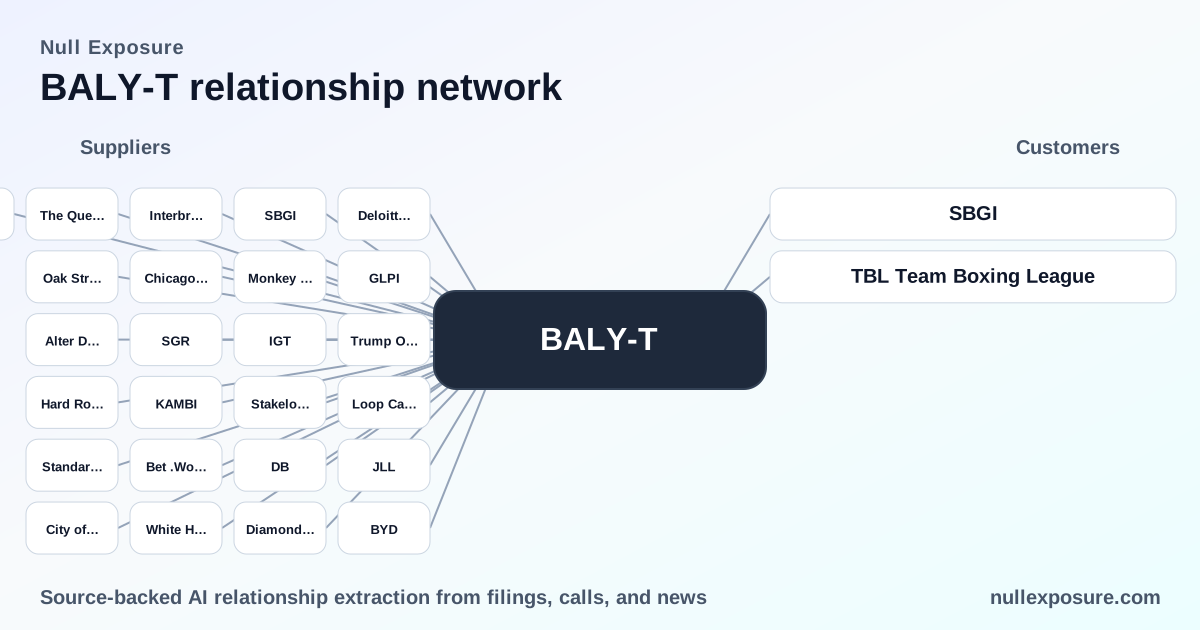
Relationship roll call — what each partner delivers and why it matters Below are the customer relationships found in the record, with concise takeaways and source references.
Gaming and Leisure Properties Inc. (GLPI)
Bally’s executed a sale‑and‑leaseback pathway: lenders representing $670 million of revolving credit commitments consented to the proposed sale and leaseback of the Twin River Lincoln Casino Resort to GLPI for $735 million before expenses and taxes, a transaction which converts property equity into near‑term liquidity while converting ownership into a long‑term lease obligation. According to an Investing.com report summarizing SEC filings in FY2025, lender consent was secured in support of the deal (Investing.com, FY2025).
Why it matters: sale‑leasebacks materially change leverage and recurring rent obligations, and GLPI is a strategic counterparty for capital recycling.
SBGI (listed as SBGI)
A FY2021 New York Times report documents Bally’s plan to use Bet.Works technology to create a branded sports gambling app; Sinclair (SBGI) is identified as a broadcaster that will leverage that technology for regional sports TV integrations. The NYT coverage frames the partnership as part of a distribution strategy to make Bally’s betting product visible across Sinclair’s footprint (New York Times, FY2021).
Why it matters: technology licensing to broadcasters extends distribution and brand reach without proportional capex.
Sinclair Broadcast Group Inc.
Sinclair will use Bet.Works’ technology to power a branded gambling experience linked to regional sports programming, aligning broadcast inventory with wagering engagement and monetization. The underlying reporting appears in a New York Times piece covering those partnerships in FY2021 (New York Times, FY2021).
Why it matters: embedding wagering into broadcast content converts audiences into customers and ties Bally’s to high‑reach media partners.
Intralot S.A. (INLOT)
Bally’s completed the sale of its International Interactive business to Intralot, a transaction valued at €2.7 billion, transferring a large interactive unit and associated revenue streams to a specialist operator. Investing.com summarized the transaction and valuation in FY2025 filings (Investing.com, FY2025).
Why it matters: the sale materially reshapes Bally’s international exposure and provides substantial liquidity, but it also removes an income stream that had strategic growth value.
The Star Entertainment Group (SGR)
The Star Entertainment accepted a $300 million rescue package from Bally’s that transfers effective control to the U.S. company, reflecting a cross‑border consolidation play and a rescue financing posture. Capital Brief reported acceptance of the offer and control implications in FY2025 (CapitalBrief, FY2025).
Why it matters: such acquisitions expand geographic footprint and operational scale, but they increase integration and regulatory complexity.
TBL Team Boxing League
TBL staged a televised open boxing combine at Bally’s Atlantic City on December 8, 2025, signaling content and events partnerships to drive venue foot traffic and cross‑sell gaming and hospitality services. This event was reported by StockTitan as part of Bally’s event activity in FY2025 (StockTitan / company announcements, FY2025).
Why it matters: live events and content partnerships create ancillary revenue and venue utilization, enhancing operating‑level profitability.
Implications for investors: risk, optionality and valuation drivers
- Financial optionality through asset sales: The Intralot sale and GLPI sale‑leaseback demonstrate an intentional use of disposals to shore up liquidity and deleverage, but these are one‑off gains rather than recurring revenue. Investors should value recurring gaming and brand licensing separately from episodic balance‑sheet transactions.
- Counterparty concentration risk: Large counterparties carry concentrated execution risk; a stalled transaction or change in partner posture can have outsized P&L and liquidity consequences.
- Strategic distribution upside: Partnerships with broadcasters and content providers create scalable customer acquisition channels at relatively low incremental cost, supporting top‑line growth for wagering and interactive products.
- Integration and regulatory complexity: Cross‑border transactions and takeover of control in regulated markets increase execution and compliance costs, which should be reflected in target multiples.
Company‑level constraints and signals The data payload contains no explicit contractual constraints flagged against BALY‑T. As a company‑level signal, that absence indicates the dataset did not surface covenant waivers, restrictive contract terms, or explicit supplier constraints in the captured relationships. Investors should nonetheless treat large, discrete transactions as implicit constraints on capital flexibility until closed and settled.
Mid‑article note: for a structured view of partner exposures and how they affect leverage and liquidity, visit https://nullexposure.com/.
Bottom line Bally’s is executing a capital‑lite growth route for interactive distribution while monetizing property and international units to finance expansion and stabilize leverage. Investors should underwrite recurring gaming and licensing revenue separately from the balance‑sheet engineering that drives short‑term EPS and cash flow, and monitor counterparties such as GLPI and Intralot for execution risk.