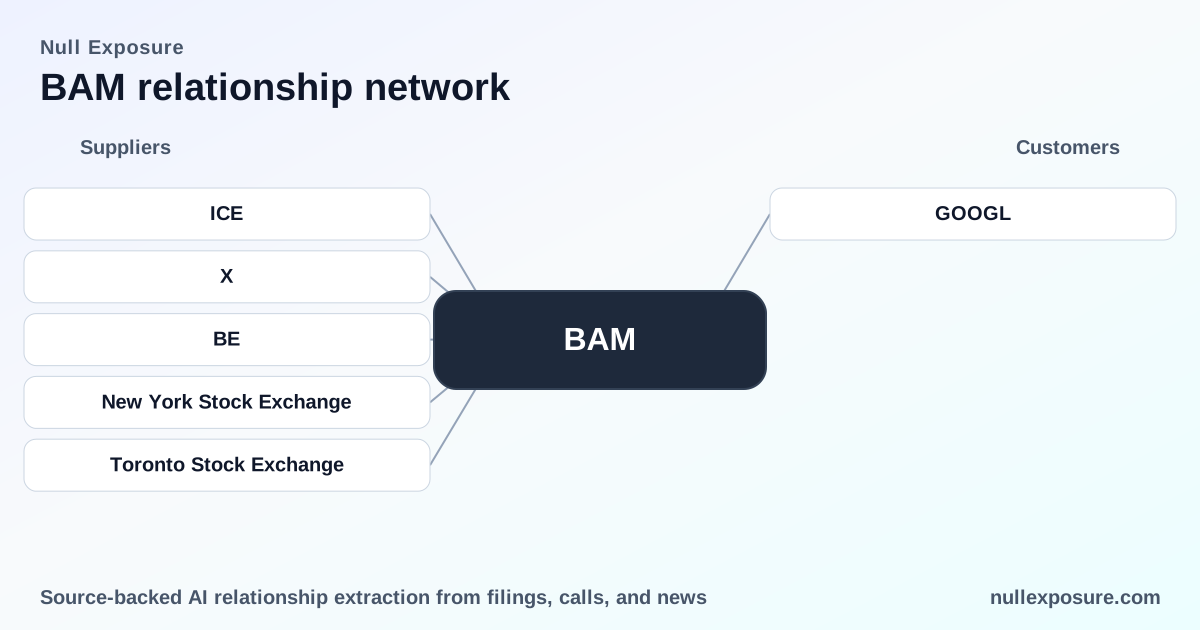
Brookfield Asset Management (BAM): Customer relationships, commercial posture, and investor implications
Brookfield Asset Management is a global alternative asset manager that monetizes by charging management fees, incentive fees and carried interest on fee-bearing capital while also co-investing significant proprietary capital in real assets. Its revenue mix blends long-dated fee-bearing mandates and perpetual capital vehicles with transactional and shorter-term commercial contracts across infrastructure, renewables, credit and real estate, creating a hybrid cashflow profile anchored by recurring asset-management economics and episodic, high-margin investment gains. For a focused look at counterparties and material customer relationships, see our companion research hub at NullExposure.
Contracting posture, client mix and operational constraints investors should price in
Brookfield’s customer relationships reflect a mix of long-term, structural mandates and shorter-term commercial contracts. The company explicitly describes fee-bearing capital that is “long-dated or perpetual,” typical of private funds with 10-year commitments and perpetual vehicles, while also operating businesses (power, lottery services, services agreements) that run under both long-term concession/PPA structures and shorter-term commercial arrangements. This duality gives durable base management income alongside volatile but high-upside investment income.
Concentration and counterparty profile are clear: Brookfield serves over 2,300 clients including sovereign wealth funds, pension plans, endowments and large institutional investors, and it positions itself as both an investment manager and a service provider. That breadth reduces single-client credit risk but increases operational reliance on institutional distribution and on maintaining fiduciary alignment. Geographically, the firm invests across more than 30 countries, yet substantially all of BAM’s revenues and assets are recognized and domiciled in North America, creating regional concentration in economic cycles and regulation.
Two spend-band signals are notable at the company level: Brookfield discloses material management fees and carried interest from its Oaktree-managed funds (aggregate fees in the billions) while operational service reimbursements tied to specific administrative arrangements can fall in the mid-six-figure range annually — evidence of both large-scale asset-management revenues and smaller, contract-level service cashflows.
The relationship roster: counterparties and what they mean for investors
Below are direct summaries of every relationship record surfaced for BAM in our review, each with a concise source citation.
GOOGL — Google (entry 1)
Brookfield-related reporting described a landmark agreement to supply Google with up to 3 GW of hydro power in the U.S., positioning Brookfield as a major renewable energy supplier into hyperscale cloud demand. Source: The Globe and Mail press release, March 9, 2026.
Google — GOOGL (entry 2)
A parallel item reiterates the same hydro-power supply arrangement referenced above, reinforcing Brookfield’s role linking renewable generation assets to large technology customers. Source: The Globe and Mail press release, March 9, 2026.
BBUC — Brookfield Business Partners (entry 3)
Brookfield disclosed a simplification that adjusts the management fee payable to Brookfield Asset Management to be based on the market cap of BBU Inc. rather than a combined metric with BBUC, changing the fee base and economic alignment between the partner vehicle and the manager. Source: The Globe and Mail press release, March 9, 2026.
BBUC — Brookfield Business Partners (entry 4, alternate source)
A secondary notice confirms the same fee-base change and corporate conversion strategy, underscoring that Brookfield is actively adjusting governance and fee formulas across sponsored public vehicles. Source: StockTitan reporting on the BBUC conversion announcement, March 9, 2026.
Just Group — JUST (entry 5)
Brookfield Wealth Solutions announced the planned acquisition of UK retirement-income provider Just Group, under which BAM is expected to become the investment manager for a significant portion of Just Group’s portfolio once the transaction closes, expanding Brookfield’s footprint in retirement-focused assets and alternative credit. Source: The Globe and Mail filing announcing BAM’s annual and special meeting, May 2, 2026.
BEPC — Brookfield Renewable (entry 6)
Coverage highlights Brookfield Asset Management’s operational role: BAM runs Brookfield Renewable’s day‑to‑day operations, signaling integration between the manager and an affiliated renewable platform that supplies cashflows and capacity for institutional mandates. Source: The Globe and Mail (Motley Fool republished analysis), March 9, 2026.
PBR-A — Petrobras (entry 7)
Reporting in Portuguese media noted that Petrobras pays Brookfield for pipeline leases and associated services, with commentary that rental payments will offset proceeds received from privatization within a defined multi-year horizon — an example of Brookfield’s infrastructure concession economics with state-owned counterparties. Source: pt.org.br analysis, March 10, 2026.
BPYPM — Brookfield (partnered partnership) (entry 8)
A MarketBeat profile described Brookfield, under CEO Bruce Flatt, as the provider of strategic oversight, capital and operational expertise to a listed partnership, reflecting the manager’s standard model of governance and hands-on management for affiliated partnerships. Source: MarketBeat company profile, May 2, 2026.
TRTN‑P‑E — Triton International preference offering (entry 9)
In a capital markets transaction, Brookfield Capital Solutions acted as a co-manager on a preference-share offering for Triton International, indicating Brookfield’s occasional underwriting and capital solutions role in secondary and structured financings. Source: Investing.com market news, May 4, 2026.
Strategic takeaways for investors
- Revenue durability is high but mixed: recurring management fees and long-term mandates create a stable base, while incentive and carried-interest receipts drive outsized variability tied to asset performance.
- Customer mix reduces counterparty credit risk: a diversified institutional client base, including sovereign and pension capital, mitigates single-buyer exposure even as large enterprise customers (e.g., Google) represent concentrated commercial relationships on the asset-operating side.
- Contracting posture is layered: Brookfield simultaneously operates under long-term concession-like contracts (PPAs, mandates) and shorter commercial agreements, so investors should model both steady fee income and episodic project-level cashflows.
- Operational criticality and integration matter: Brookfield routinely serves as both manager and service provider to its sponsored vehicles, increasing value capture but also raising governance and related-party scrutiny as a material operational constraint.
- Geographic nuance: global investment reach supports deal sourcing, but North America remains the primary revenue domicile, which has implications for regulatory and macro sensitivity.
If you want a concise counterparty risk matrix or a tailored briefing for portfolio stress scenarios tied to these counterparties, visit NullExposure to request a custom investor report.
Bottom line
Brookfield’s customer relationships are an explicit extension of its asset-management model: large, institutional mandates and strategic commercial contracts underpin recurring fees, while affiliate and operational roles extract incremental value from platform assets. For investors, the core questions are governance and execution—can Brookfield sustain long-term fee growth while managing concentrated commercial deals and affiliate economics? The relationship evidence here supports a confident view of diversified demand and substantial fee-generation capacity, balanced against the usual alternative-asset cyclicality and related-party complexity.