Banc of California: customer relationships that matter for credit and deposit investors
Banc of California operates as a relationship-focused regional bank, monetizing through deposit gathering, commercial and real estate lending, treasury services, and ancillary payments and equipment finance via subsidiaries. Its revenue mix skews to interest income from loans and leases plus fee income from treasury and payment services, with balance-sheet exposures concentrated in California commercial real estate and middle‑market business lending. For investors evaluating counterparty risk and franchise durability, the active customer relationships disclosed in 2025–2026 highlight the bank’s role as a credit provider to specialty finance and venture-stage borrowers and its exposure to relationship lending dynamics. For more context on the bank’s commercial positioning, see Null Exposure’s research hub: https://nullexposure.com/.
What the recent relationship disclosures say in plain English
Banc’s public mentions in FY2025–FY2026 show two counterparties with direct credit or secured-lending histories: OFS Capital (and related tickers) and Maze Therapeutics. These relationships illustrate Banc’s business-lending focus and the routine lifecycle of corporate credit — extensions, maturity negotiations, refinancings, and security releases.
OFS Capital — repeated credit facility amendments and an unused commitment
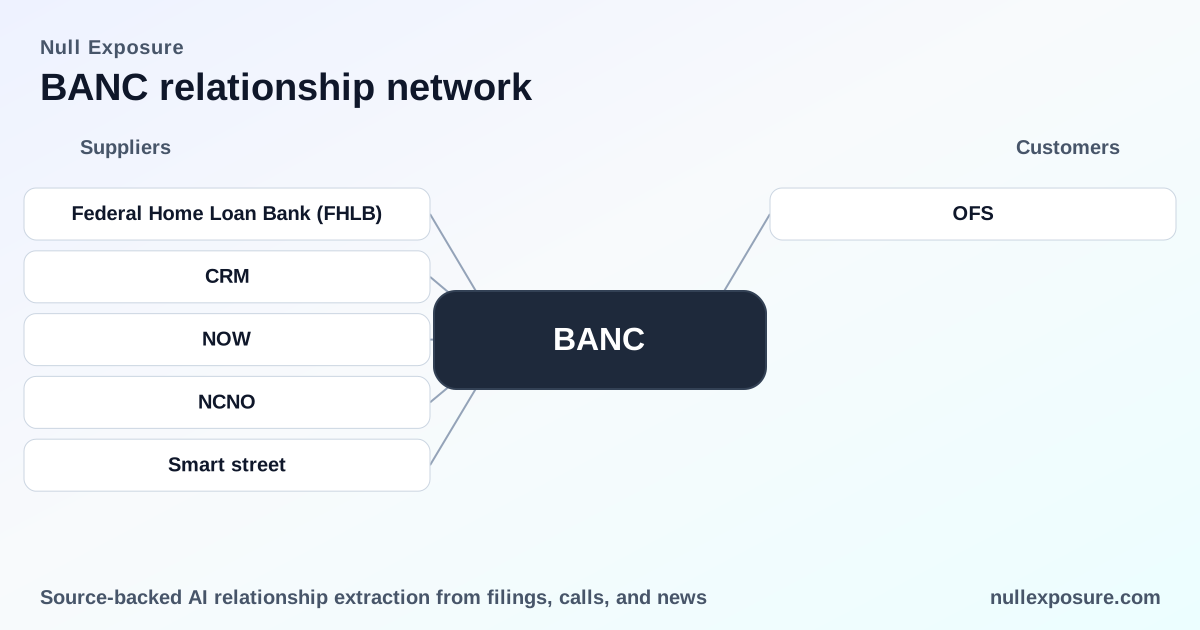
OFS Capital repeatedly extended and amended a $25 million senior secured revolving credit facility with Banc of California, including an amendment announced in early January 2026 that pushed the facility maturity from February 28, 2026 to February 28, 2028; the line was described as available for general corporate purposes and investment funding and was sometimes undrawn. According to multiple filings and transcripts, OFS confirmed the $25 million Banc facility as a material part of its liquidity arrangements through Q4 2025 and Q1 2026 (Investing.com, March–May 2026; InsiderMonkey transcript, March 2026; Yahoo Finance press release, May 2026). Source: https://m.investing.com/news/sec-filings/ofs-capital-amends-credit-facility-with-banc-of-california-lowers-financial-covenants-93CH-4585210 and https://www.insidermonkey.com/blog/ofs-capital-corporation-nasdaqofs-q4-2025-earnings-call-transcript-1708840 and https://finance.yahoo.com/news/ofs-capital-corporation-announces-fourth-213000663.html.
Maze Therapeutics — prior loan replaced and security interest released
Maze terminated its prior Loan and Security Agreement with Banc of California effective February 2, 2026, after securing a new $200 million facility elsewhere; Banc’s security interest in Maze’s assets was released as part of that refinancing, signaling a borrower-led move to a larger lender syndicate. The refinancing and release were reported in Maze’s press release and related coverage in March 2026. Source: https://www.theglobeandmail.com/investing/markets/stocks/MAZE-Q/pressreleases/59428/maze-therapeutics-secures-new-200-million-loan-facility/.
How these relationships map to Banc’s operating and business model
The disclosed customer interactions reinforce Banc of California’s role as a relationship bank for middle‑market, venture‑backed and specialty finance borrowers. Several company-level signals clarify how the bank structures and underwrites those relationships:
- Contracting posture — long-term orientation. Banc discloses operating leases with multi‑year terms and lends on extended credit facilities; the OFS facility extension to 2028 demonstrates Banc’s willingness to structure rolling, multi-year credit arrangements that support corporate liquidity.
- Counterparty mix — diversified across small business, mid‑market, and high‑net-worth individuals. Public filings identify small businesses, mid‑market and venture-backed firms, non‑profits, and high‑net-worth clients as core customers, reflecting a broad relationship book rather than reliance on a single industry.
- Geographic concentration — regional focus in North America (California-centric). A material share of mortgage and CRE portfolios is California‑based; the branch footprint centers in California with select out-of-state offices, which concentrates regional economic and real estate risk.
- Materiality and concentration — individual deposit relationships are generally immaterial. The company reports that no single deposit relationship exceeded 10% of total deposits as of year-end 2024, indicating low single-counterparty concentration on the deposit side.
- Relationship roles — lender, service provider, and payment processor. Banc underwrites loans and leases, offers treasury management, and through subsidiaries (for example, Deepstack) provides payment processing — a mix of balance-sheet and fee businesses.
- Lifecycle and maturity — active, ongoing credit relationships. Disclosures list performing financing receivables and equipment finance programs, attesting to active origination and servicing of commercial credit.
- Scale signal — material balance-sheet exposure. Total loans and leases and interest‑bearing deposits both sit in the billions, consistent with a spend/commitment band measured in the high‑tens to hundreds of millions when aggregated.
Taken together, these signals describe a relationship-driven commercial bank with regional concentration, diversified client types across the small to mid‑market spectrum, and a product mix that combines interest income and fee services.
Investment implications — what investors should price in
- Credit underwriting and refinancing risk. OFS’s repeated amendments and the maturity extension to 2028 illustrate Banc’s exposure to credit lifecycle management: banks must balance rollover risk versus workout or repricing when borrowers refinance or repay. Assess earnings sensitivity to incremental credit spreads and prepayment/refinancing activity.
- Deposit stability versus loan concentrations. The company reports no single depositor concentration over 10%, which supports stability, but the real estate and regional exposure to California requires active monitoring of CRE cycles.
- Fee diversification acts as a partial hedge. Treasury services and payments processing via subsidiaries diversify revenue away from pure net interest margin pressure, improving resilience if credit spreads compress.
- Counterparty scale and materiality. The OFS $25 million facility is small relative to Banc’s total loans and deposits, indicating immaterial direct exposure at the single‑borrower level, but a series of similar relationships can aggregate into material credit buckets.
For investors tracking relationship evolution and lending health, Null Exposure provides ongoing monitoring and contextualized alerts — subscribe at https://nullexposure.com/ for deeper coverage.
Bottom line and positioning advice
Banc of California is a classic regional, relationship-based bank whose credit role with specialty finance borrowers and venture‑backed companies is visible in public amendments and refinancing activity. The OFS Capital facility extensions and Maze’s refinancing show both sides of the origination lifecycle: Banc structures multi‑year credit to support corporate liquidity, and those credits can be refinanced away or retired when borrowers access larger facilities. Monitor regional CRE metrics, loan performance trends, and the mix between fee and interest income to gauge franchise stability. For institutional investors and operators, the priority is watching aggregate exposure trends rather than isolated facility headlines; the disclosed relationships are informative but not individually material to Banc’s balance sheet.