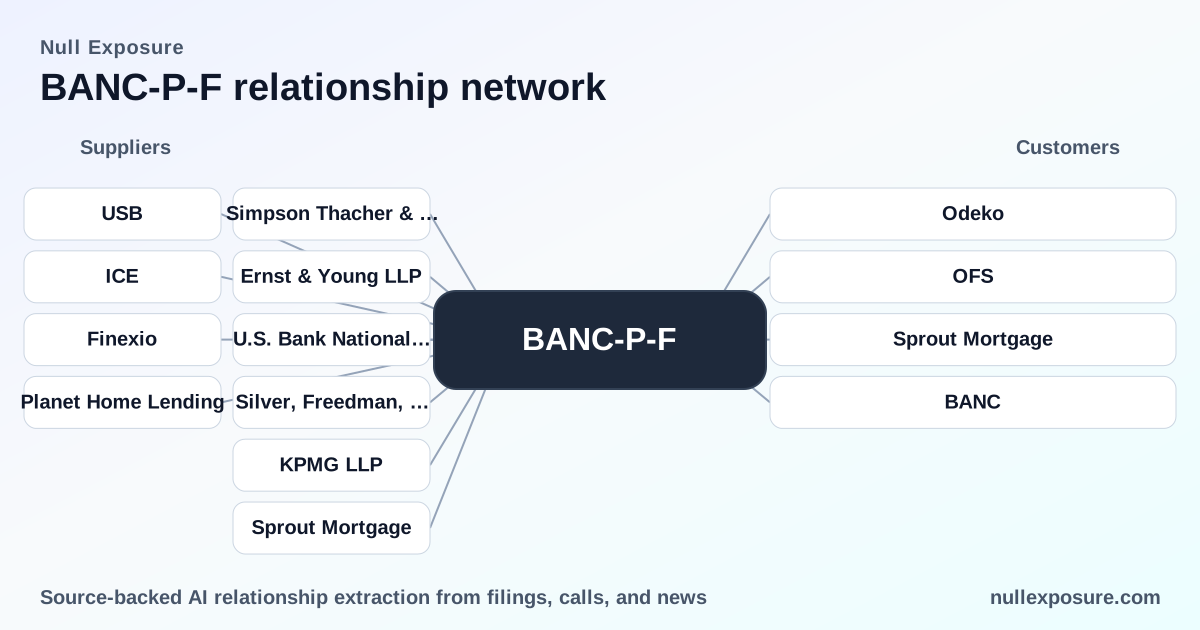
Banc of California (BANC-P-F): Customer Relationships and Lending Footprint
Banc of California operates as a regional commercial bank focused on tailored lending and deposit services across California, monetizing primarily through net interest margin on commercial and real estate loans, along with fees from treasury and deposit services. Its customer relationships in 2025–2026 highlight a mix of middle-market credit facilities, construction lending for residential projects, and specialty warehouse financing — a profile that underpins interest income while concentrating underwriting risk in real estate and corporate credit. For a consolidated view of counterparties and filings, visit the NullExposure homepage: https://nullexposure.com/.
What the lending relationships tell investors about strategy and-risk posture
Banc of California shows an active commercial-lending posture: it executes revolvers and term facilities for specialty finance firms, provides construction loans for developers, and extends warehouse lines to mortgage originators. Contracting is transactional and credit-driven — facilities are structured, amended, and often secured — which produces recurring fee and interest revenue but also leaves the bank exposed to borrower credit cycles and sector concentration in California real estate. The public reporting through 2025–2026 indicates an emphasis on secured, short-to-medium maturity commitments rather than long-duration capital placements, and active portfolio management (amendments, construction closings, and legal enforcement).
Visit https://nullexposure.com/ for relationship analytics and source tracing.
Relationship roll call — what each counterparty contributes to the picture
OFS Capital Corp (named)
OFS Capital amended its senior secured revolving credit facility with Banc of California, extending the maturity from February 28, 2026 to February 28, 2028 — a clear example of the bank’s role as a senior secured lender to publicly traded specialty finance companies. According to Investing.com (May 2026), the amendment preserves Banc’s secured position and pushes near-term refinancing risk into 2028. (https://za.investing.com/news/sec-filings/ofs-capital-extends-credit-facility-maturity-with-banc-of-california-to-2028-93CH-4055853)
OFS (alternate entry)
TradingView reported that OFS Capital entered an amendment to its Business Loan Agreement with Banc of California to maintain a senior secured revolving credit facility for general corporate purposes, including investment funding — reinforcing Banc’s provision of flexible working-capital facilities to specialty lenders. (TradingView, Mar 2026) (https://www.tradingview.com/news/tradingview:341fa316c1f1b:0-ofs-capital-signs-credit-facility-amendment-with-banc-of-california/)
OFS Capital (duplicate listing)
A second TradingView notice reiterates that Banc of California is the counterparty to OFS’s amended loan agreement, underscoring the bank’s recurring engagement with OFS Capital across Q1–Q2 2026 reporting and amendments. (TradingView, Mar 2026) (https://www.tradingview.com/news/tradingview:341fa316c1f1b:0-ofs-capital-signs-credit-facility-amendment-with-banc-of-california/)
Odeko
Odeko secured a $30 million credit facility from Banc of California as part of a $126 million Series E financing round, indicating Banc’s participation in growth-stage financing tied to working-capital and expansion needs for software-enabled hospitality operators. TheSaaSNews (Mar 2026) reported Banc’s credit commitment alongside the equity led by B Capital. (https://www.thesaasnews.com/news/odeko-raises-126-million-in-series-e)
Sprout Mortgage
Banc of California has an active enforcement position against Sprout Mortgage: court filings note that Sprout owed approximately $2,043,490.52 on a warehouse line, reflecting Banc’s exposure in mortgage warehouse lending and its willingness to litigate to collect balances. National Mortgage Professional (reported FY2022 but cited in 2026 coverage) documents the claimed outstanding balance. (https://nationalmortgageprofessional.com/news/banc-california-sues-sprout-mortgage-planet-home-lending)
BANC (project-level mention)
Local reporting on a San Jose affordable-housing project states that Banc of California provided the lead financing — a $138.6 million construction package — showcasing the bank’s capability to originate large-ticket construction loans for multi-family development. SFYIMBY (Aug 2025) cites Bay Area News Group reporting on the financing package. (https://sfyimby.com/2025/08/construction-financing-secured-for-affordable-housing-at-1271-1279-east-julian-street-san-jose.html)
Corporation for Better Housing
The Corporation for Better Housing is one of the developer/owner sponsors for the San Jose affordable housing project and is identified as a borrower benefiting from a construction financing facility principally provided by Banc of California, highlighting the bank’s role in community-oriented project lending. SFYIMBY (Aug 2025) references the project financing details. (https://sfyimby.com/2025/08/construction-financing-secured-for-affordable-housing-at-1271-1279-east-julian-street-san-jose.html)
JSL Real Estate
JSL Real Estate, co-owner on the same one-acre site in San Jose, partnered with Corporation for Better Housing and obtained access to the $138.6 million construction financing largely syndicated or provided by Banc of California, demonstrating Banc’s appetite for sponsor-backed affordable housing deals. SFYIMBY (Aug 2025) reported the financing. (https://sfyimby.com/2025/08/construction-financing-secured-for-affordable-housing-at-1271-1279-east-julian-street-san-jose.html)
Portfolio signals and company-level constraints
No explicit constraints were returned in the reviewed relationship data, which itself is an informative signal: public reporting around these counterparties focuses on commercial lending actions — amendments, construction closes, and litigation — rather than covenant waivers or asset sales that would indicate immediate distress. From the relationship set investors should infer:
- Contracting posture: Banc structures secured, often short-to-medium tenor credit facilities with amendment flexibility; this supports interest income stability but concentrates near-term refinancing and credit monitoring responsibilities on the bank.
- Concentration: Lending activity is concentrated in California real estate and specialty finance sectors; while diversified by client type (developers, specialty lenders, growth-stage companies), geography and product concentration are material.
- Criticality: Large construction financings (>$100M) and senior secured revolvers are commercially critical exposures that drive earnings but are sensitive to real estate cycles and sponsor credit.
- Maturity & lifecycle: The presence of facility amendments and warehousing disputes indicates active portfolio management during 2025–2026 that affects near-term liquidity and credit provisioning.
Investment implications and recommended next steps
Banc of California’s customer footprint in 2025–2026 shows a deliberate mix of higher-yield, secured lending and transactional credit work for growth and specialty borrowers. Positive returns depend on underwriting discipline and regional real estate stability; downside emerges through borrower distress (as in mortgage warehouse defaults) or a concentrated downturn in California property markets.
Key takeaways for investors:
- Earnings drivers: interest margin from construction and corporate revolvers; fee income from origination and amendments.
- Primary risks: borrower credit deterioration, regional real-estate concentration, and legal exposure that can crystallize losses.
- Actionable next steps: review Banc’s credit-loss reserves and regional CRE exposure in the latest filings; track amendments and maturity cliffs for major facilities (e.g., the OFS amendment to 2028).
For deeper counterparty tracing and longitudinal relationship maps consult NullExposure’s platform: https://nullexposure.com/.
By synthesizing facility amendments, construction closings, and enforcement actions across counterparties, investors obtain a clear picture of Banc of California’s commercial-lending DNA — high-touch, secured, and regionally concentrated — which frames both expected return and the principal risks to monitor.