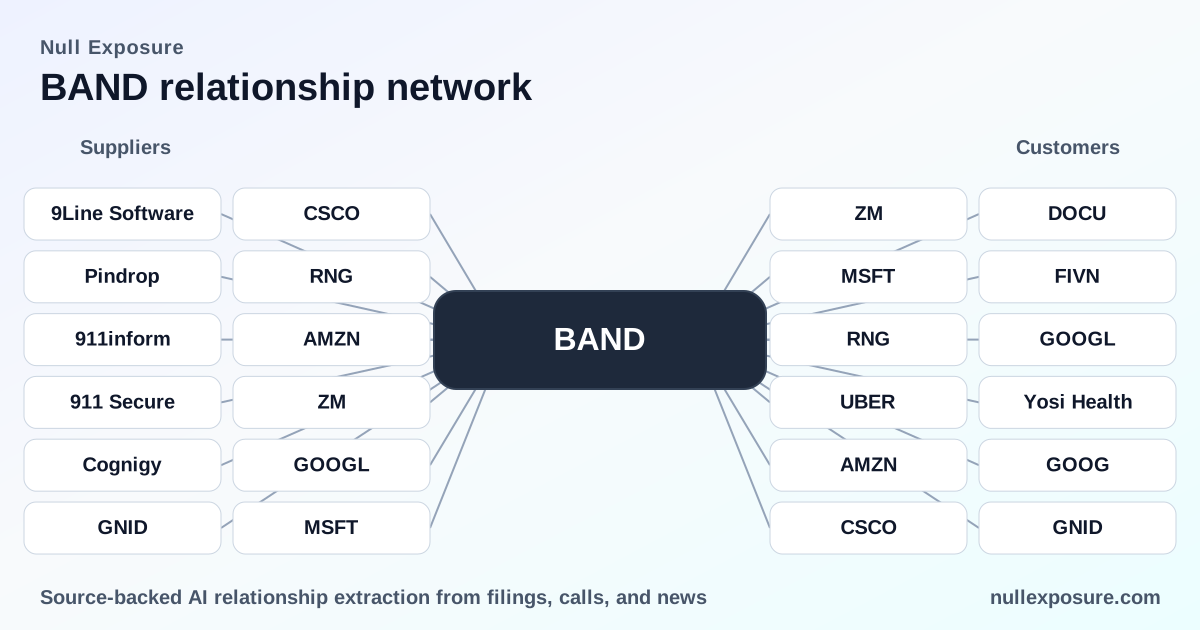
Bandwidth Inc: Customer Map and Investment Thesis
Bandwidth is a cloud communications provider that sells voice, messaging and emergency‑services capabilities to software platforms and enterprises through a mix of usage‑based and recurring contracts; it monetizes by charging for minutes/messages and platform services while pursuing cross‑sell into large SaaS and Global 2000 accounts. Revenue is both transaction‑driven and subscription‑anchored, with Bandwidth positioning its owned Communications Cloud as a defensible routing and compliance layer for major UC and contact center vendors. For a concise data package and ongoing monitoring, see https://nullexposure.com/.
How Bandwidth makes money — a concise commercial picture
Bandwidth operates as a communications platform and network operator that sells access and functionality to businesses and other platform vendors. The company combines:
- Usage‑based billing (per minute, per message) that scales with customer activity and drives topline volatility tied to customer volume.
- Subscription and service orders under master service agreements that create recurring revenue and multi‑year relationships with enterprise customers.
- A managed platform and PSTN replacement service set that includes integrated emergency routing — positioning Bandwidth as a provider to contact centers and unified communications vendors rather than a pure reseller.
Bandwidth’s disclosures stress that customers are “generally charged based on the usage of our services” and that many enterprise relationships are multi‑year and mature, while no single customer represented more than 10% of revenue in 2024. These characteristics create a revenue mix that is scalable but usage‑sensitive, anchored by long‑standing large accounts.
For deeper portfolio-level background, visit https://nullexposure.com/.
Who uses Bandwidth — the customer roster investors should know
Below I cover every customer relationship referenced in the recent results and commentary. Each entry is a plain‑English take with a source attribution.
Zoom (ZM)
Bandwidth explicitly lists Zoom among UC and contact‑center leaders that rely on its Communications Cloud, indicating integration with enterprise collaboration and contact‑center workflows. According to an 8‑K and related releases in March 2026, Bandwidth identifies Zoom as a platform customer of its Communications Cloud (8‑K, Mar 9, 2026).
Google (GOOGL / GOOG)
Bandwidth notes Google as a major technology partner that embeds Bandwidth’s voice and messaging services into its communications and contact‑center stacks; press summaries referencing Q3 commentary frame Google alongside other cloud giants (Yahoo Finance Q3 commentary, FY2025).
Microsoft (MSFT)
Microsoft is listed with peers as a user of Bandwidth’s APIs for voice, messaging and emergency services, signaling enterprise and platform integrations rather than only retail users (Yahoo Finance Q3 commentary, FY2025).
Salesforce (CRM)
Bandwidth is named as a partner in infrastructure for Salesforce’s new CRM‑native, AI‑driven Agentforce contact‑center initiative, a move that positions Bandwidth into a strategic channel for CRM‑embedded communications (Simply Wall St summary, FY2026).
Amazon Web Services (AWS / AMZN)
AWS is repeatedly cited as one of the “leaders in unified communications and cloud contact centers” that leverages Bandwidth’s Communications Cloud footprint, underscoring Bandwidth’s role as an infrastructure partner for large cloud providers (PR Newswire and SahmCapital releases, FY2025–FY2026).
Cisco (CSCO)
Cisco appears across Bandwidth releases as a longstanding partner and customer for embedded communications and emergency services capability, reflecting integration with enterprise UC and contact‑center products (PR Newswire releases and earlier partnership announcements, FY2021–FY2026).
DocuSign (DOCU)
DocuSign is referenced as a Global 2000 SaaS builder that uses Bandwidth APIs to embed messaging and voice into workflows, a typical SaaS customer profile for Bandwidth’s offerings (PR Newswire and SahmCapital commentary, FY2024–FY2026).
Five9 (FIVN)
Five9 is listed among cloud contact‑center vendors that leverage Bandwidth’s platform, highlighting Bandwidth’s presence in the cloud CCaaS channel (PR Newswire and MarketScreener releases, FY2023–FY2026).
RingCentral (RNG)
RingCentral appears as a partner/customer that uses Bandwidth’s network and API capabilities to support UCaaS and contact center products (PR Newswire and marketing releases, FY2024–FY2026).
Uber (UBER)
Bandwidth cites Uber among Global 2000 enterprises and innovative SaaS builders that embed Bandwidth’s communications capabilities directly into customer‑facing applications (SahmCapital and PR Newswire, FY2026).
Yosi Health
Yosi Health is listed repeatedly as a SaaS builder that uses Bandwidth’s messaging/voice services; the references are present in Bandwidth press materials across FY2023–FY2026, positioning Yosi as an example of healthcare‑focused platform customers (PR Newswire and company press summaries, FY2023–FY2026).
Genesys (multiple listings)
Genesys is identified multiple times among cloud contact center and engagement platform vendors that leverage Bandwidth’s Communications Cloud, suggesting channel and product overlaps in CX infrastructure (LeLezard, SahmCapital and MarketScreener mentions, FY2025–FY2026).
Agentforce Contact Center / Agentforce
Bandwidth is named as a partner to Agentforce Contact Center to deliver infrastructure for Salesforce’s AI‑driven contact center offering, linking Bandwidth to a specific implementation of CRM‑native CX (MarketScreener and related press, Mar 2026).
WEAV
An SEC‑filed 10‑K from Weav notes that Bandwidth (along with other providers) powers text messaging functionality on the Weav platform, providing a direct customer reference in a third‑party filing (Weav 10‑K, FY2024).
What the customer mix implies for investors
Bandwidth’s client roster combines major cloud platforms, CCaaS providers, enterprise Global 2000 accounts and SMB developers, which produces a set of practical operating signals:
- Contracting posture: Bandwidth runs a hybrid model—usage‑based economics dominate (consistent with per‑message/minute pricing) while MSA‑backed subscriptions provide recurring minimums and service orders. This structure supports growth but exposes revenue to customer activity cycles.
- Concentration: The company reports no single customer >10% of revenue (FY2024), a structural advantage that reduces counterparty concentration risk relative to single‑anchor enterprise models.
- Criticality and role: Bandwidth operates as a service provider and network partner for mission‑critical communications (emergency routing, PSTN replacement) — a higher‑stickiness relationship than commodity messaging vendors.
- Maturity and lifecycle: Bandwidth lists multi‑year and decade‑long customers alongside startups, reflecting mature enterprise contractual footprints alongside opportunistic SMB / developer revenue.
- Geography: Revenue remains U.S.‑heavy by destination, but Bandwidth emphasizes a global owned network spanning 65+ countries, enabling enterprise international deployments.
These signals point to a company with scalable usage upside and durable enterprise anchors, but with P&L sensitivity to message/minute volumes and variable A2P fee dynamics.
Risks, opportunities and investor takeaways
- Risk — volume sensitivity: Because customers are charged based on usage, declines in activity or pricing pressure in messaging could compress revenue and gross profit in the near term (Company filings, FY2025–FY2026).
- Risk — margin pass‑throughs: Bandwidth discloses passing A2P carrier fees to customers; while this increases revenue and COGS, it reduces the predictability of gross margins when carrier fee regimes shift.
- Opportunity — enterprise channel leverage: Partnerships with Salesforce/Agentforce and large cloud vendors create channels for higher‑value recurring services, including CRM‑native contact center implementations.
- Opportunity — product stickiness: Integrated emergency services, PSTN replacement and a global footprint produce technical and regulatory barriers to quick substitution for enterprise customers.
Bandwidth’s model is a hybrid of network operator and API platform economics: attractive upside when end‑customer volumes grow and when enterprise cross‑sell succeeds, balanced against usage volatility and fee pass‑throughs that can compress short‑term margins.
For institutional monitoring and to view these customer relationships in a dashboard context, visit https://nullexposure.com/.
Bandwidth’s customer map is an asset: large cloud names validate the platform, and diverse SaaS customers diversify revenue exposure, but investors should underwrite both usage sensitivity and the company’s ability to upsell higher‑margin, subscription services into its installed base.