BancFirst (BANF): customer relationships, the Hugo branch sale, and what investors should track
BancFirst operates as a regional commercial bank headquartered in Oklahoma City that monetizes through net interest income on a loan portfolio funded predominantly by core deposits, and through recurring fee income from payments, trust, and cash-management services. The company’s decentralized branch network across Oklahoma and select Texas markets supports durable customer relationships that drive deposit stability and cross-sell of commercial and consumer products. For research and deal-oriented investors, the firm’s recent branch-level asset and deposit transfers are the most direct observable changes to its funding base and local footprint. Visit https://nullexposure.com/ for original research and relationship intelligence.
The transaction headline: Hugo branch loan and deposit transfer to AmeriState Bank
BancFirst sold approximately $20 million of loans and $38 million of deposits from its Hugo, Oklahoma branch to AmeriState Bank in Atoka, Oklahoma, reflecting a branch-level transfer of assets and liabilities in FY2026. This was reported in a news aggregation item dated March 9, 2026. According to the report, the deal represents a localized reallocation of balance sheet items between two regional Oklahoma banks (StockTitan news, March 9, 2026).
Why that branch-level transaction matters for investors
The transfer reduces BancFirst’s deposit base in that particular community while simultaneously offloading corresponding loan exposure, preserving balance-sheet neutrality at a branch level but changing local deposit concentration and fee income dynamics. Branch sales of this kind are consistent with active management of market footprint and capital allocation within regional banking franchises and can be used to rationalize branch networks or shift credit and liquidity risks. The reported dollar amounts—$20M loans and $38M deposits—are small relative to BancFirst’s consolidated balance sheet, but they are meaningful as signals of local market repositioning and execution discipline (StockTitan news, March 9, 2026).
Complete list of disclosed customer relationships in the reviewed results
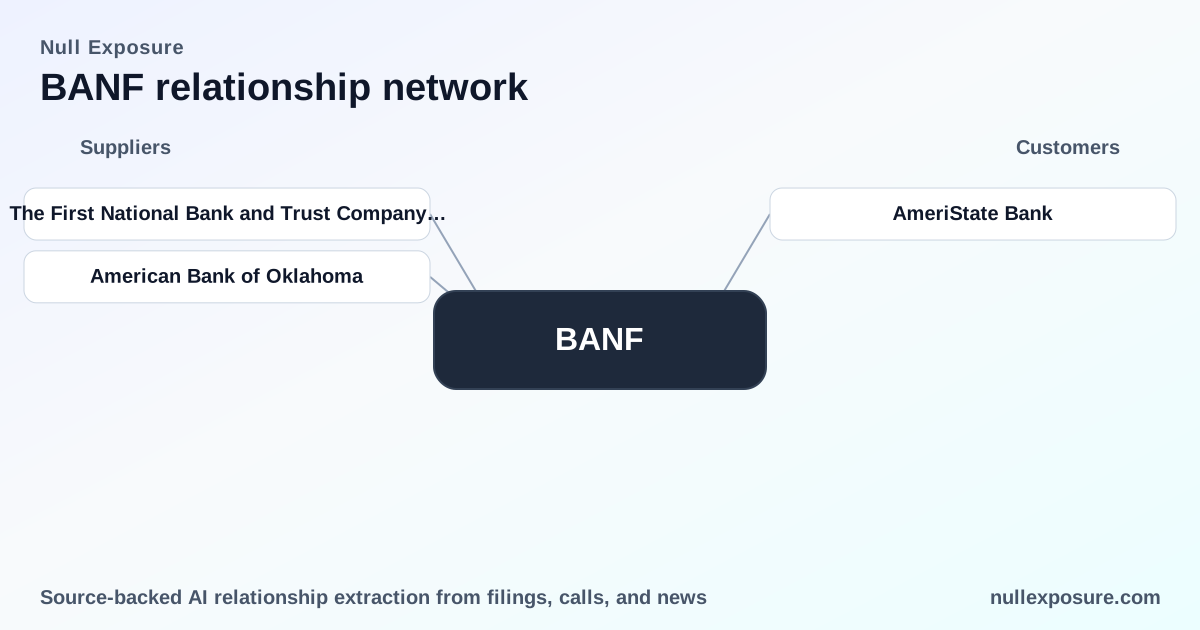
- AmeriState Bank — BancFirst agreed to sell roughly $20 million in loans and $38 million in deposits from its Hugo, Oklahoma branch to AmeriState Bank of Atoka, Oklahoma in FY2026; this was published on March 9, 2026 via a StockTitan news page covering BANF. The transaction is a straightforward branch-level transfer of assets and liabilities and highlights BancFirst’s active management of its branch footprint (StockTitan news, March 9, 2026).
Company-level constraints and what they reveal about operating posture
The source material includes a set of constraints and evidentiary excerpts drawn from BancFirst’s public disclosures. These are company-level operational signals that shape how counterparties contract with and depend on the bank:
- Short-term contracting posture. BancFirst uses overnight repurchase-style arrangements and has a very large share of uninsured time deposits maturing within one year (92.7% at December 31, 2024). That profile implies a funding base with significant near-term repricing and roll-over risk, and a contracting pattern that favors short-duration instruments.
- Framework agreements for derivatives. The bank executes derivative transactions under ISDA master agreements with upstream financial counterparties and customers, including standard right-of-set-off provisions. This creates predictable netting mechanics for credit and market exposures.
- Diverse counterparty mix. The firm serves individuals (consumer auto and other retail lending), small and mid-market businesses, and governmental units via correspondent and payment services. This mix signals broad revenue channels from retail deposits, commercial lending, and fee-generating services for institutions and government entities.
- Geographic concentration in North America. The company’s footprint is primarily Oklahoma (104 banking locations) with small presences in the Dallas and Fort Worth metroplexes via subsidiaries Pegasus and Worthington, making local economic cycles and state-level credit trends an input to portfolio performance.
- Core-deposit-funded business model that is critical to operations. Public disclosures state lending and investing activities are funded “almost entirely by core deposits,” indicating that deposit stability is a critical linchpin for asset-liability management and profitability.
- Dual commercial roles: seller and service provider. BancFirst acts as both a seller of banking products (loans, deposits) and a service provider (cash management, trust services, collections), generating revenue from interest margins and non-interest income streams.
- Active, mature customer relationships. The bank emphasizes decentralized management and continuity of staff to foster long-term relationships; contract performance often occurs within one year or less, but the relationship lifecycle is described as mature and enduring.
- Services-dominant segment mix. The company’s products and revenue drivers are concentrated in service lines—commercial, real estate, agricultural and consumer lending, depository services, and trust/cash management—reinforcing the bank’s role as a service platform for local customers.
These signals combine to profile BancFirst as a deposit-centric regional bank that manages short-term funding dynamics, executes standardized derivative frameworks where needed, and derives revenue from a diversified set of retail, commercial and institutional service lines (company filings, including descriptions referencing December 31, 2024).
Risk and concentration takeaways investors should watch
- Deposit stability is the central risk vector. With 92.7% of uninsured time deposits maturing within a year (as disclosed for the December 31, 2024 period), monitoring deposit roll rates, local economic drivers in Oklahoma, and any branch-level transfers like the Hugo sale is essential.
- Local credit cycles will drive headline metrics. Given the bank’s Oklahoma-centric footprint, regional agricultural and energy exposures are more consequential for asset quality and provisioning than for a geographically diversified national bank.
- Operational counterparty exposure includes standard ISDA set-off mechanics. Understanding counterparty netting arrangements matters for stress scenarios where derivatives or repo-style borrowings are significant.
Investment implications and tactical monitoring for analysts
BancFirst’s model delivers a compelling combination of solid return on equity (13.9% TTM) and a high profit margin, financed by a largely deposit-based balance sheet. The Hugo branch sale to AmeriState Bank is a tactical move that slightly reduces local deposit concentration while removing associated loans—a clean balance-sheet adjustment rather than a strategic pivot. Investors and operators should monitor:
- Quarterly changes in core deposits and net deposit outflows by market.
- Subsequent branch sales or purchases that reveal strategy on market concentration.
- Trends in uninsured deposit maturities and repricing pressures.
- Local credit performance in Oklahoma’s commercial, energy and agricultural sectors.
For ongoing tracking of relationship-level movements and deeper primary-source research, see https://nullexposure.com/.
Key takeaways
- BancFirst is a deposit-funded regional bank whose profitability depends on core-deposit stability and fee income from services.
- The Hugo branch transfer to AmeriState Bank transferred $20M loans and $38M deposits and is a local footprint adjustment (StockTitan, March 9, 2026).
- Short-term funding characteristics and geographic concentration are the principal operational risks to monitor, especially given the high share of deposits maturing within a year (Dec 31, 2024 disclosures).