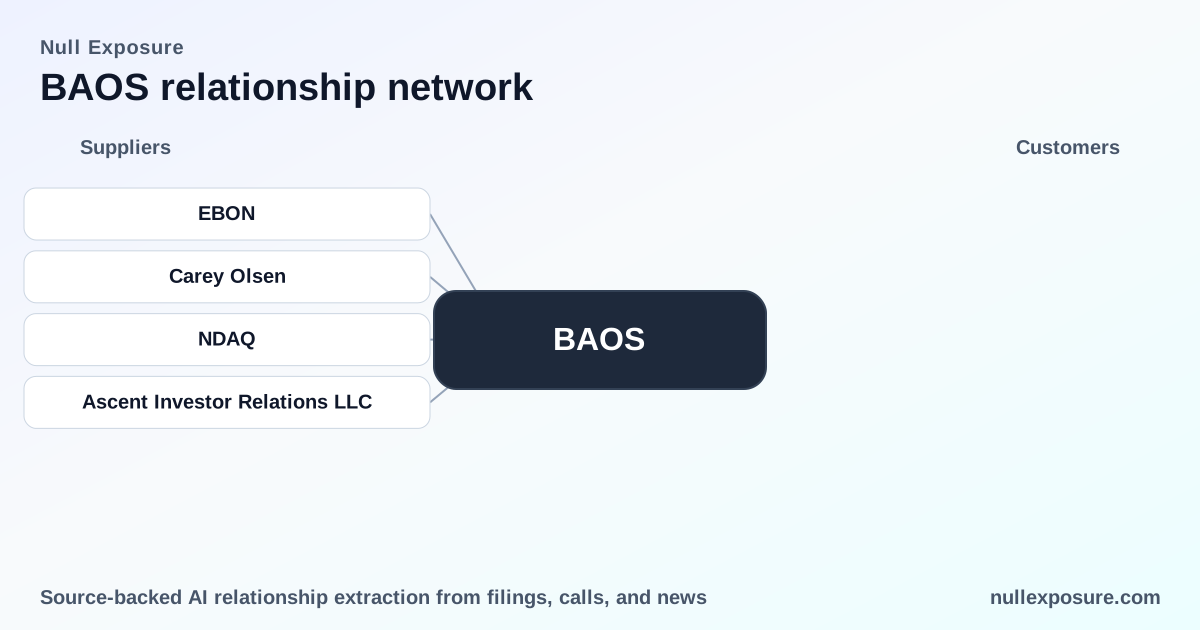
Baosheng Media Group Holdings (BAOS): Platform agency relationships drive a thin, high-concentration business
Baosheng Media Group operates as a China-based online marketing and channel-agency provider, monetizing through performance marketing fees, channel placement services, and technology/implementation contracts for large domestic internet platforms and advertisers. The company’s commercial model hinges on being a preferred agency for major digital ecosystems — converting platform access and campaign execution into recurring agency revenue and project work. For a focused investor read on customer concentration, platform exposure, and commercial durability, see our coverage at https://nullexposure.com/.
Business model and operating posture
Baosheng is an agency-first business. Revenue derives from campaign fees and technology-enabled services sold to advertisers and intermediated through platform relationships. The operating posture combines short-cycle, performance-driven contracts (campaign buys and optimizations) with pockets of longer-term work (tooling, integrations, and channel management). That mix produces volatile top-line timing and heavy sensitivity to platform rules, pricing, and advertiser budgets.
Financial signals underscore a fragile commercial maturity: negative EBITDA and sharply negative EPS alongside modest trailing revenue (RevenueTTM: 568,990) indicate the company has not yet delivered stable operating leverage. Governance and funding dynamics are material to any investment thesis: insiders control ~41% of shares while institutional ownership is negligible (~0.015%), a structure that concentrates control and limits the protective presence of diversified institutional holders.
Constraints and company-level signals
- There are no external constraints reported in the customer-scope search for BAOS; interpret this as an absence of captured legal or contractual constraint excerpts in the reviewed sources rather than an absence of commercial risk.
- From an operating-model perspective, concentration risk is a central signal: agency value is tightly coupled to continued access and preferred status on major platforms.
- Criticality: Baosheng’s services are important to advertisers seeking scaled channel delivery, but substitutability across agency competitors is high; platform access and performance track record are the primary differentiators.
- Maturity: The company exhibits early/mid-stage commercial maturity with revenue volatility, losses, and governance concentration that increase execution risk for investors.
Customer relationships — platform coverage and commercial implications
Baosheng’s reported client list centers on the dominant Chinese digital platforms. The following covers every relationship identified in the review and summarizes the practical takeaway for investors.
-
Alibaba — Baosheng is described as a core agency for Alibaba, performing channel marketing services, technology, and applications for the platform ecosystem. This relationship positions Baosheng to access large advertiser demand that flows through Alibaba’s commerce and advertising properties, which is strategically valuable for revenue scale. According to a company page on mexc.co dated May 2, 2026, Baosheng is a core agency for Alibaba in FY2026 (source: mexc.co/stocks/baos, May 2, 2026).
-
Bytedance — Baosheng is reported as a core agency for Bytedance, providing channel marketing services and technology integrations for the short-form and content-driven ad inventory. Bytedance exposure gives Baosheng access to high-volume impression markets and performance-based spend from advertisers looking to reach engaged audiences. This relationship is noted on the same mexc.co page for FY2026 (source: mexc.co/stocks/baos, May 2, 2026).
-
Kuaishou — The company is listed as a core agency for Kuaishou, executing channel marketing and application work for that platform’s video and live-commerce properties. Kuaishou’s advertiser base complements the other platforms and increases Baosheng’s addressable spend, but it also replicates platform-concentration risk across similarly structured commercial partners. The FY2026 mention is captured on mexc.co (source: mexc.co/stocks/baos, May 2, 2026).
-
Tencent — Baosheng is recorded as a core agency for Tencent, delivering channel marketing services and platform-specific technology. Tencent’s ecosystem exposure — social, messaging, and gaming-adjacent inventory — diversifies format access for Baosheng’s advertiser clients while leaving pricing and policy risk squarely tied to platform dynamics. This FY2026 relationship is also documented on mexc.co (source: mexc.co/stocks/baos, May 2, 2026).
What these relationships mean for investors
-
Customer concentration is both an asset and a liability. Being a “core agency” to Alibaba, Bytedance, Kuaishou, and Tencent gives Baosheng privileged routing to advertiser spend and can compress customer acquisition costs. At the same time, heavy reliance on a handful of platform ecosystems exposes revenue to platform policy shifts, algorithm changes, and pricing pressure.
-
Commercial stickiness is operationally conditional. Agency status generates repeatable campaign flows, but today’s core status converts into durable revenue only if Baosheng maintains performance, compliance, and integration depth. The company’s current financial profile — negative EBITDA and operating margins — highlights a gap between platform access and profitable scale.
-
Governance and capital structure increase strategic risk. High insider ownership and negligible institutional presence reduce the external checks that can force operational changes or capital infusions. This structure can accelerate or impede decisive responses to platform-driven revenue shocks.
-
Execution risk is the dominant value lever. Investors should prioritize evidence of sustained campaign win rates, platform-compliance track record, and any disclosed multi-year technology contracts that convert ephemeral campaign revenue into recurring streams.
Key takeaways for decision-making
- Platform relationships are the primary growth channel. Baosheng’s commercial fate is directly linked to continued agency status and execution performance across the four major Chinese platforms reported in FY2026.
- Operational leverage is not yet established. Current financials show that access alone has not translated into profitable scale.
- Concentrated ownership and low institutional investment heighten uncertainty. Insider control suggests potential strategic continuity but risks limited external governance discipline.
For investors and operators evaluating BAOS, the immediate task is to reconcile platform access with proof points for profitability: contract length, revenue breakdown by platform, client retention metrics, and compliance frameworks. For a deeper dossier on customer relationships and governance signals, view our coverage hub at https://nullexposure.com/.
Conclusion
Baosheng’s role as a core agency across Alibaba, Bytedance, Kuaishou, and Tencent is a valuable commercial asset that underpins its revenue model. However, conversion of that access into durable, profitable growth is unproven given current losses, concentrated ownership, and exposure to platform-level swing factors. Investors should treat BAOS as a relationship-driven play that requires active monitoring of platform-specific revenue disclosures, contract term evidence, and improvements in operating margins.