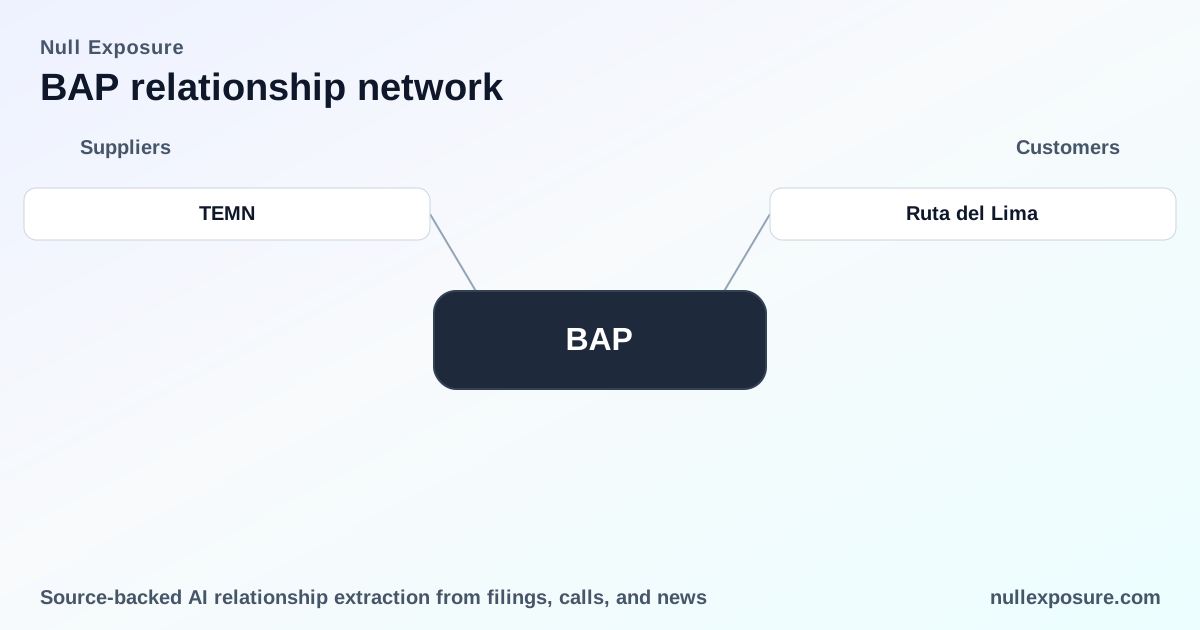
Credicorp (BAP) — Customer Relationships That Matter to Credit and Underwriting
Credicorp Ltd (BAP) operates as Peru’s largest financial-services holding company: it monetizes through traditional banking spreads, fee income from insurance and asset management, and cross‑sell across a broad retail and corporate client base. The group’s core value proposition is an integrated balance‑sheet model — loans and deposits via BCP, risk mitigation and fee capture via Pacifico (insurance) and Prima/Grupo Financiero — which together drive the bank’s strong margins and return on equity. For investors, customer‑level exposures that are small, highly provisioned, or strategically linked to sustainability lending will influence downside risk and capital planning more than headline loan growth.
For a quick portfolio view, Credicorp reported roughly $20.7B revenue TTM, a 33.5% profit margin, and ~19.1% ROE in the latest reporting window — metrics that imply material earnings coverage even for idiosyncratic losses. If you want an on‑demand feed of customer exposures and event signals tied to the group, visit the Null Exposure homepage for structured briefs: https://nullexposure.com/
What the customer signals tell us about Credicorp’s operating stance
Credicorp’s customer records in the recent capture are narrow but revealing. There are no formal constraint entries listed in the customer‑relationship extract, which itself is a company‑level signal: the vendor‑style, contract‑level red flags that would normally indicate critical single‑supplier risk or long‑dated covenant stress are not present in this slice of customer reporting. That absence translates into several operational inferences:
- Contracting posture: As a major financial group, Credicorp deploys standard loan documentation and provisioning frameworks through BCP and its insurance arm; the lack of flagged constraints is consistent with a conservative contracting posture rather than bespoke, fragile counterparty arrangements.
- Concentration: The two customer mentions here represent idiosyncratic, low‑share exposures rather than concentrated corporate dependence; where material exposure exists it is noted (see Pacifico’s bond exposure below).
- Criticality: The exposures disclosed do not represent systemically critical counterparties to Credicorp’s core deposit or payment franchises; they are credit exposures to be managed within normal underwriting and provisioning cycles.
- Maturity and recoverability: When recoverability is an issue, Credicorp documents provisioning levels and recovery pathways (arbitration, green‑loan underwriting) rather than structural write‑offs — a mature, institutional approach to problem credits.
Those are company‑level signals, not relationship‑specific constraints, and they align with Credicorp’s public financial strength and the high institutional ownership reported.
Relationship inventory: the two customer links in scope
Ruta del Lima — small insurance bond exposure in Pacifico
Credicorp disclosed a less than 1% exposure to Ruta del Lima that sits within its insurance subsidiary Pacifico; about 80% of that exposure is already provisioned, and the company expects arbitration‑driven recoveries in the 5–10% range of the bond in the near term with no further deterioration expected. This information was discussed in Credicorp’s Q4‑2025 earnings call transcript (reported March 9, 2026). Source: The Globe and Mail transcript of Credicorp’s Q4‑2025 earnings call (published March 9, 2026), which cites Pacifico’s disclosure.
BVN (Buenaventura) — corporate green financing from BCP
Buenaventura (BVN) is referenced in local reporting as a corporate client that received a US$119 million green loan from BCP in 2022, part of a broader US$240 million investment effort supporting a power plant project that went into commercial operation in 2014; the loan reflects Credicorp’s participation in project finance and sustainability‑linked lending. Source: Gestión.pe coverage of BVN’s project financing (article captured March 9, 2026; describing the 2022 BCP green loan).
How these relationships feed into investor risk and opportunity
The two relationships present different investor takeaways:
- Credit risk is contained. The Ruta del Lima bond exposure is immaterial at under 1% of the Pacifico portfolio and 80% provisioned, which reduces near‑term earnings volatility and capital hit risk. The company’s disclosure that arbitration recoveries will be pursued and are expected to be modest but positive is consistent with an orderly resolution strategy.
- Sustainability lending shows strategic direction. The BVN green loan demonstrates BCP/Credicorp’s active role in project and sustainable finance, which supports fee income and strategic positioning in renewable and infrastructure financing — a favourable franchise dynamic for long‑term growth.
- Operational implication: provisioning discipline and legal recovery channels are primary mitigants. Credicorp’s approach — reserve the bulk of expected loss and pursue arbitration/recovery — reduces uncertainty for investors and preserves regulatory capital buffers.
If you want an investor‑grade monitor of similar customer signals and the legal/provisioning outcomes that affect capital planning, Null Exposure maintains an ongoing feed: https://nullexposure.com/
What to watch next
- Monitor formal updates in Credicorp’s quarterly filings and earnings calls for actual recovery figures from Ruta del Lima arbitration and for any reassessment of provisioning.
- Watch BCP’s corporate lending pipeline for more green/project finance commitments, which will indicate whether the BVN transaction is an idiosyncratic case or part of a scalable strategy.
- Track any emergence of constraints or covenant flags in future customer captures — the current absence of constraint entries is favourable, but that can change with macro or sectoral shocks.
Final takeaway
Credicorp’s customer snapshot shows small, well‑provisioned loss exposure in the insurance book and targeted, strategic corporate lending in sustainability projects. For investors, the combination of modest direct counterparty risk and deliberate provisioning/ recovery tactics supports a constructive credit view, while sustainability lending provides a headline growth narrative for fee expansion. Keep focus on recovery outcomes and the flow of new project‑finance commitments as the primary next markers for credit and earnings risk.