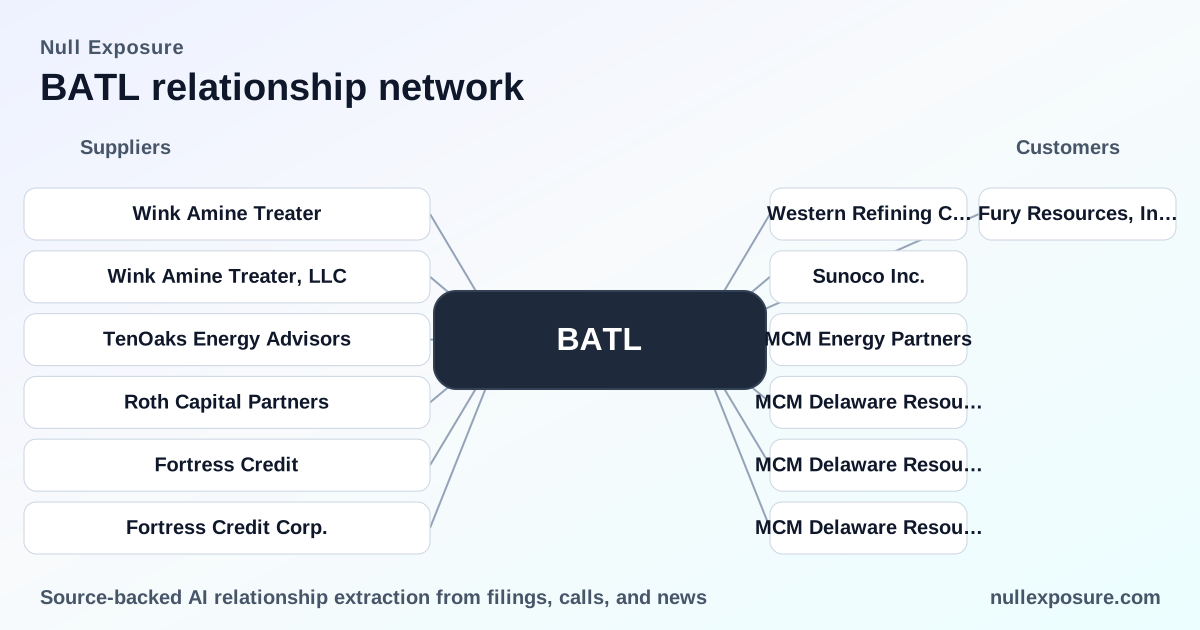
Battalion Oil Corp (BATL) — Customer relationships and commercial posture
Battalion Oil Corporation operates as an onshore oil and natural gas E&P focused on liquids-rich assets in the U.S. Delaware Basin; it monetizes through production sales to downstream marketers, refiners and pipeline companies and through opportunistic asset divestitures. Revenue is generated primarily by selling oil, gas and NGL production to a small set of large buyers, and the company has recently supplemented cash flow with targeted acreage and asset sales. For an organized view of counterparties and what they imply for commercial risk, see more at https://nullexposure.com/.
Investment thesis in one paragraph
Battalion’s business model is highly concentrated and buyer-driven: short-cycle production sales to a small number of large purchasers deliver near-term cash flow, while periodic asset sales (most recently the West Quito Draw divestiture) provide strategic liquidity and balance-sheet relief. This mix creates both a straightforward revenue engine and concentration risk that investors must price — the company’s near-term earnings are sensitive to a handful of counterparties and to the oil price environment that governs spot sales and disposals.
What the filings say about buyer concentration
According to Battalion’s 2024 Form 10‑K, two purchasers (Western Refining and Sunoco) each accounted for more than 10% of total sales in 2024, and together these two buyers represented 86% of total sales for the year, up from 79% in 2023. That is a defining commercial characteristic: high customer concentration and critical counterparty exposure directly visible in the audited filings.
Counterparty-by-counterparty review (concise takeaways)
Western Refining Company L.P.
Western Refining is one of two buyers that individually exceeded 10% of Battalion’s sales in 2024; the 10‑K states Western, together with Sunoco, drove a large majority of the company’s revenue in both 2023 and 2024. According to Battalion’s 2024 Form 10‑K, Western is therefore a critical revenue counterparty for the company in FY2024.
Sunoco Inc.
Sunoco Inc. is the other purchaser named in Battalion’s 2024 Form 10‑K as accounting for over 10% of sales; collectively with Western it represented 86% of 2024 sales, making Sunoco likewise a material buyer and a concentration risk for BATL’s near-term cash flows (Battalion 10‑K, FY2024).
MCM Energy Partners
MCM Energy Partners completed an acquisition of crude oil and natural gas assets from Battalion, expanding MCM’s Permian footprint. A WorldOil report (Feb. 25, 2026) and contemporaneous press noted that MCM’s purchase reflects a strategic asset sale by Battalion in the Delaware Basin, signaling portfolio rationalization and liquidity realization for BATL (WorldOil, 2026).
MCM Delaware Resources LLC
MCM Delaware Resources LLC, a subsidiary of MCM Energy Partners, closed on the purchase of Battalion’s West Quito Draw oil and gas assets for an adjusted cash purchase price of approximately $60.1 million, effective Dec. 1, 2025. The close was reported in a March 2026 release on Yahoo Finance and company filings; this sale converted reserves into near-term cash and removed roughly 12.4% of Battalion’s estimated proved reserves at year‑end 2024, according to investor reporting (Yahoo Finance; Investing.com reporting, March 2026).
MCM Delaware Resources (TradingView reference)
TradingView and other market news services referenced the sale and the counterparty as “MCM Delaware Resources” in March 2026, consistent with the parent/subsidiary role of the acquirer and multiple confirmations of the same transaction. This cluster of press coverage confirms the same buyer relationship recorded across multiple market outlets (TradingView, Mar. 2026).
Fury Resources, Inc.
Market reports noted an offer by Fury Resources, Inc. to acquire all outstanding Battalion common shares for $7.00 per share in cash. Coverage summarized the acquisition proposal as a control transaction for BATL shareholders and therefore a potential corporate event that would reshape counterparty and capital structure exposure if consummated (StockTitan news, 2026).
What the relationship map implies for Battalion’s operating model
- Concentration and criticality. Battalion’s revenue profile is highly concentrated: two buyers accounted for the majority of product sales in 2024. That concentration is a central commercial constraint and places outsized cash-flow dependence on a small number of counterparties (10‑K, FY2024).
- Counterparty type and contracting posture. The company explicitly notes its purchasers “consist primarily of independent marketers, major oil and natural gas companies and gas pipeline companies,” signaling that Battalion’s contracting posture is oriented toward large enterprise refiners and marketers rather than retail or dispersed off-takers. This is a company-level signal captured in filings (company 10‑K).
- Geographic concentration. Substantially all revenues are from the Delaware Basin (Pecos, Reeves, Ward and Winkler Counties, Texas), which concentrates operational and market risk regionally and simplifies buyer logistics but concentrates basin-specific risk (company 10‑K).
- Liquidity via asset sales. Battalion has executed strategic divestitures (e.g., the West Quito Draw sale for ~$60.1 million) that convert reserves to cash and reduce reserve exposure — a clear element of the company’s capitalization and liquidity strategy (press releases and filings, Mar. 2026).
- Relationship role. The company’s counterparties are buyers of production (company 10‑K), not long-term joint-venture partners; revenues are realized through product offtake and occasional asset sales rather than equity partnerships.
Risk and value drivers investors should watch
- Buyer concentration is the top operational risk. With two counterparties accounting for ~86% of sales in 2024, any demand or credit interruption from those buyers would materially affect near-term receipts (Battalion 10‑K, FY2024).
- Asset sale cadence affects liquidity and reserve base. The recent West Quito Draw divestiture reduced proved reserves but materially increased cash; future asset sales will continue to be a lever management uses to manage liquidity and capital allocation (press releases, Mar. 2026).
- Regional commodity exposure. Revenue sensitivity is tightly correlated with Delaware Basin realizations and local midstream capacity; successful hedging, marketing diversity and pipeline access will be decisive for margin stability.
Final read for investors
Battalion runs a classic small-cap E&P playbook: concentrated production sales to large enterprise buyers, supplemented by opportunistic asset monetizations. That combination produces stable, short-cycle cash when buyers and regional realizations cooperate, and substantial sensitivity when buyer concentration or local market conditions shift. For deeper counterparty intelligence, structured monitoring of the named purchasers (Western Refining, Sunoco) and of MCM’s post-acquisition plans is essential.
For more detailed relationship analytics and to monitor future updates to these counterparty relationships, visit https://nullexposure.com/.