BATRA: Monetizing a Major-League Franchise Through Real Estate, Media Rights and Venue Leases
Thesis — Atlanta Braves Holdings (BATRA) monetizes its Major League Baseball franchise by combining stable property-lease revenue from stadium and mixed‑use development assets, fee and sponsorship income tied to the team, and media-rights and distribution arrangements that feed both local and national audiences. Investors should value BATRA as a hybrid sports‑asset owner whose cash flow profile is driven by long‑term leases and media distribution agreements rather than ticket sales alone. For a concise view of customer relationships and contract signals, visit https://nullexposure.com/.
How the business actually gets paid
BATRA’s operating model is centered on owning the economic rights to the Braves franchise real estate and related commercial assets while contracting out game and media distribution in multiple layers. Primary revenue streams are:
- long‑term rental income and commercial leases tied to Truist Park, The Battery mixed‑use development and recent property acquisitions (e.g., Pennant Park),
- sponsorship, parking and retail tenancy revenue inside the stadium complex, and
- licensing of broadcast windows to local and national partners that carry games to TV and streaming audiences.
This structure creates a contracting posture that skews long‑term and asset anchored, producing predictable rental cash flows but with concentrated exposure to broadcasting cycles and regional ad markets.
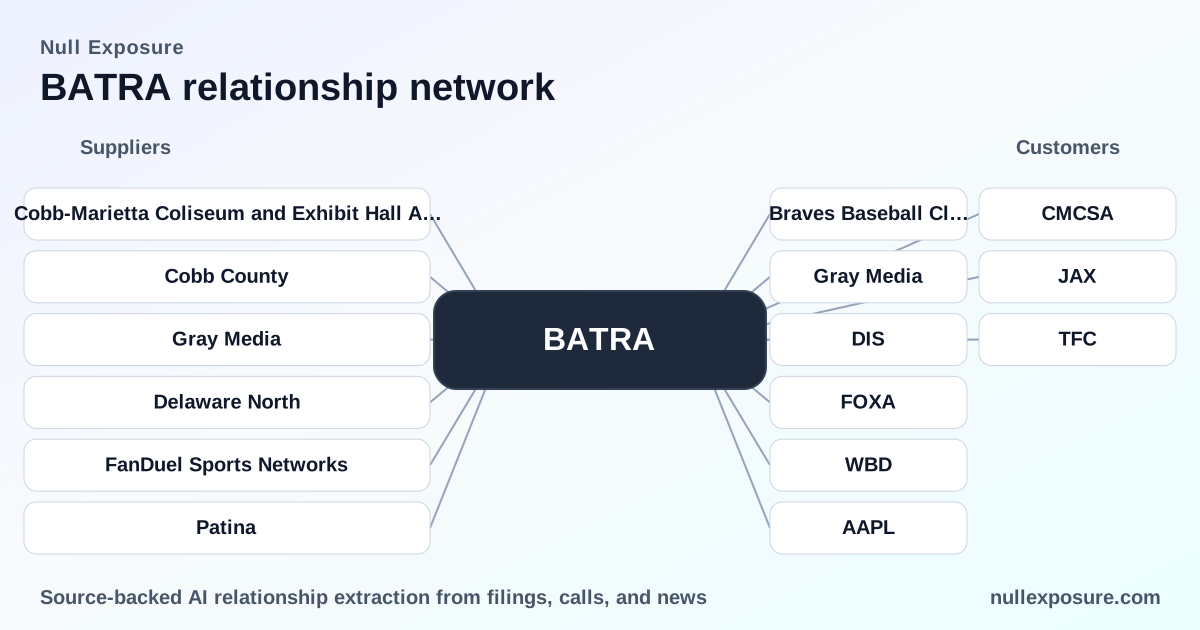
Relationship map: who BATRA does business with
Below I walk through every customer/partner mention in the source set, with concise takeaways and source references.
Braves Baseball Club, LLC
BATRA leases stadium and related development assets to Braves Baseball Club under long‑term lease agreements that produce stable rental income, aligning property performance with franchise needs. According to a MarketBeat instant alert covering FY2026, these leasing arrangements are a core recurring revenue driver. (MarketBeat, FY2026)
Gray Media / Gray Media, Inc.
BATRA entered a multi‑year agreement with Gray Media to simulcast a package of regular‑season Braves games on free, local over‑the‑air stations; Gray Media will also air Spring Training games across Southeast markets with streams available on Braves.TV. MarketScreener and a related filing note a Mar. 27 multi‑year simulcast deal and Spring Training distribution plans that expand local reach and sponsorship inventory. (MarketScreener, Mar. 27, 2026; StockTitan SEC filing, FY2025)
TBS (Warner Bros. Discovery)
TBS is listed among national broadcast partners that carry selected Braves national games, supporting BATRA’s national exposure and rights monetization. This placement is documented in BATRA’s FY2025 filings describing national distribution channels. (StockTitan SEC filing, FY2025)
ESPN (The Walt Disney Company)
ESPN is another national rights outlet named in FY2025 disclosures; national games on ESPN contribute to BATRA’s media footprint and the team’s sponsorship and advertising reach. (StockTitan SEC filing, FY2025)
FOXA / FOX/FS1
FOX/FS1 and parent FOXA are included as national television partners for Braves games, a channel through which BATRA captures national broadcast value and broad fan engagement. (StockTitan SEC filing, FY2025)
NBC / Peacock (Comcast)
NBC/Peacock is cited as part of the national distribution mix, representing streaming and network carriage that complements linear TV partners for selected games. (StockTitan SEC filing, FY2025)
Apple TV+
Apple TV+ is listed among national streaming partners in BATRA’s FY2025 disclosures, reflecting the club’s participation in the broader direct‑to‑consumer streaming distribution ecosystem for marquee matches. (StockTitan SEC filing, FY2025)
Truist Securities (TFC)
Truist Securities is reported as a new lease commencement within BATRA’s property portfolio; the company attributed a $9 million uplift in rental income partly to the Truist building and the Pennant Park acquisition during FY2025 commentary. This underscores BATRA’s ability to source institutional tenancy income. (InsiderMonkey earnings call transcript, Q3 2025)
J. Alexander’s (JAX)
J. Alexander’s is signed as a new Battery tenant, replacing underperforming retail space and representing BATRA’s active asset management and rental‑income optimization strategy for The Battery. Management cited this as an example of tenant rotation improving mixed‑use economics. (InsiderMonkey earnings call transcript, Q3 2025)
Operating constraints and what they imply for investors
BATRA’s disclosed relationship evidence produces a set of company‑level signals that shape risk and valuation.
-
Long‑term contracting posture (company signal): Filings repeatedly reference long‑term local broadcasting agreements and long‑dated leases, indicating revenue durability from both media rights and real‑estate leases rather than one‑off ticket flows. The company’s role as a licensor of territorial rights gives pricing power in local markets, but also locks BATRA into multi‑year terms that slow revenue re‑pricing. (Company filings, FY2025–FY2026)
-
Regional concentration of audience and affiliates (company signal): BATRA benefits from the largest radio affiliate network in MLB across the Southeast and local broadcast deals that prioritize the team’s home television territory, concentrating advertising and carriage economics within a defined geography. This amplifies local ad cycles and regional economic sensitivity. (Company filings and broadcast excerpts, FY2025)
-
Licensor role for local broadcast rights (company signal): BATRA functions as a content licensor for local and regional networks, which means counterparty credit and distribution stability are material — long‑term carriers (e.g., regional sports networks or local broadcasters) are pivotal to reach and ad monetization. Evidence cites SportSouth/Main Street Sports arrangements as the contractual locus for local distribution. (Company filings, FY2025)
-
Maturity and asset management focus: Recent acquisitions and tenant rotations (Pennant Park, Truist lease, J. Alexander’s tenancy) show an active property management strategy to grow rental income, implying that near‑term upside is as likely to be driven by asset re‑positioning as by on‑field performance. (Earnings call commentary, Q3 2025)
Investment implications: what to watch next
- Stability vs. concentration: BATRA’s lease and broadcast income are stable thanks to long contracts, but concentrated in local/regional channels and key institutional tenants; monitor renewals with the Braves Baseball Club and regional carriage partners.
- Media windows and monetization: National partner arrangements provide upside to sponsorship and brand reach; changes in national rights allocations or streaming terms will flow through to BATRA’s sponsorship and broadcast economics.
- Asset re‑positioning as a growth lever: Management is actively replacing underperforming tenants and acquiring properties to lift rental income — track occupancy and same‑store lease growth metrics on subsequent quarters.
For a structured view of BATRA’s customer relationships and contract signals, see https://nullexposure.com/ for additional analysis and monitoring tools.