BATRK: How the Braves Convert Ballpark Traffic and Real Estate into Recurring Revenue
Atlanta Braves Holdings (BATRK) operates as an integrated sports and mixed-use real estate business: owning the Atlanta Braves franchise and monetizing the team through game-related sales, long-term local broadcast rights, and leasing/licensing within The Battery Atlanta mixed-use development. The company’s model combines event-driven cash flow with recurring contractual income from broadcast and real-estate tenants, generating scale in sponsorships and premium seating while exposing the business to concentrated media counterparties and local market dynamics. For a deeper set of customer relationships and contract-level signals, visit https://nullexposure.com/.
How the business actually makes money — the operating model in plain English
Braves Holdings produces revenue across three integrated vectors: baseball operations (tickets, concessions, suites and premium seating, sponsorships), media monetization (local and national broadcast rights) and mixed-use real estate (retail, restaurants, offices, hotel, and lease income at The Battery Atlanta). The company’s FY2025 figures show $732 million in revenue and $90.8 million of EBITDA, reflecting material scale but compressed operating margins driven by the cost base of team operations and development activity. The firm’s EV/EBITDA of 40.8 and Price/Book ~6.1 reflect a premium valuation premised on scarce sports-franchise economics and recurring rights income, despite a negative EPS in the latest TTM.
Several company-level signals define the contractual posture:
- Long-term media contracts: Braves Holdings has an explicit long-term local broadcasting agreement that grants regional networks rights to substantially all games not selected by national partners—an arrangement that anchors predictable media revenue and is explicitly described in company documents.
- Licensing and premium-seat contracts: The company executes long-term licensing for suites and premium hospitality, turning one-off game attendance into multi-year revenue streams.
- Real-estate lessor role: Braves Holdings receives lease income as a landlord within The Battery Atlanta, embedding sponsorship and tenant mix as a strategic lever to drive non-gameday cash flow.
- Geographic focus: The Braves operate a broad regional radio network across the Southeast (177 affiliates), concentrating local-market reach in North America.
Together, these signals indicate a contract-heavy, mature monetization approach where long-dated rights and leases produce recurring revenues while event revenues remain cyclical and attendance-dependent.
Contracting posture, concentration and what it means for investors
The company’s contracting posture is contractually entrenched and relatively mature: long-term broadcast and licensing contracts give revenue visibility and increase predictability for cash flow modeling. That same contractual entrenchment creates counterparty concentration risk; long-term dependency on a regional broadcast partner concentrates a meaningful portion of content monetization with one counterparty group. The firm’s role as licensor and lessor positions it to capture upside from ancillary development, but tenant turnover and retail performance will directly affect near-term mixed-use cash generation.
Operational criticality is twofold: broadcast rights are material to revenue, and The Battery’s tenant mix is material to non-gameday earnings. The company classifies these streams under services and real-estate segments, both central to the consolidated revenue base.
Customer relationships on record
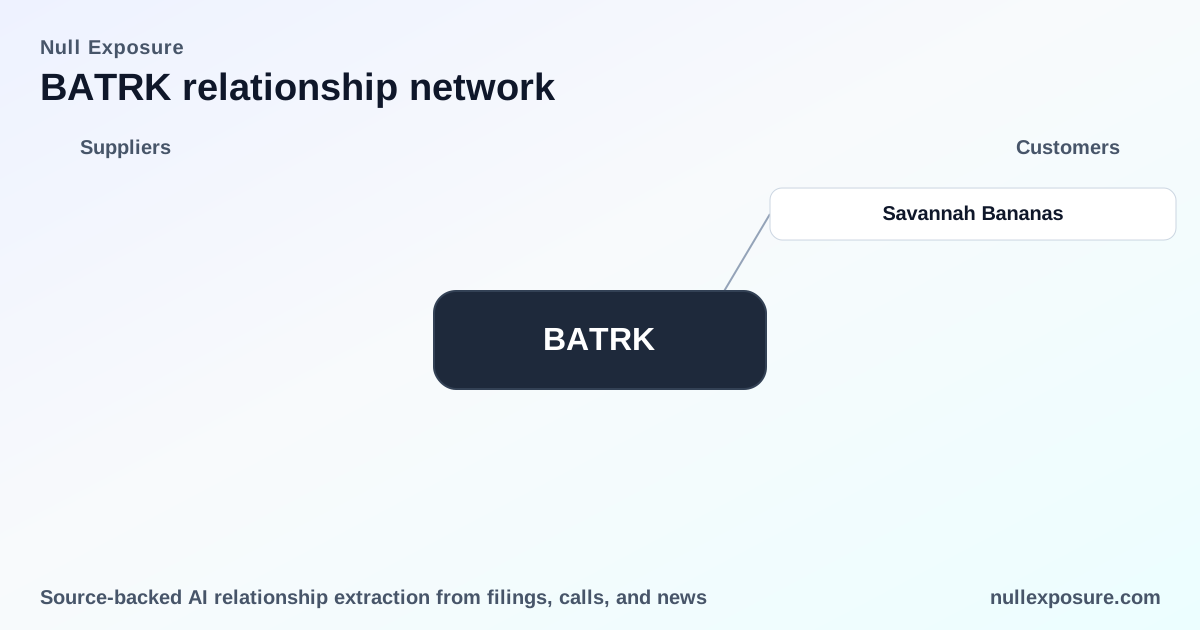
Savannah Bananas — short event partnership that boosted in-park activity
Savannah Bananas played two games at Truist Park, and Braves Holdings reported that those appearances were a notable contributor to a roughly $7 million increase in the referenced revenue line for FY2025, reflecting the impact of specialty events on stadium and mixed-use results. This was reported by BatteryPower in March 2026. (BatteryPower, March 9, 2026)
J. Alexander’s — new restaurant tenant replacing an underperforming space
Braves Holdings announced that J. Alexander’s, a higher-end American restaurant, is scheduled to open at The Battery and will replace a previously underperforming tenant, signaling active tenant optimization to raise mixed-use yield and guest experience. This detail was disclosed in the Q3 2025 earnings call transcript published on Investing.com (May 2, 2026).
Why these customer relationships matter to valuation and risk
Both named relationships illustrate two strategic levers in the company’s playbook:
- Event licensing and one-off bookings (Savannah Bananas) deliver episodic lifts to revenue and demonstrate the park’s ability to capture third-party promoters and special-event audiences. These events convert into incremental parking, concessions, and short-term retail activity and underscore the seller role the company plays on gamedays.
- Tenant curation (J. Alexander’s) shows active asset management within The Battery as Braves Holdings works to maximize lease revenue and foot traffic, reinforcing its lessor/service provider role for mixed-use assets.
At the company level, constraints and disclosures make clear that broadcasting rights are materially important and that the firm derives substantial revenue from the sale of local broadcasting rights, while also managing long-term licensing for premium seating. These characteristics support recurring cash flow but also create concentration and counterparty risk that must be modeled explicitly by investors.
Key investment takeaways
- Recurring backbone: Long-term broadcast and licensing agreements create a predictable revenue base, providing visibility beyond game-by-game variability.
- Real-estate optionality: The Battery’s tenant mix, including restaurants and specialty events, is a lever for non-gameday revenue growth but increases exposure to local retail dynamics.
- Valuation reflects growth expectations more than current profitability: EV/EBITDA (~40.8) and Price/Book (~6.1) imply investor willingness to pay a premium for franchise economics and media rights despite negative TTM EPS and compressed operating margins.
- Concentration risk is real: A dominant local broadcast partner and regional market focus are material exposures that require monitoring in contract renewals and affiliate health.
If you are modeling cash flow or preparing a diligence memo, factor long-term contract expiry profiles, tenant lease terms at The Battery, and the sensitivity of event-driven revenue to attendance and promotional activity. For a comprehensive look at customer and contract signals across media, tenants, and event partners, see our broader analysis hub at https://nullexposure.com/.
Bottom line
Atlanta Braves Holdings combines high-margin, contractually secured media rights with cyclical event revenue and growth-oriented mixed-use real-estate leasing. That mix produces attractive long-run cash-generation potential but leaves the business exposed to concentration in broadcast distribution and to the performance of in-park tenants and special events. Investors must balance the premium multiple against the company’s path to consistent operating profitability and the stability of its long-term contractual counterparties.