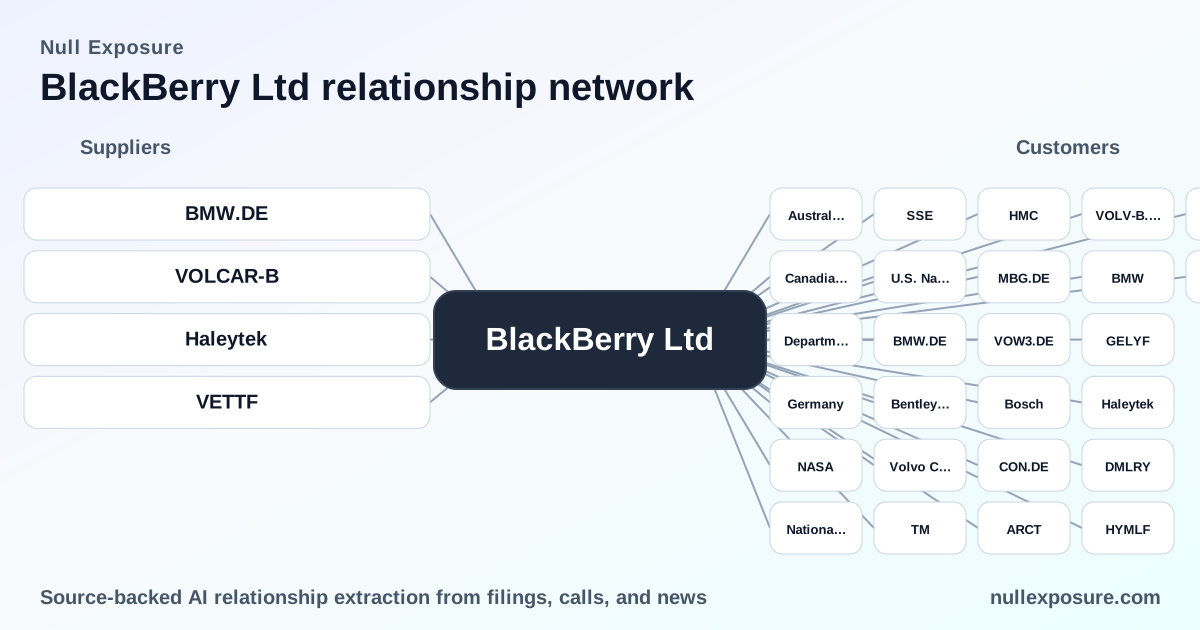
BlackBerry (BB): Customer Map and Commercial Implications for Investors
Thesis: BlackBerry monetizes through a mix of software licensing, subscriptions and professional services, selling secure communications and QNX embedded operating systems to governments, OEMs and enterprises; revenue comes from recurring software contracts and high‑value OEM licensing, with notable concentration in North America and EMEA that drives both stability and client‑specific risk. For a focused run‑book of customer relationships and operational signals, visit https://nullexposure.com/.
How BlackBerry gets paid — a concise commercial profile
BlackBerry’s business model is anchored on three monetization levers: (1) licensing of intellectual property (including QNX and Certicom), (2) subscription revenue where software depends on BlackBerry’s secure networks, and (3) professional services and engineering for OEM integrations. Public disclosures and filings show that software and services account for the bulk of revenue, with support and professional services commonly bundled into license sales. Fiscal geography splits (North America ~46.5%, EMEA ~35.3%) make the company a global vendor with regional concentration that investors should account for when modeling growth and risk.
Key company signals:
- Contracting posture: mix of upfront licensing and ratable subscription recognition depending on network dependencies.
- Customer roles: BlackBerry operates as both licensor and service provider, especially in automotive and government verticals.
- Revenue concentration: one customer comprised ~14% of revenue in fiscal 2025, indicating meaningful client concentration.
- Segments: primary exposure to software and services, with smaller hardware offerings (e.g., BlackBerry Radar IoT devices).
For a deeper relationship intelligence view, explore https://nullexposure.com/.
Government and public-sector wins you need to know
- Department of Justice — BlackBerry’s AtHoc emergency communications platform recorded a meaningful increase in utilization by the DOJ in FY2026, reinforcing government demand for crisis communications. Source: ClearanceJobs report (FY2026), January 2026 (https://news.clearancejobs.com/2026/01/06/the-future-looks-bright-for-both-of-blackberrys-main-businesses/).
- U.S. Navy — The U.S. Navy similarly expanded use of AtHoc in FY2026, adding a high‑profile, mission‑critical public‑sector customer. Source: ClearanceJobs (FY2026), January 2026 (same article).
- National University of Malaysia — The university adopted AtHoc during BB’s Q3, demonstrating expansion of secure communications into higher education internationally. Source: ClearanceJobs (FY2026), January 2026.
- Australia’s Department of Foreign Affairs and Trade — Selected BlackBerry’s emergency service during Q3, indicating traction in Australian government channels. Source: ClearanceJobs (FY2026), January 2026.
- Scottish and Southern Energy (SSE) — The UK energy provider implemented AtHoc during BB’s Q3, underlining utility sector adoption in EMEA. Source: ClearanceJobs; FY2026/earnings call excerpts (January 2026).
- Canadian government — Management disclosed active discussions to sell AtHoc, SecuSUITE and SecuSmart to Canadian public sector buyers, signaling pipeline conversion opportunities in BlackBerry’s home market. Source: ClearanceJobs (FY2026), January 2026.
- Germany — Management stated Germany increased adoption of BlackBerry’s Unified Endpoint Management offerings, evidencing sovereign and enterprise endpoint demand. Source: ClearanceJobs (FY2026), January 2026.
- NASA — BlackBerry disclosed NASA will begin utilizing the SDP8 platform, adding a technically demanding government client to the customer roster. Source: ClearanceJobs (FY2026), January 2026.
Automotive and mobility: QNX as a strategic revenue driver
- BMW / BMW.DE — QNX is cited as selected for next‑generation vehicle software and as a trusted foundation across leading OEMs, marking BMW as a strategic design win. Source: StockTitan and Finviz reports (FY2025–FY2026).
- Mercedes‑Benz — Mercedes has been linked to QNX and Vector Alloy Kore collaborations as BlackBerry accelerates SDV development, representing a safety‑critical OEM partnership. Source: StockTitan (Jan–Feb 2026).
- Volvo Cars — QNX expanded collaboration with Haleytek to deliver Software‑Defined Audio for the EX60 EV, illustrating in‑vehicle multimedia and cockpit consolidation use cases. Source: StockTitan press release (Feb 2026).
- Toyota — Listed among OEMs trusting QNX for embedded systems; this placement underscores scale penetration in global auto platforms. Source: StockTitan (FY2025).
- Volkswagen — Named as a QNX customer in communications emphasizing ubiquitous OEM adoption. Source: StockTitan (FY2025).
- Hyundai — Included among leading OEMs using QNX as a foundational embedded OS. Source: StockTitan (FY2025).
- Honda — Cited in management commentary and press as part of the QNX OEM cohort. Source: StockTitan and earnings call references (FY2025–FY2026).
- Bosch — Named among Tier‑1s and OEMs leveraging QNX technology, reflecting supplier‑level integrations. Source: StockTitan (FY2025).
- Continental — Identified as a Tier‑1 partner trusting QNX in their platform roadmap. Source: StockTitan (FY2025).
- Geely — Listed by management among OEMs using QNX, supporting BlackBerry’s global OEM footprint. Source: StockTitan (FY2025).
- Dongfeng Motor — Included in BlackBerry’s OEM list, signaling traction in China. Source: StockTitan (FY2025).
- Leapmotor — Announced selection of QNX for the D19 EV SUV platform, a concrete recent vehicle program win that converts R&D into production timelines. Source: Capital/Benzinga coverage (April–May 2026).
- WeRide — Cited as a secured partner/OEM win in trading‑desk summaries of BlackBerry’s FY2026 10‑K and call notes. Source: TradingView (FY2026).
- Haleytek — Collaborated with QNX and Volvo on Software‑Defined Audio, representing a strategic software partner in the SDV stack. Source: StockTitan (Feb 2026).
Strategic partnerships and transaction counterparts
- Nvidia / NVIDIA — Partnership to integrate QNX OS for Safety into Nvidia safety stacks expands BlackBerry into AI‑enabled robotics, medical and advanced driving systems. Source: GuruFocus news (FY2026).
- Johnson & Johnson — QNX OS for Safety will power an AI‑driven heart pump, signaling medical device OEM adoption and a non‑automotive safety use case. Source: InsiderMonkey earnings transcript (FY2026).
- Arctic Wolf — Mentioned in earnings commentary relating to the second tranche of proceeds from the sale of Cylance; this is a counterparty in a prior divestiture and cash‑flow item. Source: InsiderMonkey Q4 transcript (FY2026).
- Switzerland’s Bank Julius Baer — Cited in earnings commentary as a notable customer or reference in the same context as other enterprise relationships. Source: InsiderMonkey Q4 transcript (FY2026).
- Bentley, Nevada — Named by management as a long‑time customer that adopted SDP8 for condition monitoring and industrial applications, showing non‑automotive embedded demand. Source: InsiderMonkey Q3 transcript (FY2025).
What the commercial footprint implies for investors
- Growth engine: QNX is the clear growth lever through OEM design wins and partnerships with Nvidia and major automakers; these are high‑value, multi‑year engagements that lift revenue visibility.
- Cash conversion and one‑offs: The Arctic Wolf transaction shows management executes portfolio rationalization and monetizes non‑core assets — expect occasional cash inflections from such moves.
- Concentration and criticality: The business benefits from sticky, mission‑critical government and OEM customers, but one large customer represented ~14% of revenue in 2025 — model concentration risk into scenarios.
- Geographic mix: With nearly half of revenue in North America and over a third in EMEA, geopolitical and procurement cycles in these regions materially affect consensus revenue paths.
Final read: where the risk/reward sits
BlackBerry’s customer map demonstrates a disciplined shift from commodity devices to enterprise and OEM software monetization, anchored by QNX and secure communications platforms. Investors should value the company based on recurring license/subscription economics, the cadence of design‑win conversions in automotive, and the potential variability from large public‑sector contracts and one‑off divestiture proceeds. For a concise, actionable relationship dashboard and to integrate these signals into your underwriting, visit https://nullexposure.com/.
Bold takeaway: BlackBerry is now a software‑led vendor with durable OEM and government relationships — upside comes from converting design wins to production revenue, while downside concentrates around a small number of large customers and regional procurement cycles.