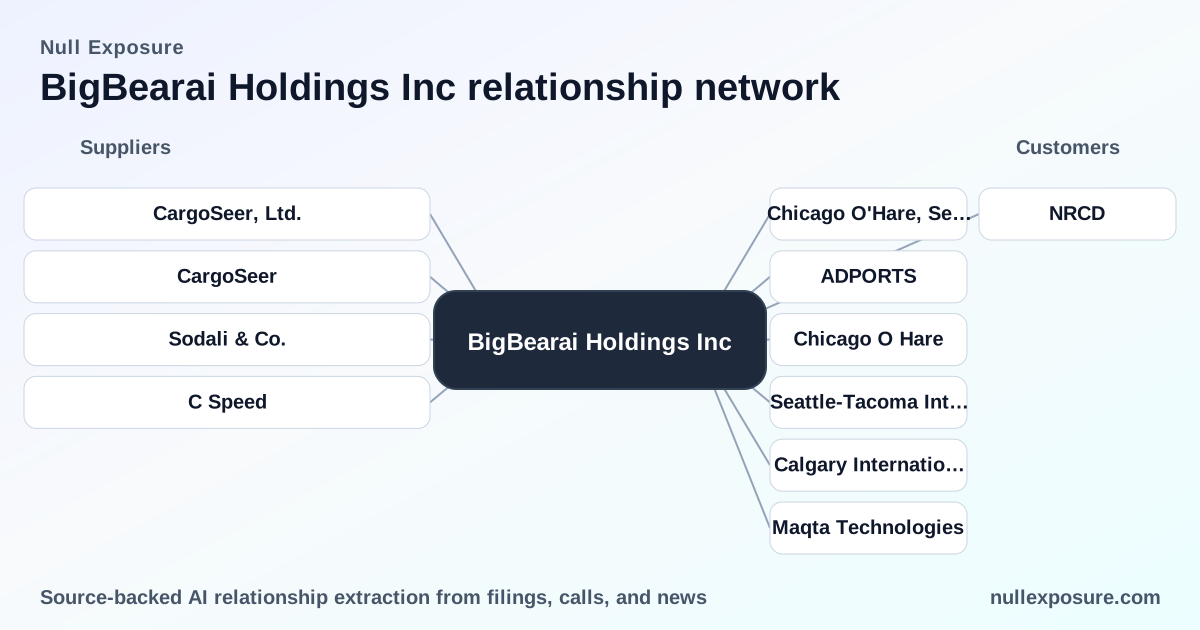
BigBear.ai (BBAI) — Customer Map and Commercial Thesis for Investors
BigBear.ai monetizes by selling edge AI software and professional services into government and commercial sectors, with revenue driven by a mix of multi‑year contracts, subscription arrangements and task orders under framework agreements. The company packages analytics (ConductorOS, BRYCK, veriScan) alongside managed services to governments, airports and commercial partners; revenue recognition is largely over time as solutions create non‑fungible operational value for customers. For a deeper look at commercial exposure and partner coverage, see https://nullexposure.com/.
How BigBear.ai wins business and where it makes money
BigBear.ai’s go‑to‑market blends product and services: the firm licenses analytics platforms and embeds specialists for deployment and operations. Government work — particularly federal and homeland security customers — underpins a disproportionate share of revenues, while strategic commercial partnerships and port/transportation deployments broaden addressable markets.
Key operating facts from public filings reinforce the model:
- Revenue TTM was roughly $128 million with material customer concentration historically (four customers represented ~52% of 2024 revenue).
- The company reports negative operating margins and EPS (Diluted EPS TTM: -0.82) while trading at a high price‑to‑sales multiple (~15.6x P/S), reflecting investor expectations for growth over near‑term profitability.
Operating constraints and contract profile — what drives predictability
Investors should treat BigBear.ai as a contractor‑centric software and services provider with the following firm‑level characteristics drawn from company disclosures:
- Long‑term contracting posture: The company states it typically engages customers with contracts up to five years and recognizes revenue over time for production and services.
- Framework and task‑order exposure: BigBear.ai competes for and receives orders under IDIQ/indefinite delivery contracts, increasing dependence on the government procurement cadence.
- Subscription and service mix: Government customers often purchase shorter subscription terms relative to private sector clients, while services and systems integration remain a material revenue source.
- Geographic concentration with global expansion: Substantially all historical revenues derive from the United States, but management targets global customers and strategic Middle East partnerships for expansion.
- Material and critical relationships: The company discloses customers representing >10% of revenue and positions its software as important or essential to certain customer operations under SLAs.
- Seller and service‑provider role: BigBear.ai functions both as a software vendor and a managed service provider, frequently supplementing customer technical staff.
- Land‑and‑expand pattern: The firm often pilots prototypes at low or no cost to secure longer‑term deployments.
These signals create a business profile with high revenue concentration, policy‑driven demand, and revenue visibility linked to contract awards and task orders. For more context on client coverage and partner validation, visit https://nullexposure.com/.
Customer relationships: live deployments and strategic partners
Below are the relationships identified in public remarks and media coverage; each entry includes a concise, plain‑English summary and the referenced source.
-
Chicago O'Hare (Chicago O Hare / Chicago O'Hare International Airport)
BigBear.ai’s veriScan biometric identity platform is live at Chicago O’Hare to support U.S. Customs and Border Protection’s Enhanced Passenger Processing program. This deployment was disclosed on the company’s Q4 2025 earnings call and reiterated in FY2026 reporting. (Q4 2025 earnings call; FY2026 key developments via SimplyWallSt) -
Seattle‑Tacoma International Airport
Seattle‑Tacoma is listed as a live deployment for the veriScan platform as part of enhanced passenger processing rollouts announced on the Q4 2025 call. (Q4 2025 earnings call; InsiderMonkey transcript) -
Nashville / Nashville International Airport
Management confirmed a live veriScan deployment at Nashville aimed at improving processing for returning U.S. citizens under enhanced passenger programs. (Q4 2025 earnings call; FY2026 reporting via SimplyWallSt) -
Calgary International Airport
Calgary is a completed deployment for biometric passenger processing, demonstrating BigBear.ai’s airport footprint extends to Canada. (Q4 2025 earnings call; InsiderMonkey transcript) -
U.S. Customs and Border Protection (CBP)
CBP is a direct beneficiary of veriScan deployments; SimplyWallSt notes the platform’s role in CBP’s Enhanced Passenger Processing program and a reported reduction in average processing times. (FY2026 key developments via SimplyWallSt) -
ADPORTS / Abu Dhabi Ports Group / Abu Dhabi Ports
BigBear.ai announced a January partnership with Abu Dhabi Ports to collaborate on AI capabilities for government and critical infrastructure customers, signaling strategic Middle East market entry and customs/trade cooperation. (Q4 2025 earnings call; news coverage via ts2.tech) -
Washington Commanders
The company has an engagement in sports analytics tied to the Washington Commanders, illustrating a commercial application of BigBear.ai’s analytics beyond defense and transport. (TradingView idea/news aggregation, FY2026) -
Narval Holding Corp
Narval is cited in relation to cargo security solutions in Panama, indicating regional logistics and port security use cases for BigBear.ai technology. (TradingView idea/news aggregation, FY2026) -
Fincantieri
Reports note collaboration with Fincantieri, a major global shipbuilder, which would extend BigBear.ai’s solutions into maritime and defense industrial applications. (TradingView/Zacks commentary, FY2026) -
DEFCON AI
DEFCON AI is listed as a collaborator that strengthens BigBear.ai’s footprint in military logistics and related defense applications. (TradingView idea/news aggregation, FY2026) -
Tsecond
Tsecond is referenced in the context of alliances supporting real‑time, edge‑based AI operations for naval exercises (UNITAS 2025) and expansion of ConductorOS/BRYCK deployments. (TradingView idea/news aggregation, FY2026) -
Maqta Technologies
Maqta Technologies teamed with BigBear.ai’s UAE division to explore customs management, border operations and cross‑border trade digital platforms—an operational complement to the Abu Dhabi Ports partnership. (News via ts2.tech, Jan 28, FY2026 reporting) -
NRCD
NRCD appears in transcript coverage connected to the same airport deployments, suggesting either a partner or contract vehicle referenced in earnings materials. (InsiderMonkey transcript, FY2026)
Each of these relationships provides commercial validation across travel, customs, ports, defense and sports analytics, and together they illustrate BigBear.ai’s strategy of pairing government work with commercial use cases to diversify revenue streams.
Investment implications — concentrated revenue, broadening addressable market
- Growth vector: Airport biometric deployments and Middle East port partnerships diversify applications beyond core U.S. federal work and create recurring revenue potential through managed services and subscriptions.
- Risk profile: High customer concentration and government procurement cycles create revenue volatility; the company is currently unprofitable and priced at a premium P/S multiple (~15.6x).
- Operational leverage: Long‑term contracts and framework IDIQ exposure increase revenue visibility when task orders flow, but conversion from pilots to long engagements remains a gating item.
- Valuation sensitivity: With market capitalization near $2.0 billion against ~$128 million in trailing revenues, valuation depends on successful scaling of commercial partnerships and margin improvement.
Bottom line
BigBear.ai is a specialized AI solutions provider that combines mission‑critical software with services to win government and commercial contracts; recent airport biometrics and Gulf port alliances materially expand go‑to‑market channels. Investors should focus on contract conversion rates, task‑order cadence under frameworks, and margin trajectory as the company attempts to translate deployments into durable, larger recurring revenue streams.
For ongoing coverage, analysis and partner mapping, visit https://nullexposure.com/.