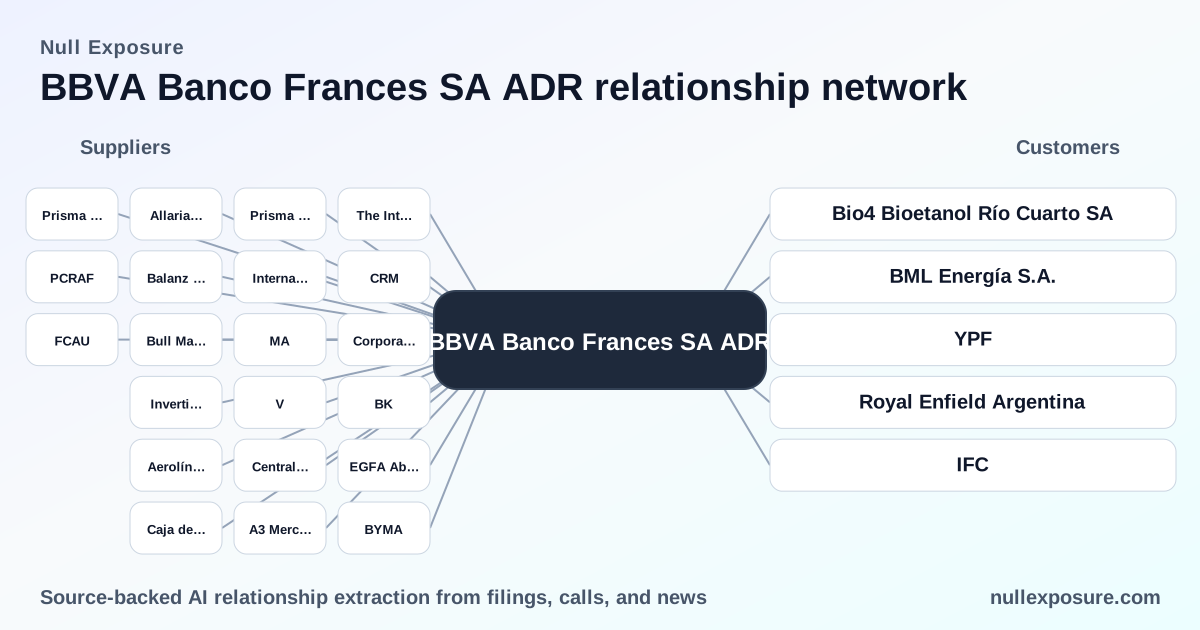
BBVA Banco Francés (BBAR): Customer relationships that define credit and fee pipelines
BBVA Banco Francés operates as Argentina’s full-service commercial bank, monetizing through traditional net interest income, corporate lending and syndication fees, and capital-markets placement activity. The bank combines retail deposit capture with targeted corporate finance and sustainable lending programs, generating recurring spreads while leveraging transaction fees from bond placements and syndications. For investors, the key takeaway is that BBAR’s revenue mix is anchored in lending relationships with large corporates and development institutions, which both stabilizes interest income and exposes the bank to macro- and sector-specific credit cycles. Learn more about relationship analytics at https://nullexposure.com/.
Quick read: what these customer links mean for BBAR’s business model
BBAR plays a dual role—lender and placement agent—with evidence of syndication participation, corporate bond placement, retail-backed product distribution, and sustainability financing. That breadth signals a contracting posture that is active in both whole-loan and arranged-debt markets, and a business model that relies on a mix of interest margin and fee revenue tied to corporate-client activity. Institutional lines of credit from multilateral lenders also provide balance-sheet flexibility and enhance liquidity capacity.
Who BBVA Argentina is doing business with (documented relationships)
Below are every customer relationship captured in the source material, with a concise summary and the original source context.
-
BML Energía S.A. — In FY2026 BBVA Argentina acted as one of the lending banks in a US$155.9 million syndicated loan to BML Energía governed by Argentine law, participating alongside other domestic and international banks; this was disclosed in a March 9, 2026 announcement by Bruchou & Funes de Rioja.
Source: Bruchou & Funes de Rioja press release (9 March 2026). -
YPF S.A. (placement) — In FY2026 BBVA Argentina served as a colocador (placement agent) in the offering of YPF’s US$185 million negotiable obligations under the company’s frequent issuer program, joining other domestic banks on the transaction as reported in March 2026.
Source: Bruchou & Funes de Rioja notice on YPF issuance (9 March 2026). -
Royal Enfield Argentina — BBVA Argentina provided a retail financing program for Royal Enfield motorcycle purchases, enabling point-of-sale consumer credit for new models as described in a January 3, 2024 industry news item highlighting the co-branded financing offer.
Source: Autocosmos report (3 January 2024). -
Bio4 Bioetanol Río Cuarto SA — BBVA Argentina has extended sustainable financing totaling ARS 9,450,000,000 over the last four years to Bio4, reflecting participation in renewable-fuel sector lending and sustainability-linked credit in FY2025 disclosures.
Source: 100Seguro coverage on BBVA sustainable financing (FY2025 reporting). -
YPF (duplicate entry) — The dataset contains a second FY2026 entry referencing BBVA’s role as a placement agent on YPF’s US$185 million issuance, the same placement described above and recorded again in the March 2026 item.
Source: Bruchou & Funes de Rioja notice on YPF issuance (9 March 2026). -
International Finance Corporation (IFC) — BBVA Argentina secured a credit line commitment of up to US$150 million from the IFC, disclosed in the bank’s Q4 2025 earnings commentary on December 22, 2025; this institutional line strengthens the bank’s international funding and development-lender relationships.
Source: BBAR Q4 2025 earnings call transcript (22 December 2025). -
IFC (duplicate entry) — The same Q4 2025 earnings-call disclosure about the US$150 million facility from the International Finance Corporation is recorded twice in the results.
Source: BBAR Q4 2025 earnings call transcript (22 December 2025).
What these relationships imply about BBAR’s operating posture and business constraints
-
Contracting posture: Active underwriter and lender. BBAR routinely participates as a colocador and syndicate member and secures committed lines from multilateral lenders, indicating a proactive posture toward fee-generating capital-markets activity and balance-sheet augmentation.
-
Customer concentration and industry exposure: Diversified across energy, agriculture/biofuel, automotive retail finance, and institutional development finance. While the bank serves large corporates (e.g., energy majors and regional industrial borrowers), revenue dependence on several large-ticket corporate financings creates episodic concentration risk in corporate lending pipelines.
-
Criticality of relationships: Strategically important counterparties. Engaging with a national oil champion and with multilateral lenders positions BBAR as a critical domestic financier for capital expenditures and tradeable debt placements, which supports fee income and enhances deposit/lending cross-sell opportunities.
-
Relationship maturity and tenor: Mix of short-to-medium tenor transactional placements and multi-year sustainable financing lines. The presence of a four‑year sustainability financing relationship and a multi-year IFC line signals both repeat business and access to longer-term foreign-currency liquidity.
These are company-level signals distilled from public disclosures and transaction notices, and they shape BBAR’s revenue stability and funding profile without tying constraints to any single counterparty unless explicitly cited above.
Risk and opportunity for investors
-
Risk: Corporate and sector concentration in Argentina’s cyclical sectors—energy and biofuels—means BBAR’s credit performance and fee pipelines correlate with commodity cycles and capex programs. Domestic currency, regulatory, and macro volatility in Argentina amplify those exposures.
-
Opportunity: Participation as a placement agent on large issuer programs and access to multilateral funding enhance margins and liquidity optionality. Sustainable financing relationships and consumer finance partnerships support fee diversification and retail deposit capture.
Bottom line and next steps
BBVA Banco Francés shows a balanced commercial strategy that mixes traditional banking margins with fee-driven capital markets activity and development-finance support. For investors evaluating credit and revenue durability, the bank’s documented customer relationships highlight both the benefits of fee diversification and the concentration risks tied to Argentina’s large corporate borrowers.
For a deeper dive into relationship-level analytics and broader exposure mapping, visit https://nullexposure.com/ — our coverage aggregates and normalizes these transaction disclosures to aid investment diligence.