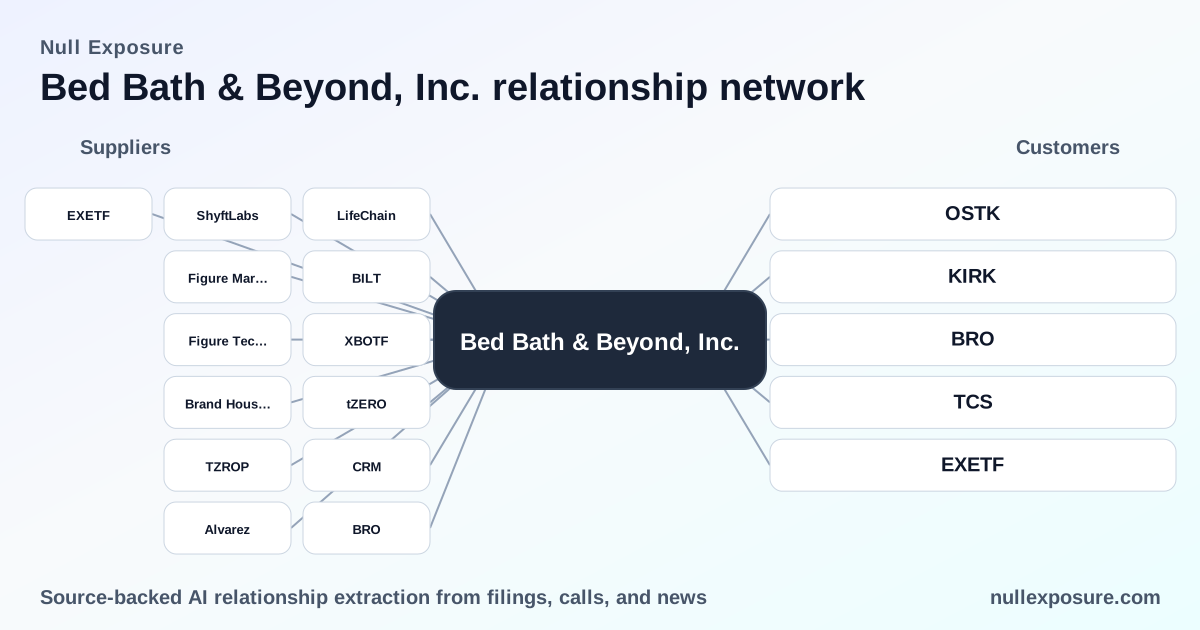
Bed Bath & Beyond (BBBY): Who Buys Into the Revival and How the Brand Converts Relationships Into Revenue
Bed Bath & Beyond operates today as a relaunched retail brand and omnichannel merchant that monetizes through product sales across e‑commerce and partner store footprints, licensing of trademarks, selective store conversions, and ancillary services (warranties/insurance and membership fees). Management is executing a wholesale partnership strategy—licensing the brand, embedding Bed Bath & Beyond assortments into third‑party retail footprints, and funding conversion activity through targeted financing arrangements to drive top‑line scale without a traditional store lease footprint.
If you want a consolidated view of partner exposure and counterparty risk for investment analysis, see the detailed relationship rundown below and visit https://nullexposure.com/ for ongoing tracking.
What the current operating model means for investors
Bed Bath & Beyond no longer resembles a conventional national store chain. The company’s go‑to‑market model is partner‑centric: it places curated BB&B assortments inside other retailers (brick‑and‑mortar rollouts with The Container Store and Kirkland’s), monetizes e‑commerce through third‑party marketplaces (historic activity with Overstock), and captures recurring revenue via a membership program (Beyond+). That structure produces several operational characteristics investors must weigh:
- Contracting posture: The firm relies on commercial partnerships and licensing agreements rather than long‑term store leases, reducing fixed cost commitments but raising dependency on third‑party distribution and merchandising execution.
- Concentration and criticality: A small set of retail partners (Container Store, Kirkland’s/the Brand House Collective) handle a substantial proportion of physical distribution and conversions, creating outsized relationship exposure.
- Maturity and financing posture: Management is using targeted financing—advancing loans to partners and accepting delayed draw facilities—to accelerate store conversions and inventory procurement, which implies active short‑term working capital interplay with counterparties.
- Revenue diversification: Beyond product sales, revenue sources include membership fees recognized ratably (Beyond+), warranty/insurance services through partners, and trademark licensing across North America.
Below I summarize every notable counterparty relationship in the available reporting and press coverage.
Relationship roll call — who Bed Bath & Beyond works with today
The Brand House Collective (TBHC)
Bed Bath & Beyond advanced $10 million under an existing delayed‑draw term loan to The Brand House Collective to fund store conversions, speed omnichannel inventory procurement, and support operations, and TBHC has been described as the multi‑brand operator managing the BB&B portfolio and Bed Bath & Beyond Home website. Source: Bed Bath & Beyond press release and filings reported in March–May 2026 (investors.beyond.com; PR Newswire; RetailDive, FY2025/FY2026).
Overstock.com / Overstock (OSTK)
Overstock acquired Bed Bath & Beyond’s intellectual property at a court‑supervised auction in June 2023 for approximately $21.5 million, later operating the ecommerce platform under the Beyond/Overstock evolution before corporate name changes. Management also reports increased sales mix into Overstock as an omnichannel outlet. Source: industry coverage and company reporting including Ad‑Hoc News and DigitalCommerce360 (FY2026 reporting and historic 2023 auction).
The Container Store (TCS / COST / Container Store)
The Container Store is executing a phased integration of Bed Bath & Beyond assortments into its footprint; 98 stores began "store changing" resets to make room for curated BB&B product assortments, with pilot rollouts scheduled within 90 days of announcement. This partner provides premium distribution points and a national physical footprint for BB&B products. Source: ChainStoreAge, RetailDive, Axios, and HomeTextilesToday coverage (FY2025–FY2026).
Kirkland’s (KIRK)
Kirkland’s is Bed Bath & Beyond’s exclusive brick‑and‑mortar partner for streamlined BB&B stores and, according to management commentaries, that pillar approximates $1.5 billion in annualized revenue, with an additional omnichannel transaction expected to add another $500 million in top line when consummated. Management stated the Kirkland’s transaction expected to close around April 1. Source: BBBY earnings call disclosures (2025 Q4) and related press (FY2025/FY2026).
Brown & Brown (BRO)
Bed Bath & Beyond partnered with Brown & Brown to create a property & casualty insurance agency to offer customers warranty and insurance options alongside product sales, positioning warranties as an ancillary, higher‑margin service. Source: BBBY 2025 Q4 earnings call (2025Q4).
Extend (EXETF)
Product warranties and shipping insurance for Bed Bath & Beyond products are being provided through Extend, indicating outsourced warranty administration and a contractual relationship for post‑sale protection services. Source: BBBY 2025 Q4 earnings call (2025Q4).
OPAD (Opendoor / Offerpad marketplaces referenced)
Management discussed a cash‑offer marketplace concept to connect homeowners with platforms like Opendoor and Offerpad, intending to provide those platforms access to Bed Bath & Beyond’s customer base as a distribution or service channel. This indicates exploratory marketplace partnerships targeting customer acquisition and cross‑sell opportunities. Source: business press and analyst reporting in May 2026 (Intellectia.ai / coverage referencing FY2025 commentary).
Key constraints and company‑level signals investors should factor in
- Subscription revenue exists: Bed Bath & Beyond records annual membership fees for Beyond+ as unearned revenue and recognizes those fees ratably over the membership period, creating predictable recurring revenue. Evidence: company disclosure on membership accounting.
- Government counterparty activity: The company sold a corporate headquarters property to Salt Lake County on December 20, 2024, signaling discrete government transaction exposure. Evidence: corporate real estate sale disclosure.
- North American footprint orientation: The company reports customer reach and licensing activity primarily in the United States and Canada, with trademark licensing in Mexico, indicating a North American geographic focus rather than a global expansion push.
- Seller / affinity marketing posture: The company has articulated a seller role through Beyond, Inc. as an e‑commerce affinity marketing operator, signaling reliance on third‑party distribution and merchandising partnerships rather than direct retail store ownership.
- Single reportable segment: Management reports one reportable Retail segment, reinforcing that operational performance and risk are concentrated in retail merchandising and partner execution.
Investment implications and risk checklist
- Upside: Rapid top‑line scalability without capex‑heavy store re‑builds if partners execute conversions as planned; ancillary services (memberships, warranties) are structural margin enhancers.
- Concentration risk: Heavy reliance on a handful of partners (Kirkland’s, The Container Store, Brand House Collective) concentrates counterparty and operational execution risk.
- Financing linkage: Management uses targeted loans and delayed‑draw facilities to finance partner conversions—this solution accelerates rollout but creates cross‑company cashflow dependencies that investors must monitor for working‑capital stress.
- Brand value and IP monetization: Historical IP sale and re‑acquisition activity with Overstock/Beyond highlights the centrality of trademark licensing and ecommerce control to future revenue stability.
If you are evaluating counterparty exposure or conducting diligence on Bed Bath & Beyond’s partner risk, Null Exposure maintains ongoing linkage and signal monitoring for these counterparties—visit https://nullexposure.com/ for the realtime relationship feed and deeper counterparty mapping.
Boldly positioned merchandising partnerships and targeted financing drive the growth thesis; investors must balance that upside with concentration and execution risk as the company moves from brand relaunch to sustainable retail scale.