Beasley Broadcast Group (BBGI): how audience reach funds a thin-margin broadcast business
Beasley Broadcast Group operates local and regional radio stations across the United States and monetizes primarily through the sale of advertising time, supplemented by integrated marketing services, events and growing station-related digital products. The company runs a classic ad-sales model with short-term, spot-oriented contracts, while incrementally pushing higher-margin digital suites and event-based revenue to offset declining traditional radio pricing.
Explore Beasley customer relationship intelligence on NullExposure
The operating model in plain English: short-term ad sales, concentrated markets, and digital upside
Beasley’s core economics are defined by short payment cycles and spot advertising inventory: payment is generally due within 30 days and the company sells commercials of varying lengths to local, regional and national advertisers. This contracting posture produces high revenue volatility tied to ad spend cycles, with limited long-term revenue guarantees.
Geographically, Beasley is a U.S.-centric broadcaster operating stations throughout the country. Revenue concentration is material and critical: Boston, Detroit and Philadelphia stations accounted for 58% of net revenue in 2024, establishing single-market performance as a driver of company-wide results. The business acts both as a service provider (integrated audio, digital and event solutions to advertisers) and as a buyer in the marketplace when running promotional partnerships and cross-platform initiatives. Station-level digital products are a growing line that introduces software-like revenue — interactive audience tools and integrated digital advertising — but traditional spot advertising remains the largest and most mature revenue source.
Key operational constraints:
- Contracting posture: short-term and spot-dominated revenue with 30-day typical payment terms; some advertisers pay in advance.
- Geographic footprint: U.S.-only operations with high concentration in a few major markets.
- Materiality & criticality: a handful of stations drive the majority of revenue, increasing single-market exposure.
- Segments: primary services are advertising and events; digital product suites represent a growing software-like revenue stream.
Relationship map: the partners that matter and what they tell investors
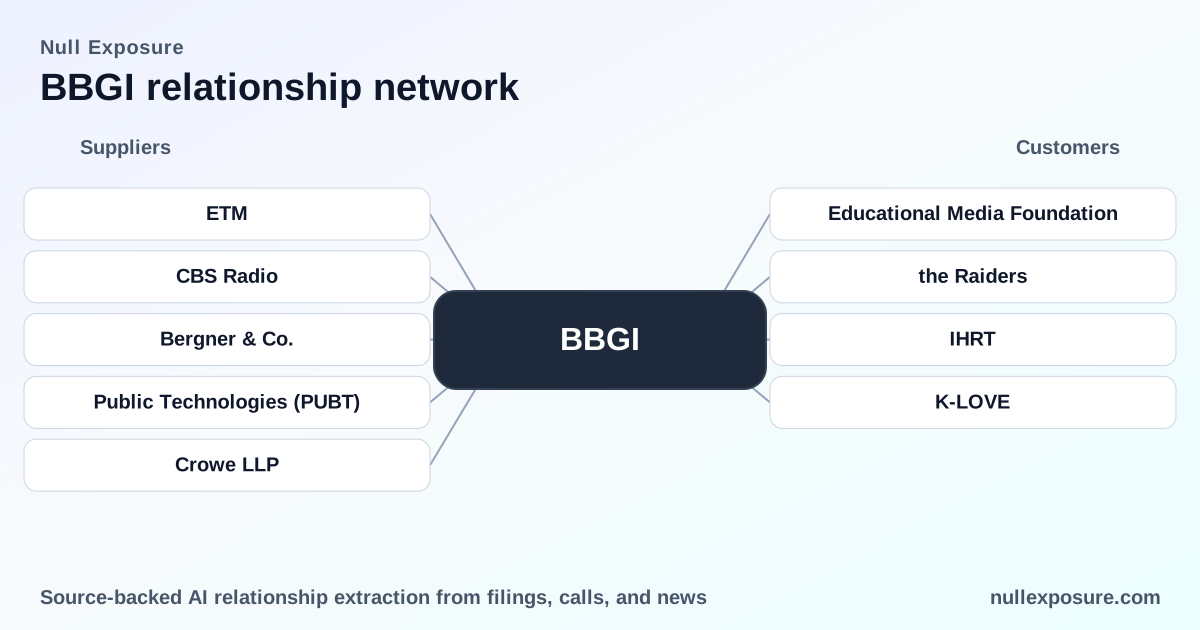
Below are every customer/partner mention in the available corpus, summarized in investor language with source notes.
Pokatok — esports sponsorship with Beasley Esports
Pokatok announced Beasley Esports, parent of the Houston Outlaws Overwatch League franchise, as a sponsor for its inaugural event in April 2024, indicating Beasley’s extension of audience monetization into esports and event sponsorships. According to Esports Insider (Sept 2023), the deal places Beasley into non-traditional audio-adjacent sponsorships that target younger, digital-first audiences. (Esports Insider)
Educational Media Foundation — asset sale counterparty
Beasley agreed to sell Class C2 WPBB-FM 98.7 in Tampa-St. Petersburg to Educational Media Foundation (K-LOVE’s parent) as part of portfolio streamlining to strengthen the balance sheet. RBR reported this transaction in March 2026, demonstrating the company’s willingness to monetize non-core frequencies to reduce leverage and reweight market exposure. (RBR, March 2026)
the Raiders — local flagship radio partnership (historic)
Beasley Media Group entered a two-year deal to serve as the Las Vegas flagship radio partner for the Raiders, illustrating the company’s role as a local broadcaster that signs temporary rights and sponsorship deals tied to sports franchises. The Raiders’ official announcement (2017) captures the typical short-term, market-specific commercial relationships that drive episodic revenue. (Raiders.com, 2017)
iHeart — platform aggregation and streaming partnerships (mention 1)
Industry reporting notes that iHeart has aggregated stations from multiple owners, including Beasley Media Group, onto a single streaming platform, signaling competitive and distribution dynamics in digital audio. RadioInsight’s March 2026 commentary outlines how major platform consolidation changes distribution economics for smaller broadcasters. (RadioInsight, March 2026)
IHRT — duplicate mention emphasizing platform dynamics (mention 2)
A second mention, indexed under the ticker IHRT, repeats that iHeart’s platform now includes stations from Beasley and other groups, confirming that Beasley’s stations participate in third-party streaming aggregators rather than exclusively proprietary digital channels. This reinforces the strategic tradeoff between wider reach and reduced control over digital distribution economics. (RadioInsight, March 2026)
K-LOVE — buyer of Tampa Bay FM (transaction headline)
Local press and industry outlets reported the sale headline as “Beasley sells Tampa Bay FM to K-LOVE parent,” underscoring active portfolio rationalization and the use of asset sales to manage liquidity and market focus. RBR’s coverage (March 2026) frames this as a balance-sheet and portfolio strategy rather than a core-operational partnership. (RBR, March 2026)
What the relationships reveal about revenue quality and strategic direction
The relationship set highlights three consistent themes:
- Ad-sales and short-term contracts dominate revenue generation; sports partnerships, esports sponsorships and station sales are incremental levers to boost revenue or manage balance sheet.
- Distribution is increasingly platformed: participation in iHeart’s streaming aggregation indicates Beasley trades some control for scale in digital reach.
- Portfolio management is active: recent station divestitures to Educational Media Foundation / K-LOVE show management using asset sales to reduce exposure and shore up liquidity.
Investment implications: risk, optionality and where value sits
Beasley is a thin-margin broadcaster operating in a structurally challenged ad market. The company reports negative profitability metrics alongside meaningful revenue: Revenue TTM is $205.94M while reported margins are compressed, and the balance-sheet actions point to active deleveraging. Operationally, short-term, spot-oriented contracts produce revenue cyclicality, and a concentrated revenue base (58% from three markets in 2024) amplifies execution risk in any single market slowdown.
At the same time, there are positive optionalities:
- Digital product suites and event sponsorships provide higher-margin revenue pathways.
- Participation in major streaming platforms extends audience reach without heavy capex.
- Asset sales are being used pragmatically to strengthen the balance sheet.
Key investor takeaways:
- High single-market concentration is a material risk to forecast stability.
- Short-term contracting and 30-day payment norms imply revenue sensitivity to ad-market cycles.
- Digital and event businesses are growth levers, but the core remains spot advertising.
For further, structured customer relationship analysis and to track how these partnerships evolve, visit NullExposure.
Bold, data-driven customer intelligence lets investors differentiate between transient headline deals and durable monetization shifts: Beasley’s recent activity signals active portfolio management and selective digital expansion, but the company’s earnings are still tied to short-duration ad sales concentrated in a handful of markets.