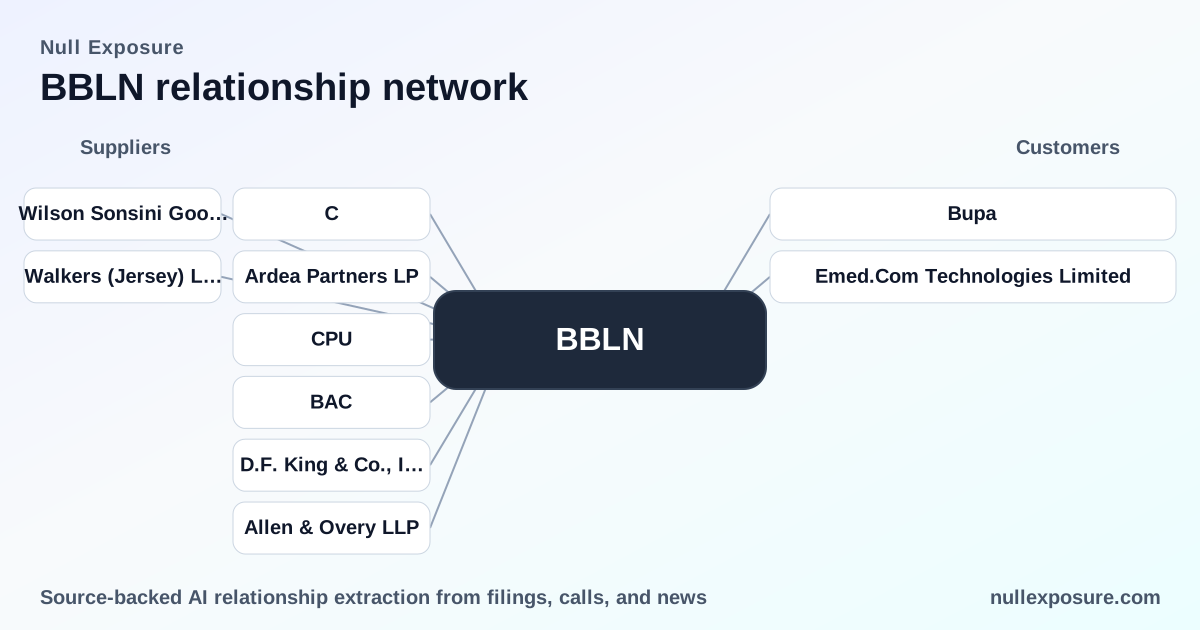
BBLN customer relationships: what investors need to know
BBLN operates as a telehealth-services originator and commercial partner, delivering virtual GP services and related digital health assets to third-party payers, employers and retail customers, and monetizes through contract fees, service-level agreements and asset transfers. Recent public filings and press coverage document a mix of continuing service contracts, capital support requirements and an asset sale that reshapes the company’s operating footprint. For investors, the relevant question is how contract concentration, revenue criticality and corporate restructuring change future cash flow visibility.
If you want a concise, market-focused dossier on counterparties and their implications, see our platform for the full context: https://nullexposure.com/
How BBLN runs the business and where the money comes from
BBLN’s commercial model centers on delivering virtual primary-care services and packaged digital health products to third parties who integrate those services into their consumer-facing propositions. Revenue is driven by B2B contracts and service agreements with insurers and retail healthcare brands, with a secondary lever realized through the sale of assets and businesses to third-party acquirers. Operationally the company runs a provider-facing platform (remote GP/triage plus patient-facing interfaces) and monetizes through recurring contract fees, per-user service charges and occasional one-off transaction proceeds from asset sales.
This structure produces a mixed maturity profile: ongoing contract revenues provide baseline monetization, while asset sales and capital injections reflect transitional or restructuring dynamics that alter near-term cash flow certainty.
Documented customer and counterparty relationships
Bupa — virtual GP provider for retail customers
Babylon provides the remote/virtual GP service for most of Bupa’s retail customers, positioning BBLN as a core third‑party supplier to a major insurer’s retail channel. This relationship signals commercial scale in payer-led retail offerings. According to Healthcare & Protection reporting (March 2026), Babylon supplies the virtual GP service used by Bupa’s retail customers. (Healthcare & Protection, Mar 9, 2026)
Babylon Healthcare — internal operating unit with sustained capital needs
Babylon Healthcare, the operational arm behind the “GP At Hand” service, requires continuing injections of capital from its parent to sustain operations, indicating dependency on parent-level funding to maintain service continuity. GP Online reported in May 2026 that Babylon Healthcare needs ongoing cash infusions from Babylon Holdings to support GP At Hand. (GP Online, May 2, 2026)
Emed.Com Technologies Limited — acquirer of Babylon assets
Emed.Com Technologies Limited acquired assets of Babylon Holding from Babylon Holdings Limited, a transaction that redistributes operating assets and reduces direct operational control by the original parent while generating transaction proceeds for BBLN. MarketScreener covered the asset acquisition and related corporate movements in March 2026. (MarketScreener, Mar 9, 2026)
What these relationships collectively imply about the business model
- Contracting posture: The company operates primarily as a supplier-under-contract to larger healthcare payers and retail brands rather than as a purely consumer-focused subscription business. That posture creates revenue predictability when contracts are stable but exposes BBLN to contract renegotiation and renewal risk.
- Concentration: The prominence of major counterparties such as large insurers creates concentrated client exposure; a single counterparty change would materially affect revenues.
- Criticality: For some partners, BBLN supplies core customer-facing services (virtual GP), making the relationship operationally critical to the partner’s retail product offering and therefore more defensible — but also a potential leverage point for counterparties.
- Maturity and restructuring signals: The reported asset sale and the need for capital injections reflect a company in transition; investors should treat near-term cash flows as partially driven by one-off transactions and parent support rather than only stable recurring fees.
These characteristics together yield a hybrid profile: recurring contract revenue underpinned by high-client concentration and exposed to restructuring-driven variability.
Risk and value levers investors should monitor
- Contract renewals and terms: Track the timing and terms of major contracts, especially with payer and insurer customers; renewal leverage dictates near-term revenue stability.
- Counterparty concentration: Quantify revenue share by counterparty where possible; any single-party exposure above typical supplier thresholds (e.g., >20–30% revenue) materially increases downside risk.
- Integration of sold assets: Monitor how Emed.Com integrates acquired assets and whether the sale reduces BBLN’s long-term revenue run-rate or creates recurring licensing/service arrangements post-sale.
- Capital support dynamics: Continue to track parent-level capital flows and the company’s access to external funding; ongoing injections signal refinancing or operational strain that affects equity holders.
Practical steps for investors and operators
- For investors: prioritize diligence on contract schedules and termination clauses for each major counterparty, and request clear disclosure of revenue attributable to any counterparty that represents material concentration.
- For operators: build contingency plans for contract renewals and diversify payor relationships to reduce single-counterparty exposure.
- For both: use third-party verification of service continuity following asset transfers to acquirers, and verify whether asset sales include transitional service agreements that preserve revenue streams.
If you want a succinct, annotated counterparty map and ongoing monitoring of these relationships, explore our analytic offerings at https://nullexposure.com/ — we maintain curated relationship timelines and source-backed summaries for investment teams.
Bottom line
BBLN’s commercial position is valuable where it retains payer-level contracts that embed virtual GP services in large retail propositions, but the combination of concentrated counterparties, evidence of parent-level cash support, and an asset sale creates an enterprise profile with both upside if contracts persist and downside if client exposure or restructuring reduces recurring revenue. Investors should prioritize contract-level transparency and track proceeds and post-sale commercial arrangements to assess sustainable cash flow.