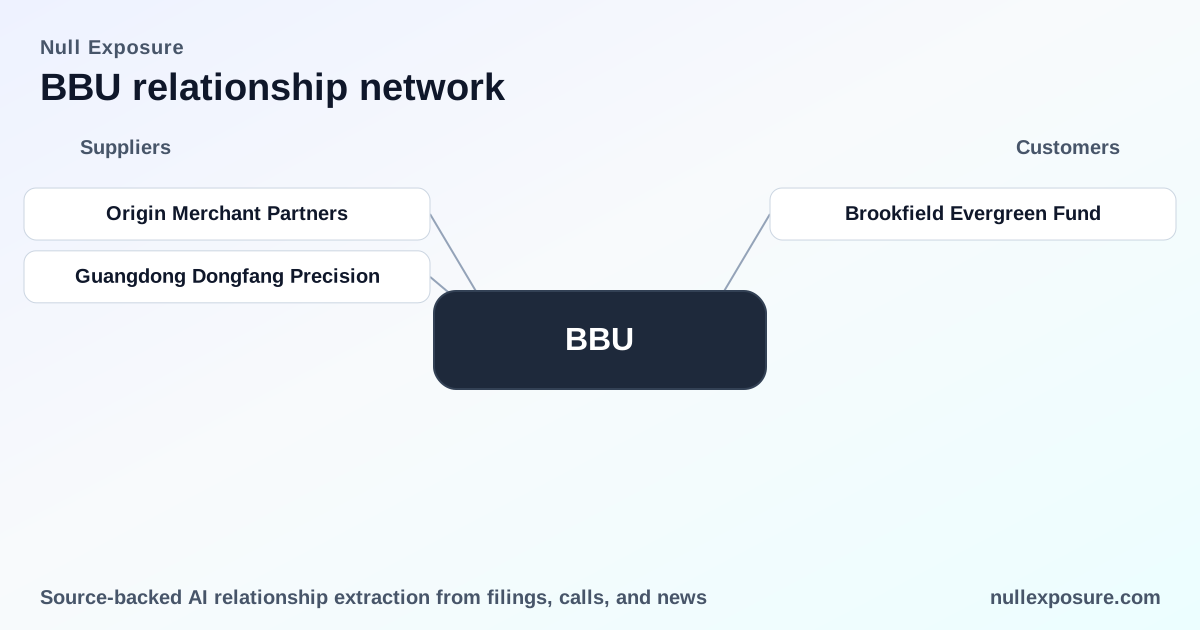
BBU customer relationships: what the Brookfield Evergreen Fund transaction tells investors
Brookfield Business (BBU) monetizes through strategic asset-level transactions and partnership structures that convert operating businesses into liquid or equity-like instruments while retaining economic exposure; the company realizes proceeds by selling partial interests in operating businesses and accepting fund units as consideration, which it values into corporate liquidity. This monetization pattern supports balance-sheet flexibility and capital recycling, and it creates a counterparty layer tied to Brookfield-managed vehicles that is material for credit and valuation analysis. For a closer look at how these customer/partner relationships affect operating posture and capital management, see https://nullexposure.com/.
The short read: a liquidity-driven deal that doubles as a partnership
In its FY2026 commentary BBU disclosed a transaction in which it sold a partial interest in three businesses to a new Brookfield Evergreen Fund and received units in exchange; the fair value of those units contributed to reported pro forma corporate liquidity of approximately $2.6 billion. That structure is a hybrid monetization move: it extracts value from operating assets while maintaining long-term upside via fund units.
Relationship detail — Brookfield Evergreen Fund
Brookfield Evergreen Fund
BBU sold a partial interest in three businesses and received units in the new Brookfield Evergreen Fund as consideration; the fair value of those units is included in BBU’s reported pro forma corporate liquidity of about $2.6 billion in FY2026. According to the BBU earnings call transcript published on The Globe and Mail (March 2026), this transaction underpins the company’s reported liquidity position for the period.
Why the single relationship in this sample matters to investors
- Capital recycling and balance-sheet management are central to BBU’s operating playbook. Receiving fund units rather than straight cash signals a preference for liquidity plus retained economic participation, which supports future upside capture while improving reported near-term liquidity.
- Counterparty alignment with Brookfield-managed funds increases operational cohesion and concentration of exposure. The counterparty here is an affiliated Brookfield vehicle rather than an external strategic buyer, so financial outcomes are linked to intra-group fund economics and governance.
- Valuation provenance matters. The contribution of unit fair value to corporate liquidity requires transparency on valuation assumptions; investors should treat the $2.6 billion pro forma figure as a combined cash-plus-marketable-equity metric rather than pure cash on hand.
What the relationship reveals about BBU’s operating model and contracting posture
BBU’s disclosed transaction is illustrative of several company-level operating-model characteristics:
- Contracting posture — cooperative and JV-oriented. The use of equity units from an evergreen fund as purchase consideration indicates BBU prefers partnership arrangements that preserve upside and align incentives rather than full divestiture.
- Concentration — affinity to Brookfield-managed counterparties. The single relationship recorded here is with a Brookfield vehicle, signaling concentration of strategic transactions within the Brookfield ecosystem rather than broad third-party dispersal.
- Criticality — transactions used as liquidity levers. The transaction’s direct line into pro forma liquidity highlights that such deals are operationally significant — they are not peripheral asset sales but strategic capital-management tools.
- Maturity — corporate-level liquidity management rather than startup-style financing. The structure and outcome (units contributing to pro forma liquidity) are consistent with mature balance-sheet optimization practices used by established asset managers and their operating companies.
These are company-level signals drawn from the disclosed transaction; they are not attributed to any individual constraint because no constraint excerpts were provided.
What investors should monitor next
BBU’s structure and this transaction raise a clear set of follow-on questions for investors and operators evaluating risk and upside:
- Transparency on unit valuation: insist on disclosure of valuation methodology and inputs for the Evergreen Fund units that feed into corporate liquidity.
- Liquidity content breakdown: verify how much of the $2.6 billion is cash versus fair-value units; runway and debt covenants interact very differently with each.
- Governance and exit mechanics: understand the redemption or monetization mechanics of the fund units, including any lock-ups or distribution waterfalls that affect convertible economics.
- Counterparty credit alignment: assess financial and operational ties between BBU and Brookfield Evergreen Fund — intra-group exposures are often quantitatively large but qualitatively different than arms-length counterparties.
For a systematic review of these relationship features across portfolios, visit https://nullexposure.com/.
Quick risk checklist for models and valuation
- Value liquidity as a multi-component figure: separate cash, liquid securities, and fund units.
- Stress-test covenant outcomes assuming limited convertibility of fund units for near-term cash needs.
- Model terminal upside differently for retained unit exposure vs. straight sale proceeds.
Closing: how to position on BBU given the disclosed relationship
The Brookfield Evergreen Fund transaction is evidence of an intentional capital-management strategy: BBU converts minority interests into tradable or mark-to-market holdings inside affiliated funds to shore up reported liquidity while preserving residual upside. For investors, that structure enhances balance-sheet flexibility but introduces valuation and counterparty concentration issues that warrant careful forensic review of unit valuation, liquidity composition, and fund mechanics. Monitor subsequent disclosures for redemption terms, valuation updates, and any incremental third-party partnerships that would diversify counterparty risk.
If you want a concise dossier mapping these relationship dynamics to credit and valuation models, explore the relationship intelligence available at https://nullexposure.com/.