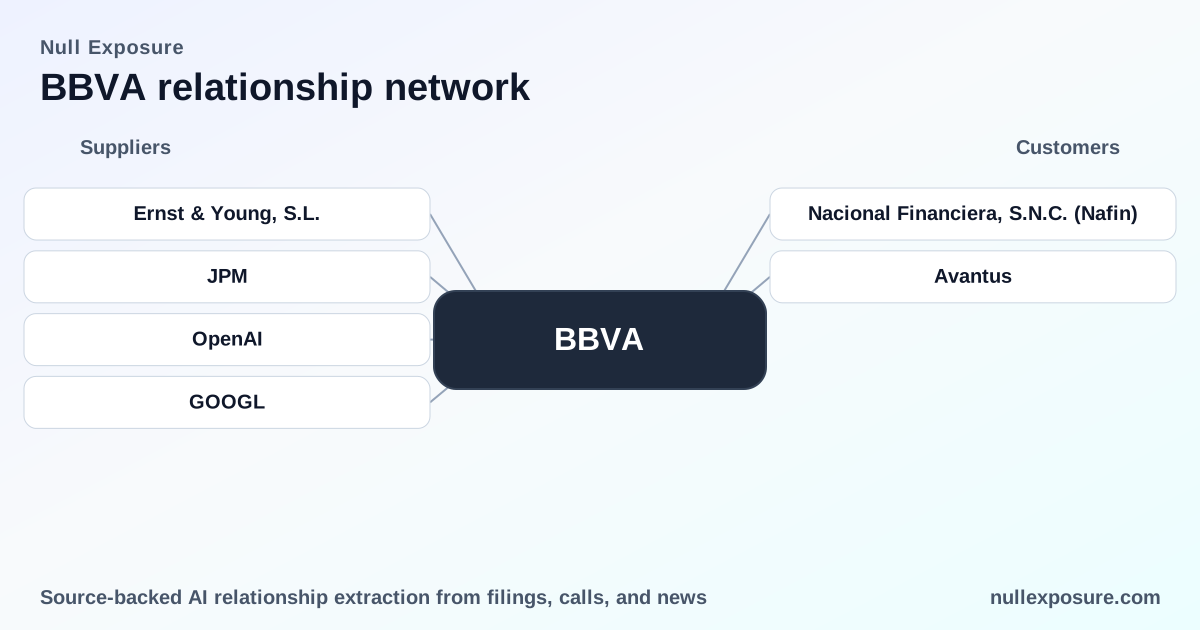
BBVA’s customer relationships: what the bank’s recent lending, underwriting and equity bets tell investors
Banco Bilbao Vizcaya Argentaria (BBVA) operates as a universal bank with large-scale retail and wholesale businesses across Spain, Mexico and parts of Latin America; it monetizes through net interest income from lending, fee income from capital markets and transaction services, and recurring deposit and asset-management flows. Recent public activity shows BBVA executing across syndicated corporate lending, project finance, bond underwriting and selective equity commitments — a diversified customer playbook that drives fee capture and interest spread across geographies. For a deeper read on BBVA relationship intelligence and how it informs counterparty and credit analysis, visit [https://nullexposure.com/].
Executive summary: BBVA’s role ranges from secured lender to arranger and equity investor. The bank’s footprint in 2025–26 transactions demonstrates a balanced mix of recurring capital-markets roles and episodic, higher-profile project and corporate financings. Key takeaway: BBVA is acting both as a backbone lender in syndicated credits and as an active markets intermediary — a configuration that strengthens fee streams while concentrating reputational and balance-sheet risk in large-ticket transactions.
How to read these relationship signals as an investor
BBVA’s mix of roles produces distinct operational characteristics:
- Contracting posture: Predominantly counterparty-facing, with bilateral and syndicated loan contracts and underwriter/placement agreements that produce enforceable, medium-term obligations.
- Concentration: Exposure is diversified by geography and sector but individual large financings (project finance, syndicated loans, or equity placements) create episodic concentration risk on the balance sheet.
- Criticality: For borrowers, BBVA often serves as a critical lender or arranger — these are transactional relationships that directly affect borrower liquidity and capital structure.
- Maturity: Relationships range from standard capital-markets placements (short–medium term) to multi-year project financings and equity holdings (longer-term strategic engagements).
These company-level signals indicate mature relationship management and an emphasis on fee capture plus interest income, without specific contractual constraints disclosed in the available relationship excerpts.
Relationship rundown — individual transactions and citations
Grupo Aeroportuario del Pacífico (PAC) — refinancing of USD 95.5m with BBVA México
PAC refinanced a bank loan that was due by entering a new financing agreement with BBVA México for USD 95.5 million, indicating BBVA’s role as a continuing lender to airport infrastructure borrowers. According to GlobeNewswire reporting on March 20, 2026, PAC executed the refinancing with BBVA México.
PAC — duplicate listing of the same refinancing announcement
The same GlobeNewswire release also appears in the feed as a parallel entry documenting the refinancing of the USD 95.5 million loan with BBVA México, reinforcing BBVA’s repeat creditor role in this corporate client relationship (GlobeNewswire, March 20, 2026).
PAC — Q1 2026 results noting refinancing with BBVA and Scotiabank
PAC’s Q1 2026 results confirm that the company refinanced existing loans with Scotiabank and BBVA for USD 95.5 million each via new financing arrangements, underlining BBVA’s continuing lender position in PAC’s capital structure (GlobeNewswire, April 20, 2026).
Polestar (PSNYW) — $300m equity investment announced with BBVA participation
Polestar disclosed a $300 million equity financing in which BBVA and Natixis committed joint funding that management said materially strengthened liquidity and the balance sheet; this positions BBVA as an active equity investor in distressed or strategic auto/EV opportunities (TS2.tech coverage of the December 19 announcement, cited March 10, 2026).
Polestar (PSNY) — restatement of BBVA’s $300m equity role
Polestar reiterated that BBVA and Natixis lined up a $300 million equity investment as part of a broader recapitalization alongside a Geely debt-to-equity conversion, demonstrating BBVA’s participation in cross-border equity solutions (TS2.tech reporting, May 3, 2026).
Polestar (PSNY) — media recap of the December financing
Independent coverage notes BBVA’s $150 million commitment (half of the $300 million) alongside Natixis, confirming the size of BBVA’s direct equity exposure in the deal (Sahm Capital reporting originally dated December 2025; referenced March 10, 2026).
Polestar (PSNYW) — Schedule 13G filing showing 8.4% ADS position
A Schedule 13G filed December 31 shows BBVA held 7,755,946 Polestar ADSs representing 8.4% of Class A ADSs, signaling a sizable, disclosed equity stake in Polestar’s ADS class (TS2.tech coverage of the 13G filing, March 10, 2026).
Ecopetrol (EC) — participant in $1.25bn syndicated loan (USD 350m tranche)
Ecopetrol secured a debt-management transaction arranged by a consortium where BBVA New York Branch is listed as a lender for USD 350 million, confirming BBVA’s participation in large international sovereign-linked corporate financings (PR Newswire, May 2026).
Ecopetrol (EC) — confirmation of BBVA role in five-year loan consortium
Reporting from Finance Colombia notes BBVA as one of the international lenders in Ecopetrol’s five-year facility, reinforcing BBVA’s underwriting and syndicated lending activity with major oil & gas corporates (Finance Colombia, May 2026).
Nacional Financiera, S.N.C. (Nafin) — BBVA Mexico acted as bookrunner
BBVA Mexico served as bookrunner on Nafin’s successful issuance of development banking bonds (MXN 9,658 billion), illustrating BBVA’s role in Mexican public-sector and development finance underwriting (BBVA corporate release, March 9, 2026).
Coca‑Cola FEMSA (KOF) — BBVA Mexico as arranger for social bond issuance
BBVA México acted as intermediary and structuring agent for Coca‑Cola FEMSA’s sustainable and social certificates issuance (MXN 6 billion), signaling BBVA’s market-making role in sustainability-linked corporate financings (BBVA press release referencing FY2022 issuance).
Avantus — >$300m construction financing for Kitt Solar project
Developer Avantus closed a financing package of more than USD 300 million for the Kitt Solar and storage project with BBVA and CIBC, showing BBVA’s active participation in U.S. project finance for renewables (CityBiz, March 2026).
Avantus — renewable project financing coverage (energy‑storage.news)
Energy‑Storage.News reports the same Avantus financing package with BBVA and CIBC for the 100MWac solar and 400MWh BESS project in Arizona, reiterating BBVA’s role as a project lender for energy transition assets (Energy‑Storage.News, March 2026).
Betterware Mexico (BWMX) — BBVA Bancomer as placement agent on inaugural debt issue
Betterware’s debut debt issuance listed Casa de Bolsa BBVA Bancomer among the placing intermediaries, highlighting BBVA’s participation in Mexican corporate debt raisings (El Financiero coverage of the 2021 transaction, cited March 2026).
Banco Santander Chile (BSAC) — BBVA shareholding line item in foreign issuer report
A foreign issuer filing lists a BBVA line (numbers reported), reflecting cross-shareholdings or reporting of BBVA exposure in Chilean banking filings (StockTitan reporting of the 6‑K filing, March 2026).
Pilgrim’s Pride (PPC) — Mexico Bajio and Mexico BBVA credit facilities
Pilgrim’s Pride entered new credit facilities including a Mexico BBVA Credit Facility to support general corporate and working capital needs, showing BBVA’s presence in corporate treasury lending across meatpacking and food supply chains (TradingView summary of company 10‑K, March 2026).
Jefferies (JEF) — BBVA Securities Inc. listed among co-managers
Jefferies announced a transaction where BBVA Securities Inc. served as a co-manager alongside global banks, illustrating BBVA’s wholesale capital markets syndicate capabilities in U.S. deal syndication (official press release republished on Yahoo Finance, May 2026).
Portfolio risks and investor actionables
BBVA’s client activity demonstrates diversified revenue channels but also episodic concentration in large-ticket financings and equity commitments. For investors, the actionable points are:
- Monitor large equity positions (for example Polestar ADS disclosure) for mark-to-market and governance exposure.
- Track syndicated loan participation (Ecopetrol, PAC, Avantus) for potential credit volatility tied to commodity and project outcomes.
- Watch fee income durability from underwriting and bookrunner roles in Mexico and Latin America.
For ongoing monitoring and sector-level exposure analytics tied to counterparties like these, see [https://nullexposure.com/].
Conclusion: BBVA is executing a hybrid wholesale strategy — steady net-interest income from regional lending plus opportunistic fee and equity activity in international corporate and project financings. The relationships above are consistent with a bank that leverages market distribution and syndication capability to monetise balance-sheet capacity while accepting episodic concentration risk.