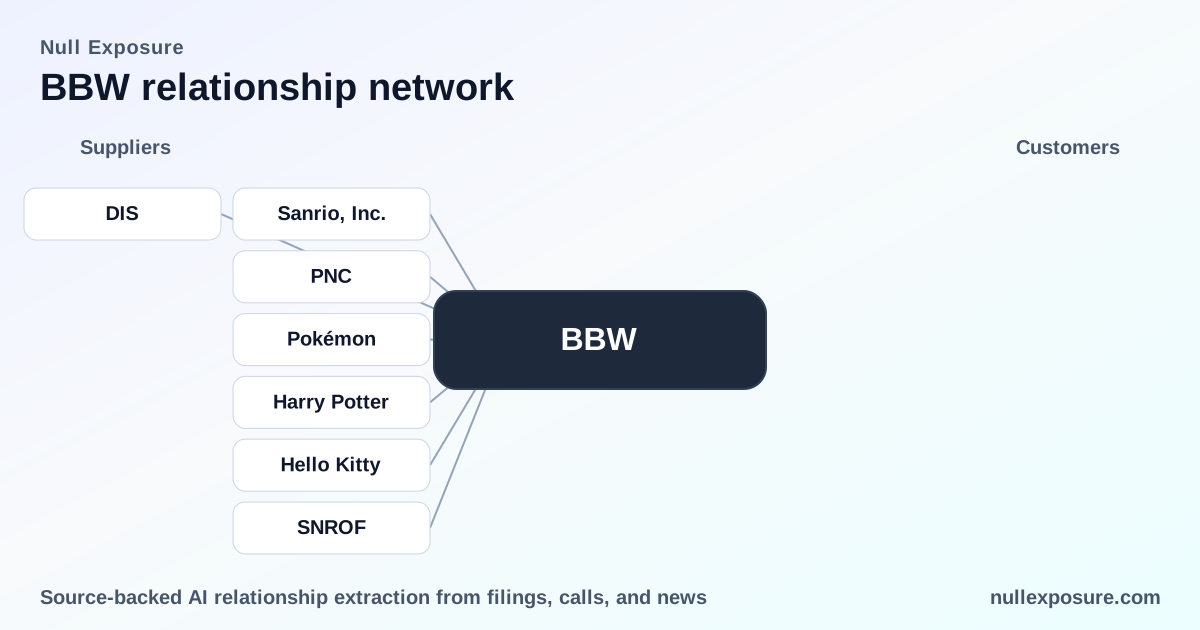
Build-A-Bear (BBW): Wholesale expansion reshapes distribution without ceding the experiential core
Build-A-Bear Workshop monetizes an experiential retail model: proprietary in-store "build" experiences, e-commerce sales, licensing and an emerging wholesale channel. The company generates the bulk of revenue through direct-to-consumer channels while selectively leveraging partners and retailers to scale product reach; the recent Walmart rollout signals a deliberate pivot to broaden distribution and accelerate retail penetration.
If you want a consolidated view of customer relationships and signals, explore https://nullexposure.com/ for primary-source tracking and relationship timelines.
Walmart: a first-ever wholesale debut with measurable scale
Build-A-Bear publicly launched its first-ever wholesale partnership with Walmart in mid-March 2026, a structural step beyond its historical mall- and experience-first distribution strategy. PR Newswire characterized the move as the company’s inaugural wholesale debut, framing the Walmart placement as a strategic runway to reach broad mass-market traffic and convert casual shoppers into brand customers. (PR Newswire, Mar 16, 2026)
Plain-English relationship summary: Build-A-Bear has executed a multimillion-dollar wholesale order that is now appearing in approximately 1,500 Walmart locations across the U.S., representing a material new physical distribution channel beyond the company’s traditional footprint. (InsiderMonkey transcript of BBW Q4 2025 earnings call; PR Newswire Mar 2026; Finviz reporting, May 2026)
Why this matters: Walmart introduces scale and lower customer acquisition cost per unit sold, but it also shifts the company into retail grocery-style distribution where price points, packaging, and logistics requirements differ materially from the in-store experiential sale.
What investors should watch in the Walmart relationship
- Execution on shelf placement and assortment consistency across ~1,500 Walmart doors will determine incremental revenue contribution and inventory turnover.
- Margin mix: wholesale pricing and trade promotion intensity will press gross margins relative to the company’s higher-margin experiential and e-commerce sales.
- Brand control and customer lifecycle: conversion back into owned channels (e.g., reward programs, email capture) will determine long-term customer value uplift from Walmart exposure.
Key takeaway: Walmart provides distribution scale but introduces margin and brand-management trade-offs that require disciplined commercial execution.
Intersource: re-entering Germany via a local partner
Build-A-Bear reentered the German market in Q4 2025 through existing European partner Intersource, opening four stand-alone stores in key German markets to re-establish the brand presence. The company positioned this as a targeted relaunch leveraging a partner with local operating capability. (InsiderMonkey transcript of BBW Q4 2025 earnings call, FY2026)
Plain-English relationship summary: Intersource functions as a partner-operated European gateway that allowed Build-A-Bear to re-open four stores in Germany quickly and with lower direct capital outlay than wholly-owned expansion. (InsiderMonkey Q4 2025 earnings transcript)
Why this matters: The Intersource arrangement preserves the core experiential store model while outsourcing regional execution risk and capital demands, supporting international growth without a large corporate store roll-out.
Company-level constraints and what they indicate about country, counterparty, and channel risk
The relationship-level signals sit within a broader set of company-level constraints that clarify Build-A-Bear’s operating posture:
- Consumer-facing counterparty profile: The company’s primary end-customers are individuals—families, gift buyers, collectors and tweens—indicating revenue sensitivity to discretionary-spend cycles and seasonal demand. This is a company-level signal drawn from corporate disclosures about customer segments.
- Global footprint and FX exposure: Build-A-Bear operates in multiple jurisdictions and currencies, signaling cross-border operational complexity and foreign-exchange considerations for European and other international partnerships.
- Seller posture and channel mix: Build-A-Bear functions predominantly as seller/retailer via corporately-managed locations, partner-operated stores, franchises, and online channels; this is a structural company characteristic rather than relationship-specific commentary.
- Active relationship stage: Reported channels and partners are currently operational and contributing to distribution, consistent with the company’s statement of active corporate, partner, and franchise locations.
- Distribution segment concentration: The company reports that its direct-to-consumer segment accounts for nearly 93% of consolidated revenue, a company-level signal that wholesale expansion is strategically important for diversification but currently a smaller component of overall revenue.
Interpreting these constraints together: Build-A-Bear is fundamentally a consumer-focused seller with high DTC revenue concentration, active partner relationships to accelerate geographic reach, and growing but still nascent wholesale exposure. Investors should treat wholesale rollouts as diversification experiments rather than dominant revenue drivers in the near term.
Investment implications and risk checklist
The Walmart and Intersource relationships collectively create an inflection in distribution strategy that has the following implications:
- Revenue diversification: The Walmart placement accelerates omnichannel distribution and provides incremental SKU velocity that is not reliant on mall foot traffic.
- Margin pressure potential: Wholesale pricing and trade promotion typically compress gross margins versus experiential in-store transactions; investors should monitor gross-profit dynamics and SG&A as the Walmart program scales.
- Execution and operational risk: Rapid rollout to ~1,500 Walmart locations requires supply chain, packaging, and retail operations alignment—execution failures would show up in inventory write-downs or underperforming sales per door.
- Brand dilution risk: Placement in a mass-market retailer increases brand visibility but reduces control over in-store guest experience, potentially affecting long-term brand equity.
- International partner leverage: The Intersource re-entry into Germany demonstrates low-capex market reactivation via local partners, which preserves cash and limits corporate operating exposure.
- Financial context: The company trades at measures consistent with value retail terrain—Market cap roughly $456 million, EV/EBITDA ~6.8, and trailing PE ~9—so operational surprises from new channels will move valuation materially given the modest absolute market capitalization.
Final read: growth with discipline
Build-A-Bear’s shift into Walmart and selective partner-operated international stores represents a measured expansion of distribution that balances scale with capital discipline. The Walmart relationship introduces scale and distribution breadth; Intersource restores European experiential access with limited capital risk. Investors should focus on margin trends, execution KPIs (sell-through, returns, inventory aging), and the company’s ability to convert wholesale reach into repeat customers for its higher-margin direct channels.
For a deeper timeline of customer relationships, primary-source links, and ongoing signal tracking, visit https://nullexposure.com/.