How Bath & Body Works Monetizes Scale: omnichannel retail, brand-first product sales, and expanding wholesale distribution
Bath & Body Works (BBWI) is a branded specialty retailer that generates cash by selling personal-care and home-fragrance products through a large brick-and-mortar footprint and a growing digital business, supplemented by loyalty-driven repeat purchases. The company monetizes through direct retail margins in stores and online, plus incremental wholesale channels that increase reach but carry different economics; FY2026 TTM revenue sits near $7.29 billion with healthy gross profit and operating margins that reflect this multi-channel mix.
If you want a concise commercial view: BBWI is a high-volume consumer goods seller with an omnichannel distribution posture and a newly broadened wholesale presence via Amazon that prioritizes reach over full retail margin capture. For more on how we track customer relationships and distribution implications, visit https://nullexposure.com/.
Why the Amazon tie-up matters for investors
Bath & Body Works’ March 2026 launch into Amazon’s U.S. stores is a strategic distribution move that increases product availability to a large online audience while preserving the company’s core retail identity. According to a GlobeNewswire press release on February 20, 2026, BBWI officially launched in Amazon U.S. stores to expand access to its fragrances and best-selling items. That launch accelerates reach into Amazon’s marketplace audience and should support top-line accessibility during promotional windows.
That said, the company itself clarified the economics: the Amazon relationship is structured as a wholesale arrangement rather than a retail partnership, which means Bath & Body Works records revenue at wholesale pricing rather than full retail sales. Management reiterated this point in the Q4 2025 earnings call transcript published in March 2026, noting the partnership is wholesale and does not equate to realizing full retail margins. Investors should therefore expect distribution gains without a proportional lift to BBWI’s gross-margin profile from those specific units.
How to interpret the trade-off
- Distribution vs. margin: Amazon increases customer touchpoints and volume; wholesale pricing reduces per-unit margin versus BBWI’s owned channels.
- Brand control: Wholesale placement on Amazon boosts discovery but requires careful assortment and brand presentation management to avoid dilution.
- Inventory and logistics: Wholesale relationships generally shift some fulfillment risk to the retailer, affecting working capital dynamics differently than direct channels.
All reported customer relationships in the feed
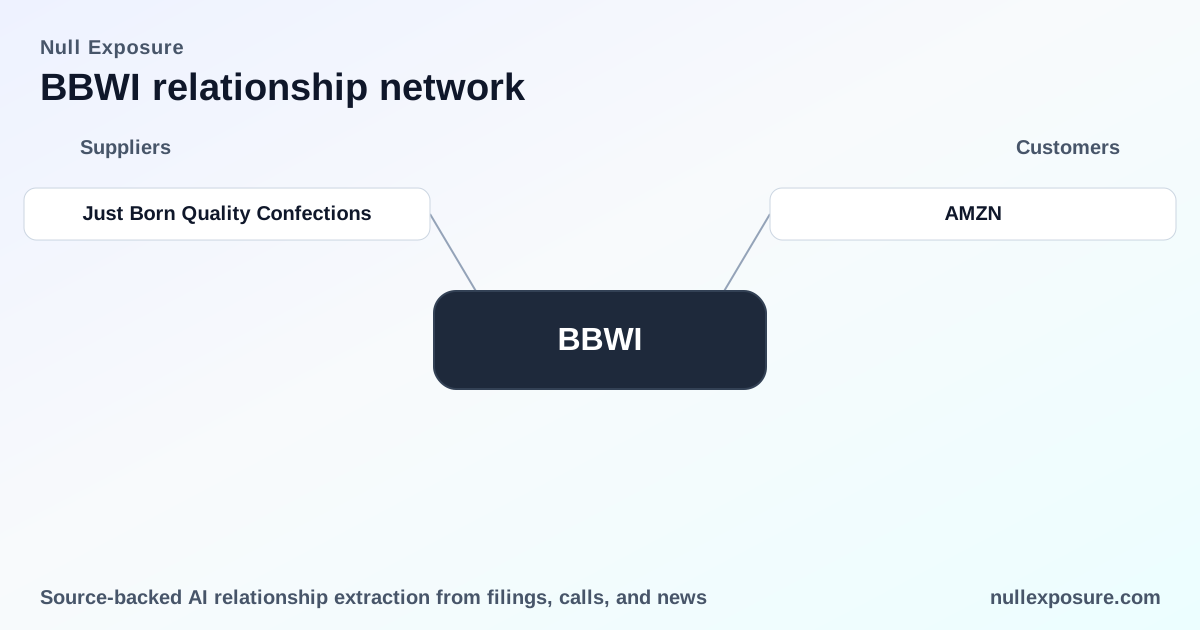
- Amazon (AMZN): Bath & Body Works launched in Amazon’s U.S. stores in early March 2026 to broaden consumer access to its fragrances and high-demand products; the company explicitly characterized the relationship as a wholesale model where BBWI does not record full retail sales. Source: GlobeNewswire press release, Feb 20, 2026; Q4 2025 earnings call transcript (InsiderMonkey), March 2026.
(Every customer mention surfaced in the results points to Amazon/AMZN — the coverage set is duplicated across multiple outlets including Finviz, Proactive Investors, Intellectia.ai, and additional GlobeNewswire feeds, all reporting on the same Amazon launch and the company’s comments around it.)
Business-model constraints that shape customer economics
The relationship signals and company disclosures in our feed imply several company-level operational characteristics:
- Contracting posture (spot): BBWI recognizes sales when merchandise is received by the customer, which supports a spot-sale recognition pattern for direct channels and normal retail cash flow dynamics rather than long-term contractual revenue recognition. This is a company-level signal drawn from its revenue recognition description and influences cash flow timing and margin realization.
- Counterparty type (individual): The primary buyer cohort is individual consumers, reinforced by BBWI’s loyalty program that converts purchase activity into rewards redeemable in-store or online; this model drives repeat purchase economics and promotional cadence.
- Geography (North America): The firm’s retail and digital penetration is concentrated in the U.S. and Canada, consistent with the company’s store base and its initial Amazon rollout limited to U.S. stores.
- Relationship role (seller): BBWI operates as the seller of branded personal- and home-care products across owned and partner channels, with direct control of merchandising, marketing identity, and pricing in its core channels.
- Segment (core product): The business is focused on its core product lines—body care, bath products, home fragrance and related categories—which support brand loyalty and SKU-level promotional strategies.
Collectively, these constraints highlight a mature, retail-oriented operating model where scale-driven margins and brand equity are central, and wholesale partnerships function as tactical distribution expansions rather than structural shifts in the business model.
Investment implications and risk factors
- Positive: reach without incremental store cost. Amazon provides accelerated distribution and incremental customer acquisition at lower marginal cost than opening new stores; this supports revenue growth and can optimize inventory turnover.
- Caution: margin dilution where sales are wholesale. Because Amazon is a wholesale channel for BBWI, the company will realize lower per-unit revenue on products sold through that channel versus owned retail or direct-to-consumer online sales—this is a clear trade-off called out by management in Q4 commentary.
- Brand stewardship is essential. Maintaining premium perception on a mass platform requires tightly controlled assortments, packaging, and pricing cadence; failure to do so risks commoditization.
- Operational maturity and scale cushions execution risk. With ~1,900 U.S. and Canada stores, a robust e-commerce platform, and ~ $7.29B TTM revenue, BBWI has the scale to absorb channel experiments while protecting core retail economics.
Bottom line: distribution growth with disciplined margin management
Bath & Body Works is enlarging its distribution footprint by placing product in Amazon’s U.S. stores, a move that increases customer access but does not directly translate to full retail revenue recognition because the agreement is wholesale. Investors evaluating BBWI should treat Amazon as a volume and discovery play that complements — rather than replaces — BBWI’s high-margin owned channels. The key watch items are the pace of wholesale volume, the company’s ability to preserve brand control on third-party platforms, and any directional change in channel mix that would affect aggregate margin.
For ongoing coverage and relationship-tracking intelligence on BBWI and other branded retailers, see our research hub at https://nullexposure.com/.