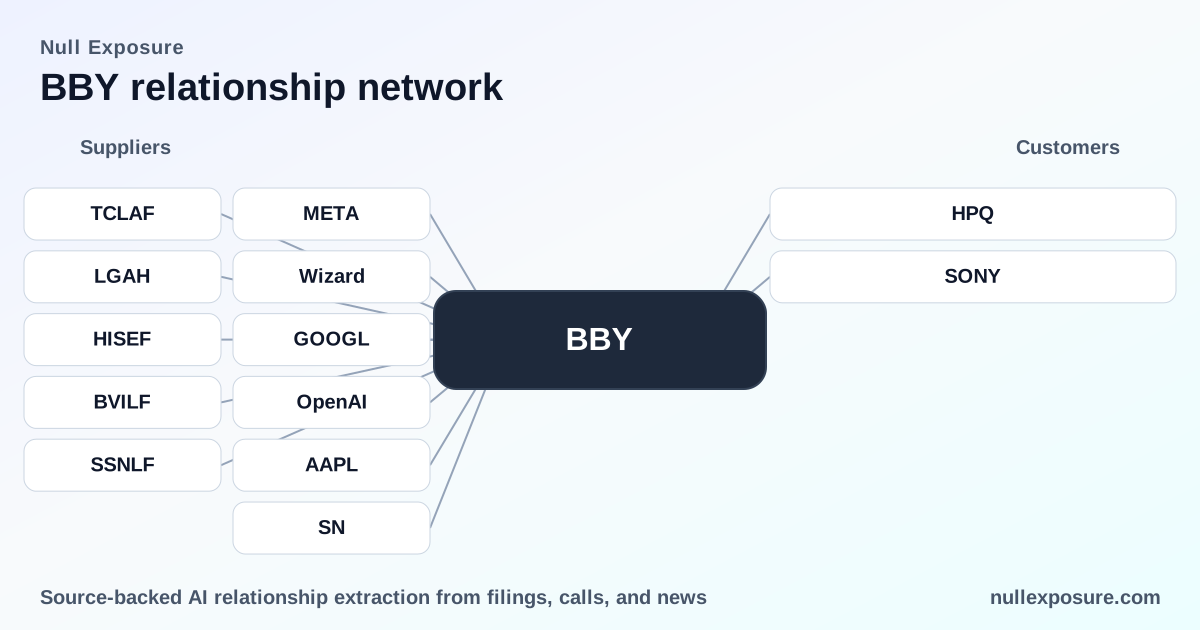
Best Buy (BBY): Customer Relationships and Where Revenue Really Comes From
Best Buy operates as a multi-channel consumer electronics retailer that monetizes through product sales, an expanding services franchise (installation, repair, warranties, memberships) and a growing point-of-purchase media business that sells targeted advertising to device brands. The company’s operating model pairs high-volume hardware turnover with a services layer—Geek Squad and home-install programs—that lifts margins and creates recurring revenue streams; concurrently its proprietary in-store and online shopper signals enable a profitable media network sold to major vendors. Investors should value Best Buy as a hybrid retailer-services-platform, with margin upside concentrated in services and advertising while core retail remains cyclical and inventory-driven.
If you want a compact map of these relationships and what they imply for BBY’s revenue mix and risk profile, see the section below or visit https://nullexposure.com/ for ongoing coverage.
What the relationship map says about Best Buy’s operating model
Best Buy’s customer and partner relationships reveal four company-level operating signals:
- Geographic focus is North America. Best Buy runs operations in the U.S. and Canada, which concentrates market exposure to North American consumer trends and regulatory environments (company disclosures, 2026 fiscal materials).
- Primary role is seller-retailer with services attached. Corporate messaging emphasizes product sales and sustainability through the products sold, reflecting a classic seller posture augmented by service offerings.
- Services are a material business segment. Public disclosures list delivery, installation, memberships, repair, set-up, technical support and warranty services as discrete lines of business, indicating service-driven margin expansion and recurring revenue.
- Contracting posture: relationships with brands for advertising are commercial and scalable; service integrations with homebuilders are project- and program-based, representing a mixture of transactional and recurring engagements. This posture implies medium-term revenue stickiness from services and advertising, alongside short-term retail volatility.
These characteristics together form Best Buy’s operating playbook: drive hardware distribution to capture installed bases, upsell services at point of purchase, and monetize shopper attention through a retail media network.
Relationship snapshots — what investors need to know
HP (HPQ)
Best Buy’s retail media network and in-store targeting allow HP to reach shoppers at the moment of purchase, effectively turning Best Buy locations into performance advertising venues for PC and peripheral demand generation. A Finterra piece syndicated on FinancialContent (March 2026) highlights Best Buy’s proprietary traffic data and how brands like HP use it to target point-of-sale shoppers.
Sony (SONY) — brand advertising partner
Sony is cited alongside HP as a major brand leveraging Best Buy’s media network to influence purchase decisions in-store and online, underlining Best Buy’s role as not just a reseller but also a channel marketer for supplier partners. The same FinancialContent article (March 2026) references Sony by name when describing Best Buy’s media capabilities.
SONY (duplicate mention)
Sony receives a second explicit mention in the FinancialContent coverage, reinforcing that multiple vendor partners are using Best Buy’s shopper data and advertising inventory as part of their go-to-market mix (FinancialContent, March 2026).
Landsea Homes (LSEA) — smart-home installation and activation partner
Multiple press releases from Landsea Homes and third-party coverage document that new-home projects integrate Best Buy’s Geek Squad services for smart-home activation, white-glove setup and resident training sessions—covering Apple Home integrations, HomePod mini provisioning, smart locks, thermostats and video doorbells. PR Newswire announcements and regional reporting (PR Newswire and CityBiz/StreetInsider, 2024–2026) describe developer rollouts in California, Texas, Arizona and Colorado that include Best Buy-managed smart-home activation as a built-in homeowner service.
WH (Wyndham/Bilt Rewards context)
A Bilt Rewards newsroom release (May 2026) lists Best Buy among brands for which rewards points can be redeemed via gift card options, indicating Best Buy’s participation in third-party loyalty and gift-card ecosystems that expand customer acquisition channels and deepen transactional touchpoints with loyalty program members.
Strategic implications for investors
- Revenue mix shift toward services and media. The vendor advertising relationships (HP, Sony) are evidence of a profitable, high-margin media channel layered on top of retail sales. Services contracts with homebuilders (Landsea Homes) demonstrate an adjacent, higher-margin revenue stream driven by installation and recurring support.
- Concentration and criticality. Best Buy’s business retains concentration in North America and dependence on major consumer-electronics vendors for category flow and advertising spend. This structure elevates exposure to cyclical consumer demand in the U.S. and Canada while granting leverage to negotiate ad and shelf economics with large brands.
- Contracting posture and maturity. Advertising agreements are commercial and scalable; homebuilder integrations reflect program-level maturity—repeatable but project-tied—pointing to moderate maturity with room for standardization and margin capture as Best Buy formalizes more builder or developer partnerships.
- Operational resilience through service-led margins. Installation, membership and repair services shift revenue from one-time product sales to higher-margin engagement, cushioning EBITDA during hardware downturns; this drives the valuation case that Best Buy’s services and media can widen reported operating margins versus pure retail peers.
Key risk considerations: dependence on consumer electronics cycles, advertising spend tied to brand product cycles (e.g., PC refresh driven by AI-driven upgrades), and geographic concentration in North America. Key upside: scalable retail media margins and expanding service penetration into new verticals (homebuilders, loyalty partnerships).
If you want ongoing, structured analysis of Best Buy’s partner economics and how vendor advertising and service deals influence valuation, explore our coverage at https://nullexposure.com/.
Bottom line
Best Buy has evolved beyond a straightforward electronics retailer into a composite business: high-frequency retail flows, a durable services franchise, and a monetizable media layer that sells customer attention back to brands. The relationship map—HP and Sony as advertisers, Landsea Homes as a services integrator, and participation in loyalty/gift ecosystems—illustrates a diversified revenue base that supports margin expansion even as product sales remain cyclical. For investors, the critical lens is how management converts these relationships into predictable, high-margin revenue streams and how concentration in North America and vendor-dependent advertising cycles will influence forward earnings.