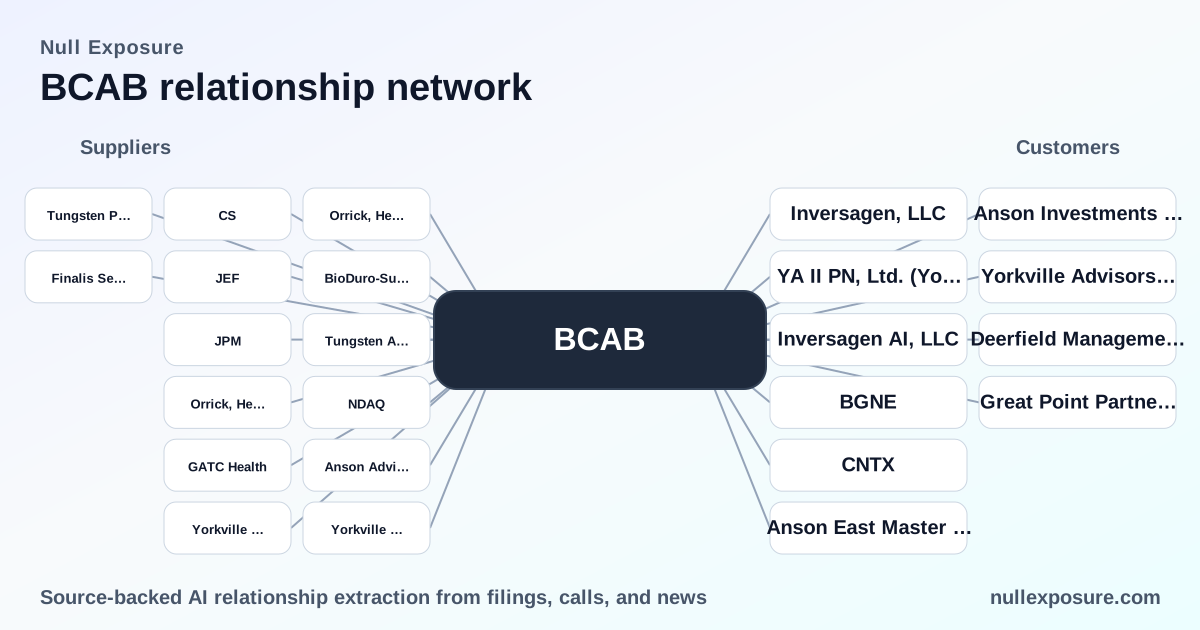
BioAtla (BCAB) — Customer and Partner Map for Investors
BioAtla monetizes its CAB antibody platform by out‑licensing assets and collecting upfronts, milestones and royalties while supplementing cash flow with flexible financing arrangements; the company acts primarily as a licensor and asset originator rather than a late‑stage developer or commercial operator. Revenue drivers are licensing fees and milestone receipts, with financing lines and pre‑paid advances used to bridge development funding needs. For an operator or investor evaluating BioAtla’s customer/partner footprint, the company’s contracts determine near‑term liquidity and the upside left on pipeline programs.
If you want a concise partner map for diligence, start with how BioAtla structures deals (upfront + milestones + royalties) and how it uses contingent financings to manage runway — this article walks through every external relationship surfaced in filings and press coverage. For more background work and follow‑up, see NullExposure’s research hub: https://nullexposure.com/.
How BioAtla’s commercial model shapes investor returns
BioAtla’s business model is asset‑light and partnership‑heavy: it develops platform candidates to a point of value inflection and then licenses programs to third parties that assume global development and commercialization risk. That posture drives three practical implications for investors:
- Concentration of operational risk offloaded to partners — BioAtla’s economics depend on counterparties advancing programs and hitting milestones rather than on BioAtla executing large, costly phase 3 programs itself.
- Revenue lumpy and milestone‑driven — collaboration revenue will be volatile and tied to partner advances and one‑time payments.
- Liquidity supplemented by investor financing — the company uses pre‑paid advances and standby purchase agreements to extend runway rather than broad equity raises.
These characteristics explain why licensing income and contingent payments are critical to valuation; they also explain why financing counterparties and institutional investors are functionally as important as commercial licensees to near‑term survival.
What the constraints tell us about posture and contract structure
Company‑level signals extracted from filings and press releases show BioAtla is a frequent licensor on global licenses, with explicit evidence naming multiple license agreements. The constraints indicate:
- Contract type: licensing — BioAtla grants exclusive worldwide licenses on select CAB antibodies (evidence explicitly cites the Context license).
- Geography: global — at least some licenses (notably the Context license) are exclusive and worldwide.
- Relationship role: licensor — filings reference multiple exclusive license agreements (examples named in disclosures include BioAtla Holdings, Inversagen, Himalaya Therapeutics and Context).
These are company‑level signals: BioAtla consistently structures deals where it retains royalty upside while transferring development/commercial obligations to partners.
The partner ledger — each external relationship summarized
Below are every partner or counterparty surfaced in the sources provided, with a one‑to‑two sentence investor‑oriented summary and the source.
Inversagen, LLC
BioAtla granted Inversagen an exclusive license in 2019 for CAB‑antibodies addressing inflammatory diseases associated with aging and senescence in exchange for low‑single‑digit royalties, positioning BioAtla to collect passive royalty income while Inversagen takes disease‑area development risk; this was disclosed in a company release (GlobeNewswire, FY2025).
Inversagen AI, LLC
BioAtla agreed, subject to investor financings, to sell common units of an SPV (BA 3021 SPV LLC) to Inversagen AI in a private placement targeting $40 million over multiple closings, a financing‑linked transaction intended to advance specified programs (StockTitan republishing of an 8‑K, FY2026).
BGNE (BeiGene) — early CTLA‑4 agreement (BGNE)
BeiGene in‑licensed a conditionally activated CTLA‑4 inhibitor from BioAtla in a reported $269 million deal originally announced in 2019, representing a material early validation of the CAB platform’s value to large oncology partners (NAI500 blog reporting, FY2019).
BeiGene, Ltd. — amended terms on BA3071
Under an amendment reported in FY2020 BeiGene obtained an exclusive global license to BA3071, taking responsibility for global clinical development and commercialization while BioAtla retained royalty economics on future sales; the change underscores BioAtla’s strategy of outsourcing late‑stage execution (StockTitan news republishing, FY2020).
YA II PN, Ltd. (Yorkville)
BioAtla entered a Standby Equity Purchase Agreement (SEPA) with Yorkville giving BioAtla the right to sell up to $15.0 million of common stock over 36 months, subject to customary conditions, as disclosed in the company’s 8‑K (StockTitan republishing of 8‑K, FY2026).
Yorkville Advisors Global
Earlier financing disclosure shows a commitment to purchase, at company option, up to $15 million of common stock at a discount over three years under a standby facility described in a company release (GlobeNewswire press release announcing flexible financing, FY2025).
Context Therapeutics (CNTX)
BioAtla out‑licensed BA3362 (dual CAB‑Nectin4 x CAB‑CD3 TCE) to Context under an exclusive, worldwide license that provides BioAtla with upfronts, milestones and royalties and carries upside of up to $133.5 million plus royalties; Context triggered a $2.0 million milestone in October 2025 and BioAtla reported collaboration revenue tied to Context in FY2025/FY2026 (GlobeNewswire releases and InvestingNews / company financial results, FY2025–FY2026). This license is explicitly cited in constraint evidence as a global licensing arrangement.
CNTX (tickered reference)
Multiple filings and press reports refer to Context Therapeutics by its ticker (CNTX) when describing the BA3362 deal, including disclosures of milestone payments and license economics that materially affect BioAtla’s reported collaboration revenue (QuiverQuant and StockTitan republishings, FY2026).
Anson East Master Fund LP
As part of a set of pre‑paid advance agreements disclosed in an 8‑K, Anson East Master Fund LP agreed to advance funds to BioAtla under a PPA arrangement, providing short‑term non‑dilutive (but conditional) capital to the company (StockTitan republishing of 8‑K, FY2026).
Anson Investments Master Fund LP
Anson Investments Master Fund LP is likewise a party to the Pre‑Paid Advance Agreements that collectively provided BioAtla with a $7.5 million advance, reflecting the company’s use of structured advance financings to manage cash flow (StockTitan republishing of 8‑K, FY2026).
Deerfield Management Company
Deerfield Management Company is listed among institutional investors participating in BioAtla’s financing activities, signaling institutional support in the company’s structured financings (StockTitan news page, FY2026).
Great Point Partners
Great Point Partners is named alongside Deerfield as an institutional participant in funding activities disclosed around the 2025–2026 financings, indicating a syndicate of healthcare‑focused investors backing capital solutions (StockTitan news page, FY2026).
Investor implications — what to watch next
- Catalyst timing is partner‑driven. Valuation inflection points occur when licensees hit development milestones or trigger payments; monitor partner trial progress and milestone notices.
- Liquidity is hybrid. BioAtla supplements receipts with standby equity and pre‑paid advances; these arrangements alleviate short‑term dilution risk but concentrate counterparty exposure to a small set of specialized investors.
- Retained upside vs. execution risk. BioAtla preserves royalty upside but cedes control of late‑stage development to partners; the value realization depends on partner execution and commercial success, not BioAtla’s balance sheet.
Conclusion and next steps
BioAtla is structured as a licensor and asset originator: its balance of licensing receipts, milestone volatility, and financing counterparties defines near‑term survivability and long‑term upside. For an investor or operator conducting further diligence, focus on partner development timelines (Context, BeiGene), scheduled milestone windows, and the maturity/conditions of the Yorkville/Anson financing facilities. For more partner maps and transaction analytics on small‑cap biotechs, visit NullExposure’s research center: https://nullexposure.com/.