BCAL (Southern California Bancorp): Servicing-led community bank with a hybrid revenue mix
Southern California Bancorp (NASDAQ: BCAL) operates a regional commercial bank that monetizes through interest margin, loan sales, and retained servicing fees, combining recurring servicing income with episodic gains and losses from secondary-market loan activity. The bank’s business model centers on relationship banking in Southern California—14 branches, a mix of retail and commercial customers, and an expanding portfolio of loans serviced for others that provides predictable fee income alongside traditional lending revenue. For further context and monitoring tools visit https://nullexposure.com/.
How BCAL makes money and what moves the P&L
BCAL runs a hybrid operating model. Core interest income from commercial and consumer lending remains the foundation, but two non-interest drivers are material and shape investor returns:
- Servicing income: The bank retains servicing rights on many loans it originates; servicing fees are contractually stated between 0.25% and 1.00% over the life of those loans, creating a recurring revenue stream that scales as serviced balances grow. This is reported in the company’s December 31, 2024 filings.
- Sales and trading of loans: BCAL actively sells originated loans—most notably SBA 7(a) loans—and recognizes spot gains and losses when these sales occur; SBA 7(a) sales in 2024 totaled $6.3 million with gains on sale of $415 thousand, while certain C&I loan sales produced losses in the same period. These items introduce volatility to reported income.
The combination of recurring servicing fees and periodic sale gains/losses defines BCAL’s monetization profile: part subscription-like recurring fees and part transactional earnings.
What the relationships dataset reveals about strategy and posture
Company-level signals drawn from recent filings and disclosures present a clear operating posture:
- Contracting posture is mixed: BCAL records long-term contracts through retained servicing agreements (0.25%–1.00% servicing fees) and also executes spot sales of loan assets (SBA 7(a) sales and occasional C&I sales). Both revenue types are material to earnings.
- Counterparty diversification emphasizes local economy: The bank’s customer base is concentrated on individuals, small and mid-market businesses within California—consistent with a community/regional commercial bank targeting Southern California.
- Geographic concentration is regional: Operations are anchored in California across 14 branches; filings characterize the bank as serving the state, which concentrates economic exposure to local market cycles.
- Role breadth increases optionality: BCAL acts both as seller (selling loan assets into the secondary market) and as a service provider (servicing loans for others). Servicing for third parties rose from $58.8 million at year-end 2023 to $138.0 million at year-end 2024, placing serviced balances in the $100m+ band and creating a scalable fee base.
- Maturity and activity: Relationships are active, with large and growing commitments to extend credit ($925,076 disclosed as contractual commitments) and a growing serviced-loan book—signals of a bank in execution phase rather than run-off.
Relationship coverage — Friendly Hills Bank
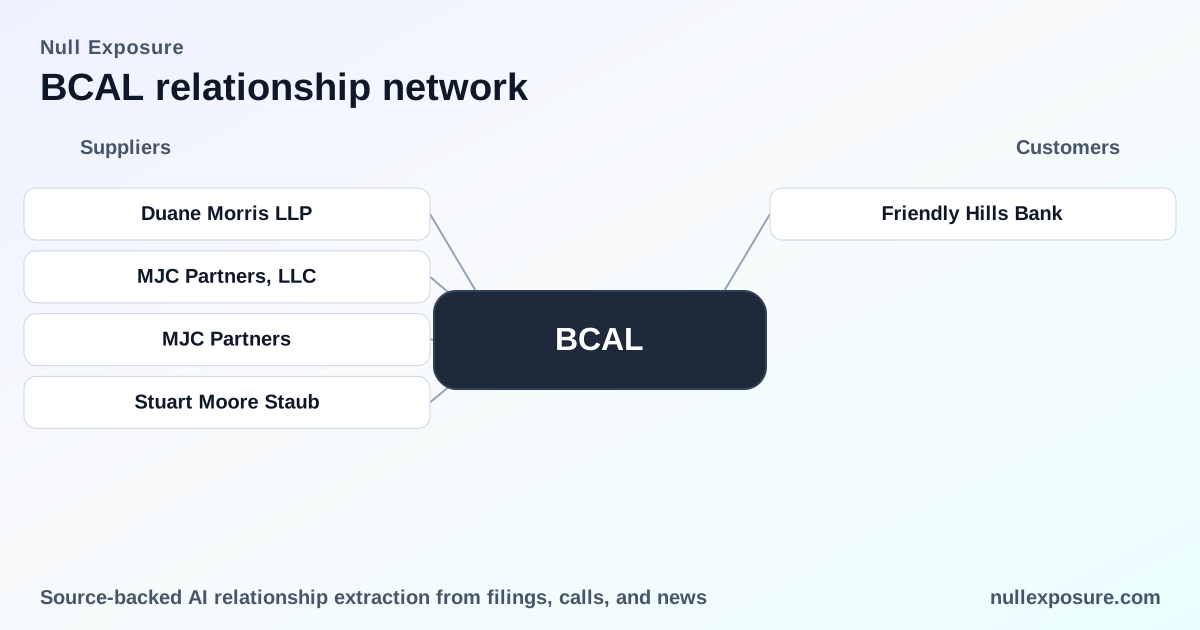
Friendly Hills Bank: BCAL sold three branch sites as part of a reshaping of branch footprint, transferring physical locations to Friendly Hills Bank during management’s post-acquisition optimization. This transaction was reported in a Banking Exchange item on March 9, 2026. (BankingExchange, March 9, 2026 — "California bank CEO returns after legal settlement".)
How these relationships and constraints translate to investor-facing risks and levers
BCAL’s commercial profile creates a set of actionable investment themes:
- Recurring fee runway is a core valuation lever. The jump in loans serviced for others to $138.0 million at December 31, 2024 implies meaningful, stable servicing cash flow that supports valuation multiples and reduces earnings cyclicality relative to pure spread banking.
- Transactional volatility will persist. The bank’s practice of selling SBA loans (SBA 7(a) sales of $6.3 million in 2024 with gains) and sizable C&I sales (net carrying value sold $77.6 million with losses in 2024) makes quarterly earnings sensitive to sale timing and loan-credit outcomes.
- Regional concentration magnifies local macro risk. Heavy exposure to Southern California commercial and consumer activity makes BCAL sensitive to regional economic cycles and real estate dynamics.
- Public-sector funding link. Participation in a state public deposits program indicates exposure to government counterparties and potential benefits from non-FDIC-covered deposits—both a source of stable funding and a governance consideration.
- Scale and execution optionality. The bank’s active role as both seller and servicer, plus a compact branch network, allows management to reprice or reshape the footprint (evidenced by branch site sales to Friendly Hills Bank) to improve returns on capital.
Practical implications for investors and operators
For investors assessing BCAL as an operating bank investment:
- Focus on the growth trajectory of serviced loans and realized servicing fees, since these provide recurring cash flow that improves multiple expansion prospects.
- Monitor loan sale cadence and credit performance as these will drive headline quarterly variations in net income.
- Evaluate regional economic indicators for Southern California—CRE occupancy, small-business lending trends, and public-deposit flows—to anticipate funding stress or opportunity.
- Watch management’s execution on branch rationalization and portfolio composition: sales like the Friendly Hills Bank transaction are direct levers to lower fixed costs and redeploy capital.
Conclusion and next steps
BCAL is a relationship-driven regional bank evolving into a servicing-focused hybrid model: recurring servicing fees reduce earnings cyclicality while spot loan sales create return-enhancing (and volatile) events. Investors should value the business on a blend of stable fee economics and episodic transactional outcomes, with attention to regional macro and credit trends.
For ongoing tracking of BCAL’s customer and servicing relationships, and to receive structured updates, visit https://nullexposure.com/.