BCAT — Who Holds the Trust, How it Earns, and what small-holder moves tell investors
BlackRock Capital Allocation Trust (BCAT) is a BlackRock-managed closed-end/term investment vehicle that earns and monetizes value through active capital allocation and management fees, while shareholders capture returns via market price and NAV appreciation. The trust concentrates on a blended exposure to equities and fixed income and is priced and traded on the NYSE; revenue to the manager is fee-based and the investment thesis for shareholders is income plus capital appreciation driven by BlackRock’s allocation decisions. For deeper positioning and ongoing monitoring, see our coverage at https://nullexposure.com/.
How BCAT operates in plain terms
BCAT functions as a manager-driven investment trust: BlackRock allocates the trust’s capital across asset classes, and the vehicle’s market value is set by investor demand on the exchange. Key operating signals at the company level:
- Scale and market position: Market capitalization ~ $1.6 billion indicates a mid-cap closed-end trust with institutional visibility.
- Ownership concentration: Institutional ownership is moderate at ~19.9%, implying a broad retail/institutional mix rather than domination by a small number of strategic holders.
- Pricing signals: Trailing P/E is 7.17 and Price/Book near 1.0, showing valuation that discounts earnings relative to peers and suggests yield-seeking demand.
- Maturity and management: As a BlackRock-managed vehicle, BCAT benefits from an established investment infrastructure and distribution reach.
- There are no relationship-specific contractual constraints reported in the sourced customer signals, which functions as a company-level signal of conventional fund structure and absence of identified vendor or counterparty concentration in the provided feed.
These characteristics translate into an operating posture where contracting is standard fund-services relationships, concentration risk is moderate, criticality of any single external counterparty is low based on available signals, and the trust’s maturity is high given its BlackRock sponsorship and public listing.
Five small but visible holders — what the recent moves mean
Below are the investor-level moves captured in the news feed. Each entry is a succinct, plain-English summary with the immediate source.
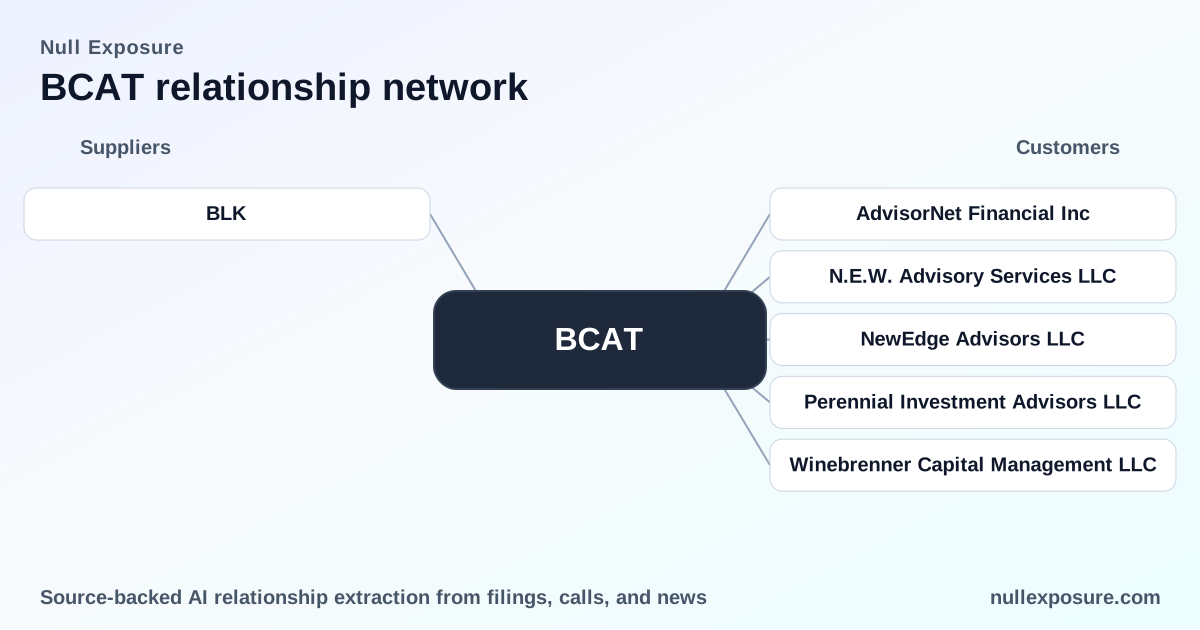
AdvisorNet Financial Inc
AdvisorNet Financial increased its BCAT stake to 2,995 shares, an addition of 1,048 shares during the most recent quarter, valued at roughly $44,000 in FY2026. According to a MarketBeat instant alert published March 9, 2026, this is a small incremental buy likely consistent with retail/advisory client positioning.
N.E.W. Advisory Services LLC
N.E.W. Advisory Services reported owning 2,400 shares after purchasing 1,200 shares during the period, representing about $34,000 of exposure in FY2026. MarketBeat’s March 9, 2026 instant alert recorded the transaction and highlights modest advisory-level accumulation.
NewEdge Advisors LLC
NewEdge Advisors added 724 shares and now holds 16,100 shares of BCAT, totaling approximately $238,000 in FY2026. The March 9, 2026 MarketBeat note shows this is a larger position relative to the other advisory buys, suggesting NewEdge treats BCAT as a tactical allocation in some client accounts.
Perennial Investment Advisors LLC
Perennial Investment Advisors increased its ownership to 54,867 shares, up by 1,211 shares during the period, valued at roughly $811,000 in FY2026. The March 9, 2026 MarketBeat alert reports this as the biggest single incremental position among the observed advisors, indicating a materially larger advisor-level commitment.
Winebrenner Capital Management LLC
Winebrenner Capital Management now owns 46,000 shares after acquiring 1,000 additional shares, with exposure around $680,000 in FY2026. MarketBeat’s March 9, 2026 coverage records the holding and suggests a steady, mid-sized advisory stake.
What these relationship signals imply for BCAT’s investor profile
The moves cataloged are small, incremental buys by advisory firms and regional managers rather than strategic stakes by large institutional owners. Two practical implications for investors:
- Risk profile remains diversified: These holder changes are modest relative to BCAT’s market cap and shares outstanding, reinforcing that the trust’s liquidity and market behavior are governed by many small-to-medium holders rather than a handful of controlling investors.
- Tactical inflows, not structural shifts: The pattern of modest purchases across multiple advisory firms is consistent with yield or allocation adjustments in client portfolios, not with activist or strategic repositioning.
Key takeaways and risk factors
- BCAT’s operational backbone is BlackRock’s management capability, which reduces execution risk associated with active allocation decisions.
- Holder concentration is moderate; institutional ownership under 20% suggests broad investor distribution and typical retail-advisor participation.
- Observed relationship moves are small-scale and do not represent concentration risk or counterparties that are critical to BCAT’s operations.
- Valuation metrics indicate yield orientation — trailing P/E of 7.17 and Price/Book near parity — a signal for income-oriented investors that valuation is not premium.
- Absence of reported relationship constraints in the feed is a company-level signal that no contractually critical customer relationships were flagged in this coverage window.
For institutional monitoring or competitive intelligence teams that need systematically updated visibility on BCAT’s holder dynamics and relationship signals, our portal provides continuous tracking and context-driven alerts — learn more at https://nullexposure.com/.
Bottom line for investors and operators
BCAT is a BlackRock-sponsored allocation trust that profits through management and allocation execution; the recent disclosures reflect small, distributed advisory-level buying rather than concentrated strategic stakes. That pattern supports a view of BCAT as a broadly held, manager-centric vehicle where market price swings and yield-seeking flows drive liquidity and performance more than any single customer relationship.
If you require a tailored brief on how these holder trends intersect with liquidity, distributions, or proxy considerations, our team can deliver a concise investor memo on demand.