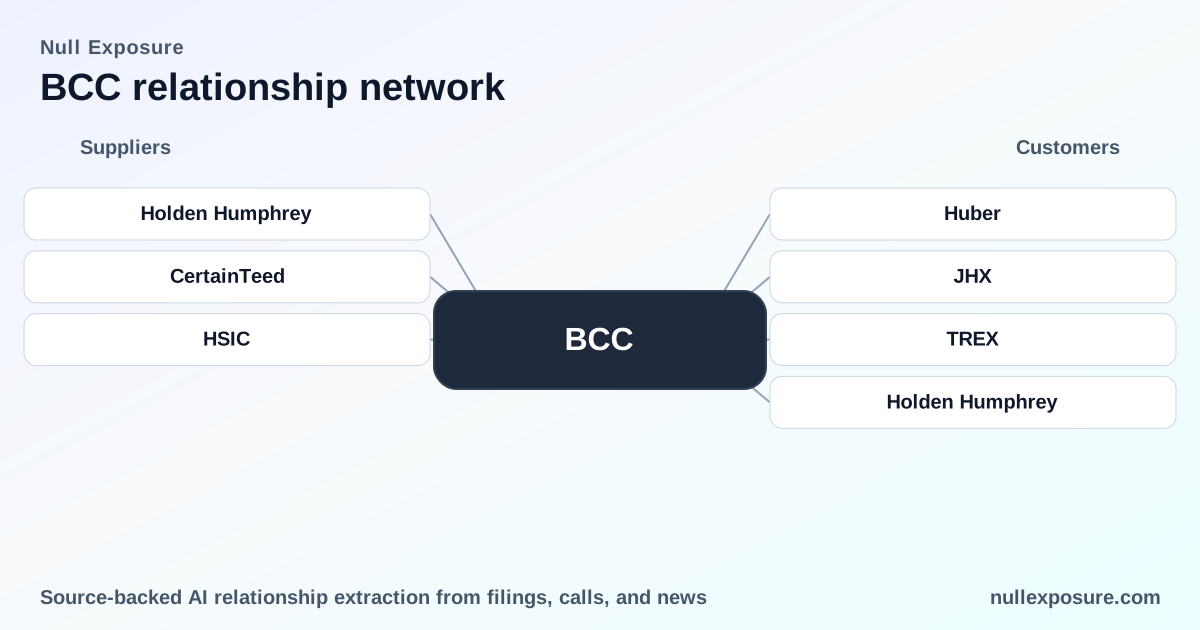
Boise Cascade (BCC) — customer map and revenue implications
Boise Cascade manufactures engineered wood products (EWP) and operates a nationwide building materials distribution network; it monetizes through manufacturing margin on EWP and wholesale distribution throughput across its Building Materials Distribution (BMD) segment. Revenue is driven by a dual model: stable, higher-volume distribution flows and value-added manufacturing of LVL, I‑joists and laminated beams that command structural premiums. For investors, the customer book shows concentrated commercial flows into distribution channels that both source from and resell Boise Cascade product, creating integrated revenue exposure across manufacturing and distribution. For a deeper view of relationship intelligence, visit https://nullexposure.com/.
Quick read: what the customer map implies for investors
- Concentration risk is material: top ten customers accounted for roughly 48% of sales in 2024 with two customers alone at ~12% and ~10% of total sales.
- Internal channel criticality: Boise Cascade’s BMD segment functions as both its largest customer and its core distribution engine, representing ~70% of Wood Products segment sales, which concentrates dependency within corporate boundaries.
- North America-centric exposure: Majority of sales and distribution are in North America, with limited currency exposure outside the U.S., primarily Canada.
Key takeaway: revenue durability depends on the health of U.S./Canadian construction and wholesale channels, and on Boise Cascade’s ability to manage concentrated counterparty exposure through the BMD network.
Customer relationships — who shows up in public filings and calls
I cover every relationship surfaced in the available records below. Each entry is a concise business-facing note with a source reference.
Huber
Boise Cascade reported “solid growth with Huber” on its 2025 Q4 earnings call, identifying Huber as an active commercial partner contributing to recent revenue expansion in EWP and related product lines. (BCC 2025 Q4 earnings call, March 7, 2026.)
BLDR (Builders FirstSource)
Builders FirstSource lists Boise Cascade among its largest suppliers in its FY2024 Form 10‑K, indicating Boise Cascade’s role as a significant upstream lumber and engineered wood supplier to national builders and distributors. (BLDR FY2024 10‑K, filed December 31, 2024.)
James Hardie
Boise Cascade cited “solid growth with James Hardie” on the 2025 Q4 earnings call, signaling stronger sales into siding and specialty building markets where James Hardie operates. (BCC 2025 Q4 earnings call, March 7, 2026.)
JHX
The filing/search results also list JHX as an identifier for James Hardie; the public mention matches Boise Cascade’s reported growth relationship with that counterparty on the same earnings call. Treat this entry as the ticker-level reference to the James Hardie relationship named above. (BCC 2025 Q4 earnings call, March 7, 2026.)
Trex
Trex is identified by Boise Cascade management as another growth customer on the 2025 Q4 call — a relationship that aligns Boise Cascade with composite decking channels and specialty decking manufacturers. (BCC 2025 Q4 earnings call, March 7, 2026.)
Holden Humphrey
Industry reporting noted Boise Cascade completed the acquisition of Massachusetts-based distributor Holden Humphrey, integrating regional distribution capacity and customer relationships into Boise Cascade’s BMD footprint. (SimplyWallSt news report, March 9, 2026.)
Contracts, concentration and commercial posture — what drives operational risk
Boise Cascade’s public disclosures and commentaries create several actionable company-level signals for commercial diligence:
-
Concentration and criticality: The company discloses that its top ten customers represented ~48% of sales in 2024, and that two customers account for ~12% and ~10% respectively; internally, the BMD segment accounted for ~70% of Wood Products segment sales, which signals internal counterparty concentration where a large share of manufactured output flows into the company’s own distribution network. This structure compresses margin risk but raises single‑channel dependency. (BCC FY2024 disclosures.)
-
Geographic posture: The business is North America‑centric, with most wood products sold to wholesalers, big‑box home centers, dealers and converters across the U.S. and Canada, limiting geographic diversification and tying results to North American housing and non‑residential construction cycles. (Company disclosures.)
-
Contracting posture and relationship maturity: Public commentary frames relationships with major building-material players as ongoing commercial partnerships with recurring purchase patterns rather than one‑off projects, supported by Boise Cascade’s role as both manufacturer and national stocking distributor. This suggests multi‑year supply rhythm and operational integration across manufacturing and distribution nodes. (Company segment descriptions.)
-
Role clarity: Boise Cascade operates both as manufacturer (EWP, LVL, I‑joists) and as distributor via BMD, while simultaneously acting as a buyer of certain inputs and finished goods for distribution. This vertical integration reduces market spread leakage but concentrates counterparty credit risk inside the corporate umbrella. (Company segment descriptions.)
Risk summary: high customer concentration, vertical integration into distribution and North America exposure create asymmetric upside in strong cycles and notable downside in prolonged construction slowdowns or if large distribution partners re-contract.
Investment implications and next steps
- Positive thesis: Integrated manufacturing plus national distribution gives Boise Cascade pricing and placement advantages when construction activity is healthy; EBITDA strength and forward P/E signal operational leverage to demand recovery.
- Watch points: Monitor exposures to the two largest external customers identified in filings, changes to BMD throughput, and the integration outcomes from the Holden Humphrey acquisition for any shift in margin mix or counterparty concentration.
- Actionable diligence: For a transactional diligence pass, request counterparty concentration schedules, BMD internal transfer pricing policies, and post‑acquisition integration metrics for Holden Humphrey.
For analysts seeking systematic relationship mapping and continuous monitoring, explore the methodology and subscription options at https://nullexposure.com/.
Bold final takeaway: Boise Cascade’s revenue profile is structurally advantaged in a recovery but materially concentrated — investors must balance distribution-driven stability with counterparty concentration risk.