BCDA: Customer Relationships That Define Commercial Viability
BioCardia monetizes by developing the CardiAMP cell therapy platform and selling the point-of-care cell processing system and related procedures to health systems and treatment centers, while capturing value through procedure reimbursement and device sales. The company’s pathway to revenue depends on reimbursement from large public payers, adoption by leading cardiac centers, and regional distribution partnerships—a commercial mix that magnifies the importance of a small number of strategic customers and regulatory alignment. For an investor, the critical observation is simple: product approval without payer coverage and institutional adoption does not create scalable revenue. For more customer-level intelligence, visit https://nullexposure.com/.
Reimbursement is the linchpin: why customers equal cash flow
BioCardia’s core commercial product is not a recurring pharmaceutical pill but a point-of-care cell therapy platform and associated clinical procedures. That business model converts around two levers: (1) one-time device/procedure revenues tied to hospital adoption and (2) follow-on clinical services and monitoring that receive reimbursement. Given this construct, relationships with payers and hospital systems determine addressable revenue more directly than standard biotech licensing deals. Contracts, coverage policies, and referral networks are therefore the primary commercial constraints.
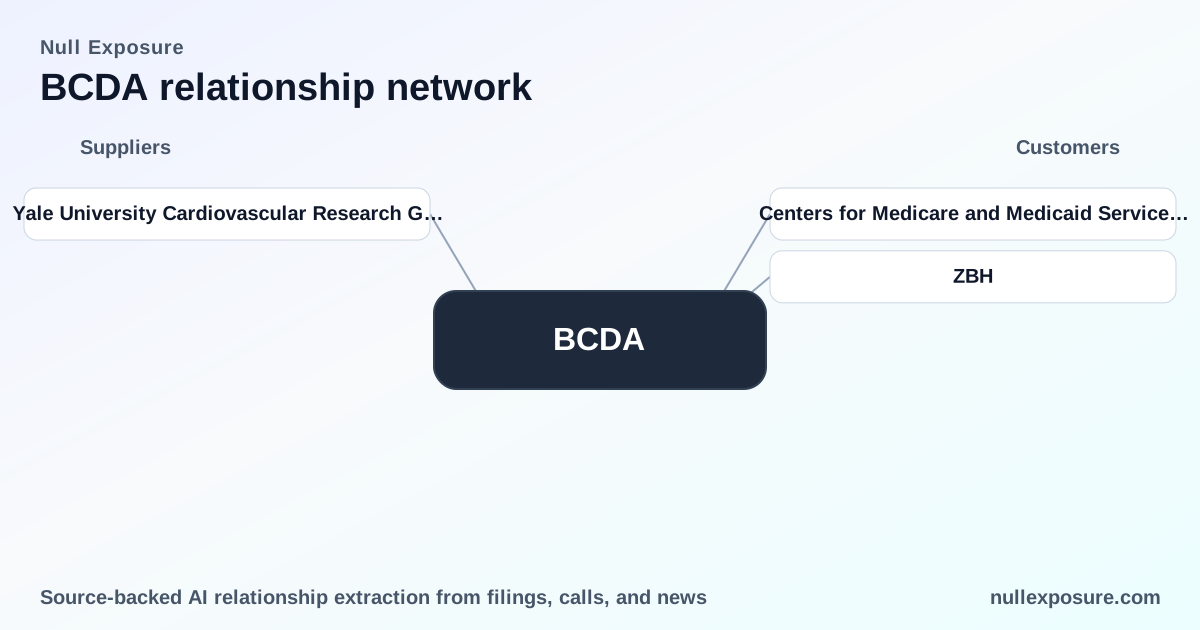
Centers for Medicare and Medicaid Services (CMS): national coverage that unlocks access
BioCardia has secured Medicare national coverage for the CardiAMP programs, and Medicare reimbursement explicitly covers patient screening, the CardiAMP Cell Therapy System and procedure, and follow-up visits—up to specified payment levels. According to multiple news reports in March–May 2026, the Department of Health & Human Services Centers for Medicare & Medicaid Services has designated CardiAMP HF, CardiAMP HF II and CardiAMP CMI as qualifying for Medicare national coverage, with covered costs described in the company statements (see StockTitan, GlobeNewswire/ManilaTimes, Investing.com). This CMS relationship is a direct revenue enabler: government reimbursement converts approved procedures into billable hospital services.
- Short plain-English summary: Medicare has designated CardiAMP indications for national coverage and reimburses screening, the device/procedure and follow‑up, effectively enabling hospitals to bill for CardiAMP services under Medicare. (Sources: StockTitan article, March 2026; GlobeNewswire/ManilaTimes release, April–May 2026; Investing.com coverage, May 2026 — https://www.stocktitan.net/news/BCDA/bio-cardia-cell-therapy-for-ischemic-heart-failure-to-progress-to-oie9nfr6fb17.html; https://www.manilatimes.net/2026/04/20/tmt-newswire/globenewswire/biocardia-and-japan-pmda-align-on-acceptability-of-cardiamp-clinical-data-to-support-regulatory-approval-in-ischemic-heart-failure/2323923; https://www.investing.com/news/company-news/biocardia-receives-japanese-patent-for-heart3d-imaging-software-93CH-4641238.)
Because the CMS excerpt explicitly names the payer, the reimbursement constraint is attributable to this relationship: CMS coverage is a structural enabler that materially changes the economics of hospital adoption.
Zimmer Biomet Japan (ZBH): an installed, regulated channel in Japan
The CardiAMP cell processing platform already exists in a point-of-care configuration that is approved and used in Japan under a local trade name via Zimmer Biomet Japan; that installed base gives BioCardia a path to commercial distribution in Japan for related indications. Finance reporting in March 2026 and clinical media noted that the platform operates in Japan for orthopedic applications under the BioCUE name through Zimmer Biomet Japan, providing a precedent for regulatory and clinical adoption in that market (see CGTLive and Yahoo Finance coverage).
- Short plain-English summary: Zimmer Biomet Japan markets an approved point-of-care platform (BioCUE) that is functionally the same system and is already in clinical use, giving BioCardia a distribution and regulatory precedent in Japan. (Sources: CGTLive, March 2026; Yahoo Finance coverage of the company release, March 2026 — https://www.cgtlive.com/view/biocardia-reveals-plans-request-meeting-fda-regarding-cardiamp-heart-failure-cell-therapy; https://finance.yahoo.com/news/biocardia-provides-timing-regulatory-activities-100000947.html.)
What the relationships collectively imply for BCDA’s operating model
These customer links and the company statements produce a clear profile of BioCardia’s commercial posture:
- Contracting posture: BioCardia operates as a seller to large institutional and public payers and hospitals rather than as a licensor; its go-to-market is direct sales to select cardiology centers in the U.S. and distribution partnerships in Japan. The company explicitly states a dedicated direct sales model for the U.S. and partner distribution if approved in Japan, which is consistent with the Zimmer Biomet Japan arrangement described in press coverage.
- Concentration: The business exhibits high revenue concentration: company disclosures show three customers accounted for roughly 62%, 22% and 16% of total revenues in 2024, signaling very high customer-level concentration that raises counterparty risk if one major center changes procedures or referrals.
- Counterparty mix and criticality: Coverage from CMS represents a government counterparty that is highly material to realizing revenue; CMS reimbursement transforms clinical approvals into hospital-reimbursable procedures and is therefore a critical dependency.
- Maturity and scalability: The installed point-of-care approval in Japan (via Zimmer Biomet Japan) demonstrates a regional precedent for regulated use, but broader commercial scaling requires expanded hospital adoption, reimbursement stability, and execution of a direct sales force—factors that are still nascent given the company’s clinical-stage status.
Risk and opportunity checklist for investors
- Positive: CMS national coverage materially de-risks payer acceptance and establishes a pathway to billable procedures in the U.S.
- Positive: An established channel in Japan through Zimmer Biomet Japan validates the point-of-care model and shortens time-to-market in that geography.
- Negative: Extreme customer concentration (three clients dominating 100% of reported revenue in 2024) creates single‑counterparty risk and revenue volatility if one major hospital alters its adoption or referral patterns.
- Negative: Execution risk exists in building a direct sales model and in converting regulatory precedents into broad, repeatable procedure volumes.
If you want a deeper customer-level exposure map and quantified concentration analysis for portfolio due diligence, run a tailored review at https://nullexposure.com/.
Final takeaways for operators and investors
BioCardia’s commercial value hinges on two linked dynamics: payer coverage (CMS) that permits billing and hospital adoption driven by a small set of influential cardiology centers and validated regional distribution (Zimmer Biomet Japan). The coverage decision by CMS is the most consequential single relationship for near-term revenue realization, while the Japanese channel offers a parallel commercialization route. Investors should treat CMS coverage as a realized commercial milestone and handle the company’s extreme revenue concentration as the primary risk to model and monitor.