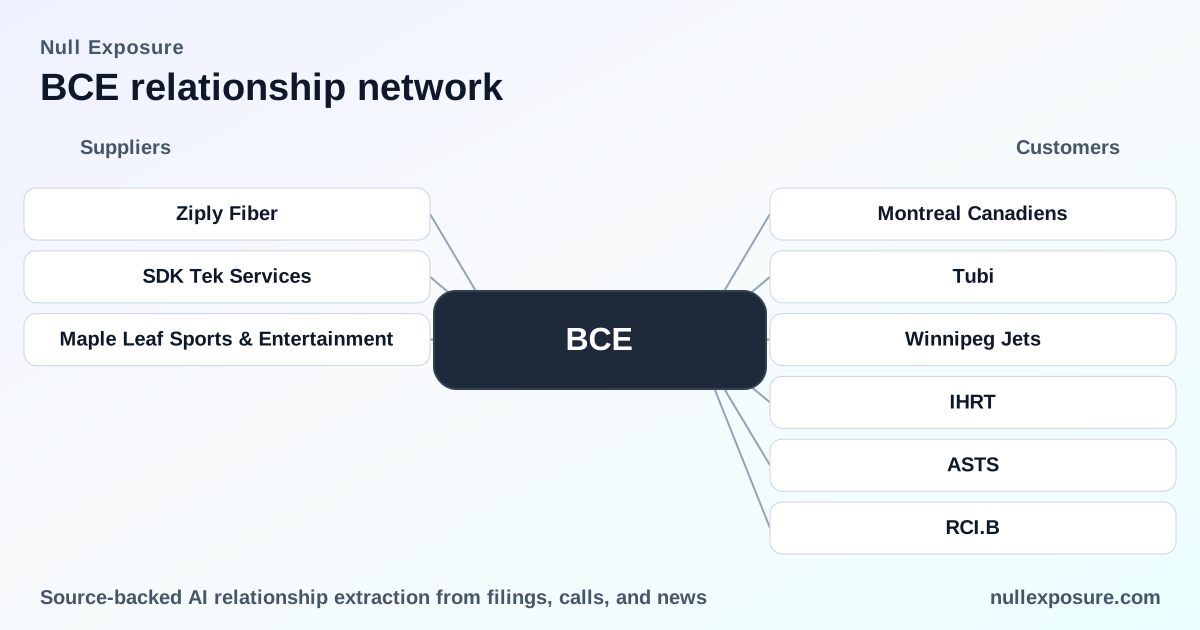
BCE Inc.: Customer relationships that drive media, connectivity and the new AI stack
BCE is a vertically integrated Canadian telecom and media operator that monetizes through subscription and access fees (wireless, wireline, broadband, TV), wholesale and advertising revenue (media platforms and sports rights), and growing infrastructure monetization (data‑centre colocation and AI fabric services). Recent activity shows management leaning into media rights and advertising distribution while simultaneously repositioning capital via asset sales and large AI infrastructure investments—moves that change revenue mix and counterbalance debt reduction with longer‑term infrastructure monetization. For a compact view of these partner relationships and what they imply for revenue concentration and strategic optionality, visit https://nullexposure.com/.
How management is structuring customer exposure and what that means for investors
BCE’s partner activity signals several company‑level operating characteristics that matter for valuation and risk:
- Contracting posture: diversified and strategic — BCE pursues long, exclusive media and platform agreements (sports broadcast rights, podcast representation) while layering shorter‑term commercial arrangements for distribution and colocation. This creates a mix of predictable subscription cash flow and higher‑margin, shorter‑duration commercial wins.
- Concentration: meaningful but manageable — media rights and large infrastructure tenants create pockets of concentration in content and AI colocation, but the overall telecom footprint remains broadly distributed across consumer and enterprise customers.
- Criticality: high for content and infrastructure partners — exclusive regional sports rights and AI data‑centre hosting indicate high criticality for both BCE’s media distribution and for tenants that depend on Bell’s network/colocation capabilities.
- Maturity: legacy cash flow plus an early‑stage infrastructure growth engine — traditional telecom revenue remains mature and cash generating; the AI fabric and colocation initiatives are growth investments with multi‑year monetization horizons.
These signals inform credit and equity perspectives differently: stable cashflow underpins dividend/cash‑flow valuation, while AI‑and‑media moves introduce execution and capital‑allocation risk that could re-rate growth expectations.
The roster: partner‑by‑partner implications for revenue and strategy
Montreal Canadiens
BCE announced a long‑term extension for regional broadcast and streaming rights for the Montreal Canadiens on its 2025 Q3 earnings call. This cements BCE’s content position in Canadian sports and secures subscription and advertising inventory tied to marquee local viewership (BCE 2025 Q3 earnings call, March 2026).
Winnipeg Jets
Management disclosed a parallel long‑term extension for regional coverage of the Winnipeg Jets on the same 2025 Q3 earnings call, reinforcing the company’s regional sports footprint and sustained advertising revenue opportunities tied to local broadcasts (BCE 2025 Q3 earnings call, March 2026).
Tubi
BCE entered a strategic ad distribution partnership with Tubi to expand free streaming inventory and ad monetization across Canada, a move described by management on the 2025 Q3 earnings call that expands BCE’s addressable ad market beyond owned and operated channels (BCE 2025 Q3 earnings call, March 2026).
iHeartMedia (iHeartRadio)
BCE expanded its long‑term partnership with iHeartMedia to include Canadian representation of iHeartRadio’s podcast portfolio, signaling a push into audio advertising and podcast monetization that complements BCE’s broader advertising strategy (BCE 2025 Q3 earnings call, March 2026).
AST SpaceMobile
BCE announced a partnership with AST SpaceMobile to deliver direct‑to‑cell satellite service, positioning Bell to extend wireless coverage and offer differentiated wholesale and consumer propositions in underserved areas (BCE 2025 Q3 earnings call, March 2026).
Cerebras Systems
Cerebras is named as a tenant for BCE’s planned 300‑megawatt AI data centre in Saskatchewan, indicating BCE will monetize infrastructure through high‑value AI colocation agreements with specialized AI compute companies (Datacentre Magazine, May 2026; Reuters coverage cited March 2026).
CoreWeave
CoreWeave joins Cerebras as a signed tenant in BCE’s AI data centre initiative, demonstrating BCE’s ability to attract hyperscale GPU cloud and AI compute customers to its AI fabric project (Datacentre Magazine, May 2026; Reuters coverage cited March 2026).
HIVE (Hive Digital Technologies)
Hive has expanded its AI colocation footprint in partnership with Bell Canada AI Fabric across Western Canada; public filings and Hive press releases list Bell as a strategic data‑centre partner supporting Hive’s HPC and AI hosting revenue growth (Hive press release and Proactive Investors, May 2026).
CoreWeave / Cerebras (combined note)
Multiple media reports in early 2026 show BCE attracting specialized AI tenants (Cerebras, CoreWeave) to its AI Fabric, reinforcing the strategic shift toward infrastructure monetization as a new revenue line rather than a pure cost center (Datacentre Magazine and Reuters reporting, March–May 2026).
Rogers Communications (RCI / RCI.B) and MLSE divestiture
Rogers completed the acquisition of an additional 37.5% stake in Maple Leaf Sports & Entertainment from BCE in a deal valued at roughly $4.7 billion, a material asset sale that reduces BCE’s exposure to venue and team ownership while generating proceeds to pay down debt (Canadian Lawyer / SimplyWall reporting, March 2026).
Motorola Solutions Canada Networks Inc. / Motorola Solutions
BNN Bloomberg and other outlets reported BCE’s sale of its land mobile radio networks services business to a division of Motorola Solutions for $675 million—part of a broader $7 billion asset sale program management is deploying to reduce leverage and reallocate capital (BNN Bloomberg reporting, March 2026).
KVHI (compatibility/consumer device partner)
A product note in March 2026 highlighted TracVision UHD7 compatibility with Bell service for customers traveling in Canadian waters, signaling BCE’s distribution reach into niche marine‑connectivity markets and the continued value of carrier compatibility arrangements (Soundings Online, March 2026).
Why these relationships matter for investors
- Near‑term cash and deleveraging: Sales such as the MLSE stake and the land mobile radio unit are explicit liquidity events that reduce leverage and create optionality for strategic reinvestment. Reports place the Motorola deal at $675m and the MLSE divestiture near $4.7bn (BNN Bloomberg; Canadian Lawyer, March 2026).
- Advertising and content monetization: Longer sports rights and new ad distribution partnerships (Tubi, iHeartRadio) raise ad inventory and engagement, improving margin mix versus pure connectivity revenue.
- New growth engine—AI colocation: Attracting tenants like Cerebras, CoreWeave and Hive turns capital spending into a monetizable platform with higher unit economics per megawatt than traditional wholesale connectivity when fully commercialized (Datacentre Magazine; Hive press materials, May 2026).
- Execution and capital allocation risk: Building and filling a 300MW AI complex requires execution across construction, sales and power procurement; success materially impacts medium‑term growth assumptions.
For a consolidated view of how these partner relationships fit into BCE’s revenue map and strategic priorities, see https://nullexposure.com/.
Investment view — clean balance of cash flow and strategic risk
BCE retains stable, cash‑generative core telecom operations while reshaping its asset base toward monetizable media inventory and an emergent AI infrastructure business. The MLSE sale and the Motorola transaction materially improve the balance sheet and provide runway for capital allocation. Investors should value BCE as a hybrid utility‑like cash generator with a nascent infrastructure growth leg—rewarding for income‑focused investors but conditional on successful AI fabric execution and ad‑monetization scaling.
Key monitorables in the next 12 months: realized proceeds and timing of asset sales, commercial ramp of AI tenants and colocation ARR, and advertising revenue trends from new distribution partnerships.