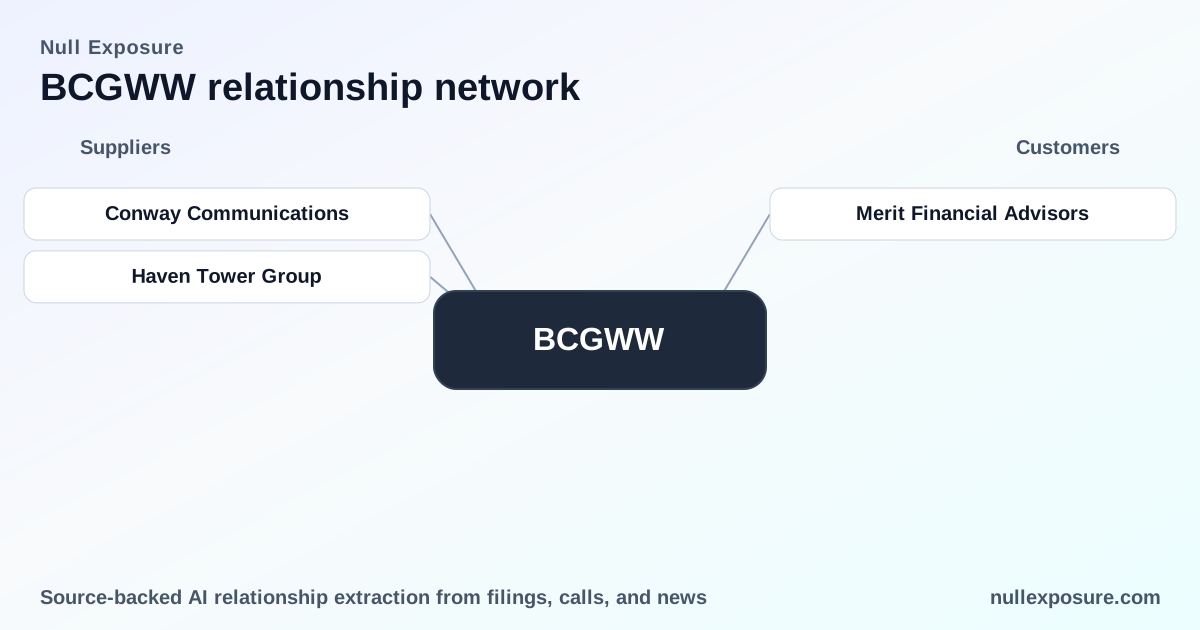
BCGWW (Binah Capital Group Warrants): Customer Relationships and Commercial Footprint
Binah Capital Group monetizes a multi-legged financial services platform by operating broker-dealer and advisory businesses (including PKS Investments) that charge recurring advisory and brokerage fees while delivering transaction execution and administrative services to independent advisors and their clients. Investors gain exposure via BCGWW warrants to a company that generates scale revenues — Revenue TTM $185.0M with gross profit of roughly $35.7M — driven by platform economics and advisor-led distribution. For a deeper counterparty map and ongoing updates, visit https://nullexposure.com/.
How Binah actually makes money and how the contracts behave
Binah’s commercial model is service-led and subscription-oriented. The company collects advisory fees that are recognized ratably over time, reflecting ongoing performance obligations to advisor clients; this is a recurring revenue profile rather than one-off deal income. Public disclosures show a platform that provides ongoing investment advice, brokerage and execution services and administrative services, indicating revenue mix across advisory fees, transaction commissions and platform fees.
Operationally this produces several investor-relevant characteristics:
- Contracting posture: The firm uses subscription-style advisory contracts with ratable revenue recognition, which smooths cash flows and improves predictability compared with episodic transaction-only models (company filings, FY2025 disclosures).
- Customer concentration and composition: The platform serves a broad base of independent advisors and individual registered representatives — filings reference ~1,900 registered individuals and branch networks across the United States — which reduces single-counterparty concentration but creates exposure to advisor retention and recruitment dynamics.
- Criticality of service: As a broker-dealer and advisory platform, Binah is a critical infrastructure provider for advisor teams that rely on cellular execution, custody arrangements and compliance services; losing distribution partners would have an outsized revenue impact.
- Maturity and scale: The reported Revenue TTM of $185M and modest profitability signals a company past early-market proof-of-concept and operating at material scale, though operating margin is effectively breakeven to slightly negative, indicating ongoing investment in distribution and platform capabilities (Operating Margin TTM approximately -0.47%).
Customer relationships in the public record
Binah’s disclosed customer and partner relationships are concentrated in the independent wealth channel and broker-dealer integrations. The public results identify the following relationship:
Merit Financial Advisors — PKS Investments to service an acquired advisor team
Merit Financial Advisors will place a recently acquired former Commonwealth Financial Network advisory group onto PKS Investments, a Binah company, as its broker-dealer, integrating that team into Binah’s brokerage and advisory platform and extending reach into Merit’s client base. This is recorded in a December 3, 2025 news release and later indexed in March 2026 reporting. (Sahm Capital press release, 2025-12-03.)
What each disclosed relationship implies for revenue and risk
The Merit relationship is a straightforward channel expansion: onboarding an acquired advisory group onto PKS Investments converts an M&A outcome for Merit into recurring advisory and brokerage revenue for Binah. Because Binah’s contracts are structured to recognize advisory fees ratably, this onboarding will translate into predictable, subscription-like revenue streams rather than lumpy commissions (company filing language on advisory fee recognition, FY2025).
Operational and credit implications:
- This is an active commercial engagement; filings and platform descriptions list Binah as an active provider to advisor teams and registered individuals across the U.S., supporting ongoing service delivery.
- The relationship sits squarely within Binah’s services segment: brokerage, advisory and administrative services form the revenue engine that captures margins over time rather than one-off transactions.
- Geography is domestic (North America), with PKS and related broker-dealer entities headquartered and operating branch networks throughout the United States (company disclosures).
Constraints and company-level signals that shape the commercial outlook
Public constraint excerpts and filing language combine into an operational picture investors should treat as company-level signals rather than relationship-specific assertions (unless explicitly named):
- Subscription orientation: Advisory fees are recognized ratably, indicating recurring revenue and multiyear service obligations that support predictable cash flow (company filings, FY2025).
- Counterparty type: The platform serves a mix with a strong tilt toward individual registered advisors and small advisor teams as primary counterparty units, consistent with a national wealth management platform supporting roughly 1,900 registered professionals (company disclosures).
- Geographic footprint: The business is primarily U.S.-centric, with headquarters in Albany, NY and branch offices across the country; regulatory and operational risk is therefore concentrated in North American markets.
- Dual role dynamics: Binah functions both as a service provider (providing advisory, execution, and administrative services) and as a buyer of services in markets where it sources third-party capabilities; this two-sided posture implies more complex supplier and client negotiations.
- Segment focus: The company’s revenue is concentrated in the services segment—broker-dealer operations and advisory platforms—rather than product manufacturing or hardware.
These signals imply a mid-stage services business with recurring revenue, U.S.-centric regulatory exposure, and dependence on advisor retention and onboarding to sustain growth.
For a systematic, investor-grade map of counterparties and relationship health, see https://nullexposure.com/.
Investment implications and risk checklist
Binah’s model produces an investable profile and attendant risks that credit and equity investors should weigh:
- Upside: Recurring advisory revenue and broker-dealer economics create scalable margin opportunity as advisor counts grow and utilization of platform services increases; the reported Revenue TTM ($185M) demonstrates scale that supports incremental margin expansion.
- Retention and recruitment risk: Platform economics rely on advisor retention and new advisor onboarding; relationships like the Merit onboarding are positive indicators but throughput must be sustained.
- Regulatory and operational concentration: U.S.-only operations concentrate regulatory oversight and operational continuity risks in one jurisdiction.
- Profitability runway: Gross profits are meaningful (~$35.7M), but operating margins are modest; sustained investment in distribution or technology could compress near-term profitability.
Key action items for investors:
- Monitor advisor onboarding metrics and retention rates as drivers of recurring revenue.
- Track operating margin trajectory to assess whether scale generates sustainable profitability.
- Watch regulatory developments affecting broker-dealer economics in the U.S. market.
Bottom line: what BCGWW investors should take away
Binah Capital operates a U.S.-focused broker-dealer and advisory services platform with subscription-like advisory fee recognition, broad independent-advisor coverage, and growing scale (Revenue TTM $185M). The announced Merit Financial Advisors onboarding to PKS Investments reinforces the company’s distribution-led growth model and capacity to convert third-party advisor acquisitions into recurring revenue. The company’s value hinges on advisor retention, U.S. regulatory stability, and margin expansion as scale increases.
For ongoing counterparty tracking and to map customer concentration across Binah’s platform, consult https://nullexposure.com/ for expanded coverage and updates.