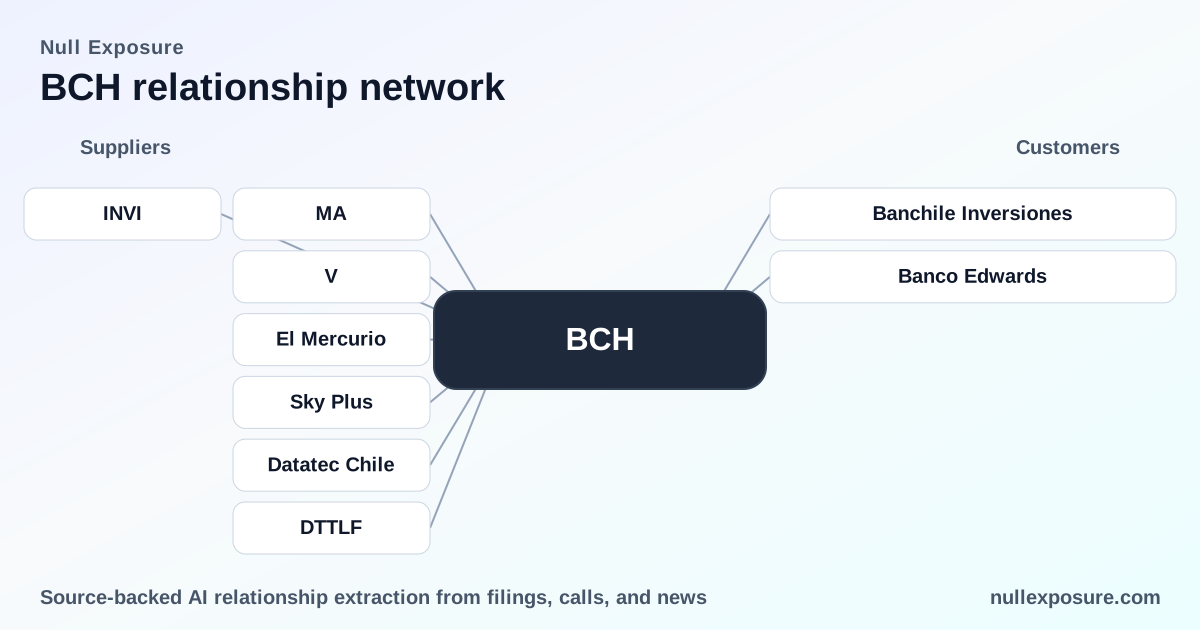
Banco de Chile (BCH) — Customer relationships and distribution: Banco Edwards & Banchile Inversiones
Banco de Chile is a full-service Chilean bank that monetizes through interest margin on lending, fee income from payments and corporate services, and asset-management and advisory fees via affiliated channels. Its business model emphasizes retail and corporate deposit gathering, cross-sell through group brands, and digital product distribution to SMEs and businesses, driving recurring fee flows and lower-cost funding. For investors, the relevant signal is distribution reach: product rollouts that plug into internal channels can accelerate revenue capture with limited incremental customer-acquisition spend. Learn more about coverage and analytical tools at https://nullexposure.com/.
A product launch that extends distribution into group channels
In mid‑2025 Banco de Chile launched a product called “mi‑pass” targeted at small and medium-sized enterprises (PYME) and business customers. The launch is designed to be available across the bank’s group brands, explicitly including Banco Edwards and Banchile Inversiones, which expands the bank’s ability to monetize business-segment relationships through a single, group-wide offering. A June 2025 news report on Chocale described the rollout and its availability to the group’s client bases, reflecting a coordinated go‑to‑market approach rather than isolated pilots.
What this means operationally: the bank is leveraging affiliate distribution to accelerate adoption among business clients, which supports faster fee and service revenue capture without proportionate increases in direct sales cost.
How each customer relationship shows up in the record
Banco de Chile’s public coverage lists two named customer-channel relationships tied to the mi‑pass offering. Each relationship below is summarized in plain English with the cited public reporting.
-
Banchile Inversiones — The bank’s mi‑pass service is available to clients of Banchile Inversiones, integrating the investment and brokerage client base into the new SMB/business product distribution. According to a June 2025 Chocale article, the rollout explicitly includes Banchile Inversiones clients as part of the availability set. (Chocale, June 2025: https://chocale.cl/2025/06/banco-de-chile-lanza-mi-pass-para-clientes-pyme-y-empresas/)
-
Banco Edwards — The mi‑pass product is also available to customers of Banco Edwards, extending the offering into this retail/corporate channel within the group. The same June 2025 Chocale report lists Banco Edwards among the included channels for the launch. (Chocale, June 2025: https://chocale.cl/2025/06/banco-de-chile-lanza-mi-pass-para-clientes-pyme-y-empresas/)
These two relationships indicate internal distribution rather than arm’s-length third‑party commercial agreements; the reporting frames them as part of the bank’s multi‑brand availability plan rather than separate external customer contracts.
Company‑level constraints and operating signals
The reviewed coverage and relationship records do not flag explicit contractual constraints in the sampled reporting. That absence itself is a signal: no public disclosure in the referenced coverage pointed to binding third‑party supply constraints or exclusivity limits that would restrict Banco de Chile’s ability to commercialize mi‑pass across its channels.
From a business-model perspective, the available information implies the following company-level signals:
-
Contracting posture: The bank uses internal affiliate distribution to scale product reach, which reduces reliance on external sales partners and preserves margin capture. This is a strategic posture that improves control over pricing and integration.
-
Concentration: Distribution concentration for this product is within the group, not concentrated among unrelated external customers; that reduces counterparty risk on the distribution side but concentrates execution risk within the group’s marketing and onboarding processes.
-
Criticality: Plugging Banco Edwards and Banchile Inversiones into the rollout is operationally important for speed to market and penetration in SME/corporate segments; the channels are critical for adoption but are internal levers that the bank controls.
-
Maturity: The launch dates to FY2025, indicating the offering is in early commercialization rather than a long-matured revenue stream; revenue impact will depend on adoption velocity across the two channels.
These signals should be treated as company-level inferences since no contractual excerpts in the reviewed coverage explicitly tie constraints to named relationships.
Investor implications and risk checklist
The inclusion of Banco Edwards and Banchile Inversiones as distribution channels has immediate implications for revenue dynamics and execution risk.
-
Revenue upside: cross-sell economics improve when new products are sold into existing client relationships; if the bank achieves modest attachment rates among the channels’ SME and business customers, fee and service income should scale faster than standalone customer acquisition.
-
Execution risk: given the launch is recent, onboarding, integration, and client education will determine adoption; internal channel coordination becomes the gating factor. Investors should monitor early uptake metrics and any commentary in quarterly reporting.
-
Competitive and regulatory risk: SME and business product segments are competitive in Chilean banking; pricing pressure and regulatory oversight around fees and business lending will influence realized margins.
-
Visibility: The public coverage is limited to a single media report in June 2025; investors should seek quantitative disclosures (adoption rates, fees, incremental revenue) in the bank’s quarterly filings or investor presentations for precise modeling.
Key takeaway: distribution through Banco Edwards and Banchile Inversiones is a low-cost route to scale for mi‑pass, but revenue realization depends on adoption and operational execution across internal channels.
What to watch next (practical steps for analysts)
- Monitor Banco de Chile’s quarterly disclosures for metrics tied to the mi‑pass rollout (clients onboarded, fee income, penetration in SME segments).
- Track investor calls and investor presentations for any quantified targets or pilot results tied to Banco Edwards and Banchile Inversiones.
- Evaluate competitive responses in Chile’s SME banking market to assess pricing and share risks.
If you want a systematic view of Banco de Chile’s customer relationships and ongoing coverage tracking, visit https://nullexposure.com/ for tailored analysis and continuous monitoring.
Bottom line
Banco de Chile has executed a coordinated product rollout that leverages internal affiliate channels—Banco Edwards and Banchile Inversiones—to distribute a new SME/business product, mi‑pass, in FY2025. This approach improves distribution leverage and preserves margin capture, but the financial impact will be determined by adoption speed and operational execution across the group channels. Investors should prioritize follow‑up on disclosure-driven adoption metrics and management commentary to convert this distribution signal into quantifiable revenue assumptions.
Sources: Chocale news report on Banco de Chile’s mi‑pass launch (June 2025): https://chocale.cl/2025/06/banco-de-chile-lanza-mi-pass-para-clientes-pyme-y-empresas/.