Brink’s (BCO): Customer Footprint and Commercial Signals that Drive Revenue
Brink’s monetizes a global, recurring-services model: secure cash and valuables management, ATM managed services (AMS), and digital retail solutions (DRS) sold to a mix of financial institutions, retailers, government agencies and merchants. Revenue comes mainly from service contracts—both usage-priced and multi-year recurring agreements—combined with short-term receivables; cash-in-transit and custody characteristics create working-capital and counterparty credit exposures that directly affect margins and capital deployment.
For deeper customer-level visibility and to explore how these relationships feed into revenue trajectories, visit https://nullexposure.com/ for our full investigative view.
How Brink’s commercial model actually works (and why it matters to investors)
Brink’s operates as a service-first business with software and hardware adjuncts. The company’s core offerings—cash and valuables management, DRS and AMS—are delivered through a combination of personnel, secure logistics, smart devices and software analytics. The company invoices mostly on a monthly cadence with payment terms generally between 30 and 60 days, and recognizes revenue using an output method tied to units of service provided, which aligns cash flows to activity rather than fixed milestones. According to company filings, DRS and AMS revenues are “typically contractually recurring with multi-year terms,” creating a mix of near-term usage volatility and longer-term contractual visibility.
Key operating-model signals:
- Contracting posture: A blend of monthly, usage-based billing and multi-year recurring contracts—this creates predictable base revenue but exposes the company to volume swings. (Company filings, FY2025–FY2026.)
- Counterparty breadth: Customers span governments, global banks, large retailers, mid-market and small businesses—Brink’s is both highly diversified by customer type and geographically concentrated through an expansive global network serving 100+ countries. (Investor materials / filings.)
- Revenue mix: Services dominate; hardware sales (safes, devices) are incidental. DRS includes software and analytics components, elevating margin potential but also requiring ongoing platform investment. (Company filings.)
- Working-capital profile: Brink’s can take temporary title to cash in transit and records liabilities while cash is in custody—this creates balance-sheet nuances and credit exposure tied to client receivables. (Company filings.)
These characteristics translate to stable recurring cash flows with episodic sensitivity to transaction volumes and client credit profiles, factors investors should weigh when assessing valuation and credit metrics.
Customer relationships that move the needle today
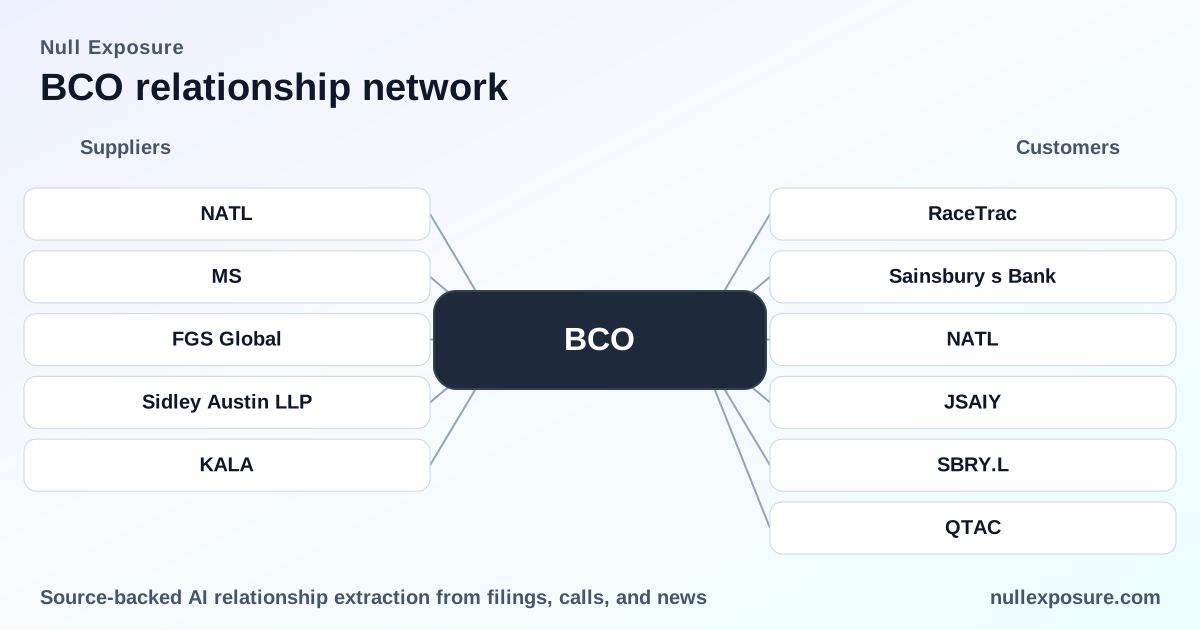
Below are direct references to customer relationships called out in public materials. Each entry is a concise, plain-English note with the source context.
-
RaceTrac — Brink’s completed onboarding and is at full revenue run rate with RaceTrac in North America, indicating the company has transitioned this convenience-store relationship into recurring AMS/DRS revenue. Sourced from Brink’s 2025 Q3 earnings call transcript (first seen March 2026).
Source: 2025 Q3 earnings call (March 2026). -
NCR Atleos Corporation (NATL) — Company commentary on industry calls noted reciprocal customer/supplier interactions with NCR Atleos, signaling operational integration or commercial overlap in payments/ATM ecosystems. This remark surfaced on a public business combination communication in FY2026.
Source: Business-combination communication citing Tim’s remarks (FY2026). -
Sainsbury’s Bank — Brink’s management reported finishing onboarding of Sainsbury’s Bank in the U.K., a large AMS/DRS client that contributes to Brink’s European revenue run rate. This was disclosed across earnings commentary in FY2026.
Source: Q2 2025 earnings call transcript and FY2026 news coverage (AlphaStreet / earnings call). -
NATL (duplicate entry) — A second reference to NCR Atleos Corporation reiterates that Brink’s and NCR Atleos have acted as customers and suppliers to one another in different regions, underscoring bilateral commercial ties in the ATM/payments value chain. Reported in the same FY2026 business-combination communication.
Source: Business-combination communication (FY2026). -
Sainsbury’s (retailer) — Brink’s reported completing onboarding of Sainsbury’s in Europe, bringing retailer-level cash-management and DRS revenue to full run-rate, which strengthens European service footprint and recurring revenue visibility. Reported in the 2025 Q3 earnings call.
Source: 2025 Q3 earnings call (March 2026). -
Sainsbury’s Bank (Q2 reference) — A Q2 2025 earnings call specifically lists Sainsbury’s Bank among recently onboarded large AMS customers in the U.K., reinforcing that the Bank relationship was transitioned earlier in 2025 and contributed to sequential growth.
Source: Q2 2025 earnings call (2025). -
JSAIY (duplicate listing of Sainsbury’s Bank ADR) — The same Q2 2025 commentary appears under the ADR symbol listing, signaling the public-market cross-reference to the Sainsbury’s Bank onboarding disclosure.
Source: Q2 2025 earnings call (2025). -
TFC-P-R — Local news reporting around an FY2023 ATM incident referenced a Brink’s-owned ATM; the report described the ATM account as balanced for the day and noted the machine is owned by Brink’s, illustrating operational exposure and reputational sensitivity tied to ATM ownership and service delivery.
Source: Local news report (ActionNewsJax, FY2023). -
QTAC — Brink’s stated it completed onboarding and is at full revenue run rates with QT (QTAC) in North America, indicating QTAC is contributing to AMS/DRS transactional volumes. This came from the 2025 Q3 earnings call.
Source: 2025 Q3 earnings call (March 2026). -
QT (duplicate of QTAC) — The earnings call repeats QT among key onboarded accounts, reinforcing that the QT relationship is operational and revenue-generating as of the 2025 Q3 disclosure.
Source: 2025 Q3 earnings call (March 2026).
What these relationships say about growth drivers and risks
Collectively, these named onboardings—major convenience chains (RaceTrac, QT/ QTAC), large retailers and banks (Sainsbury’s / Sainsbury’s Bank) and systems players (NCR Atleos)—show Brink’s is executing on a mix of high-volume transactional clients and multi-year service contracts. That mix is a core growth driver: large merchant and bank onboarding creates stickier revenue and scale efficiencies for AMS/DRS, while usage-based billing amplifies revenue when transaction volumes rise.
Key risk factors to monitor:
- Volume sensitivity: Usage-based recognition ties revenue to transactional activity; recessionary or client-specific volume declines compress near-term revenue. (Revenue recognition policy; company filings.)
- Receivables and custody exposure: Monthly billing and short-term cash custody create working-capital needs and counterparty credit exposure—especially material with government or large-enterprise customers. (Company filings.)
- Operational/reputational incidents: ATM ownership and servicing expose Brink’s to localized incidents that can attract media attention and client remediation costs. (Local news, FY2023.)
Investment takeaway and next step
Brink’s is a service-dominant infrastructure play in cash and payments logistics with a balanced revenue profile: recurring multi-year contracts provide baseline stability while usage-based AMS/DRS exposure creates upside in volume cycles. For investors focused on revenue quality and counterparty risk, the recent onboardings of RaceTrac, QT, Sainsbury’s (retailer and bank) and the operational linkage to payments vendors like NCR Atleos are material signals of both scale and execution.
For a structured, customer-level deep dive and ongoing monitoring of Brink’s commercial relationships, see our coverage at https://nullexposure.com/ — we map customer onboarding events and contractual signals that feed into forward revenue models.
Bold, customer-driven execution has improved Brink’s revenue visibility, but the company’s exposure to transaction volumes and short-term receivables requires active monitoring to assess sustained margin expansion and cash conversion.