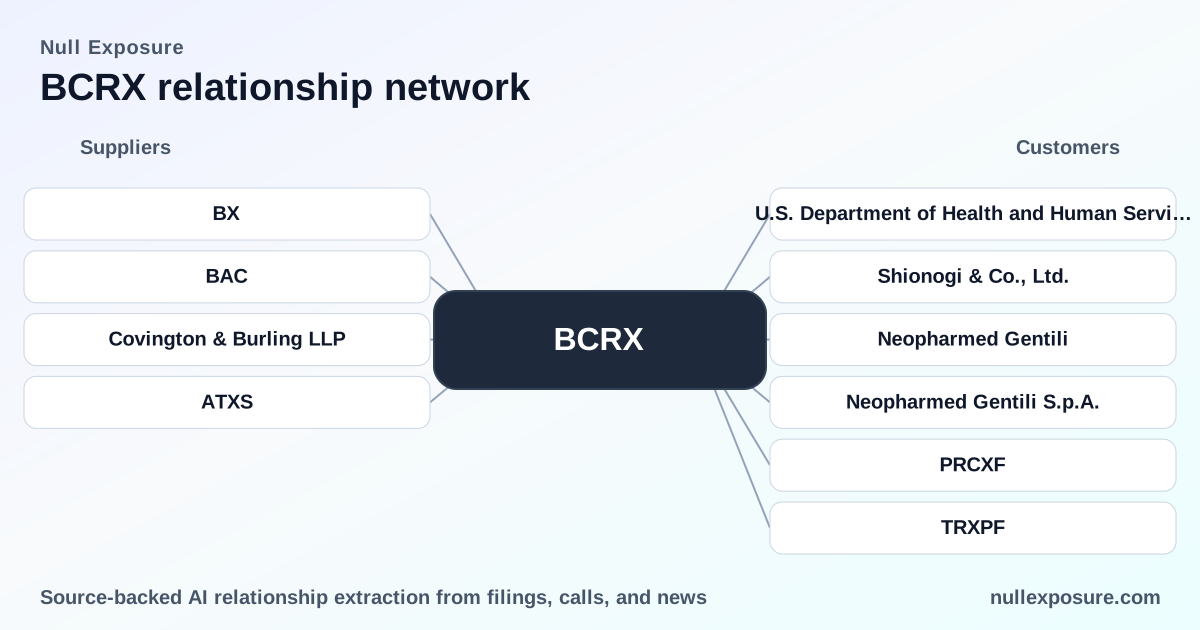
BioCryst (BCRX): Customer Map and Commercial Signals investors should price in
BioCryst discovers and commercializes oral small‑molecule drugs and monetizes primarily through product sales, government procurement contracts for legacy antivirals, and royalties/licensing with international partners; recent strategic asset sales have also generated meaningful one‑time cash inflows. Revenue today is driven by end‑market product sales and partner royalties, with government procurement and selective divestitures an important source of cash. For a deeper view of counterparty concentration and contract structure, see our site: https://nullexposure.com/
How BioCryst’s customer footprint shapes cash flow and risk
BioCryst operates a hybrid commercial model: direct-to-patient U.S. sales through a single specialty pharmacy channel, wholesale/distributor channels in EMEA and elsewhere, and long‑term procurement agreements with U.S. government agencies for older antiviral assets. That mix produces a revenue profile with both recurring product sales and episodic large contract receipts or asset-sale proceeds.
- Contracting posture: BioCryst holds multi‑year procurement arrangements and commercial supply terms that include optional annual extensions, indicating a long‑term supplier relationship with government buyers and recurring specialty pharmacy demand.
- Concentration: The company reports an expectation that roughly 80% of peak revenue will be U.S.‑based, and the U.S. specialty pharmacy functions as a single critical commercial channel — a concentration that magnifies execution risk if that channel shifts.
- Criticality: Government contracts to equip the Strategic National Stockpile for pandemic response make some product lines strategically critical to public health customers and therefore relatively stable in spend profile.
- Maturity: ORLADEYO commercialization in the U.S. has been active since late 2020; the business mixes mature product revenue (including partner royalties) and active launches in other markets, supporting a path to profitability while leaving some dependency on partner payouts and occasional asset sales.
Customer relationships — the full list and what each means for investors
U.S. Department of Health and Human Services
BioCryst has a formal procurement relationship with HHS for its antiviral peramivir (RAPIVAB), including a multi‑year procurement contract with a 12‑month base and four optional 12‑month ordering periods; the 10‑K reports the award for procurement over a five‑year period for RAPIVAB doses. According to BioCryst’s FY2024 Form 10‑K, the contract is structured to support the Strategic National Stockpile and represents a long‑term government customer relationship. (Source: BioCryst 2024 10‑K, Note on procurement contract)
Shionogi & Co., Ltd.
Shionogi is named in BioCryst’s filings as a partner from which the company receives royalty receivables, indicating an ongoing licensing or commercialization revenue stream tied to products in markets where partners commercialize locally. (Source: BioCryst 2024 10‑K, royalty receivables disclosure)
Neopharmed Gentili S.p.A. (Neopharmed Gentili / Neopharmed Gentili)
BioCryst sold its European ORLADEYO business to Neopharmed Gentili in late 2025, generating a material one‑time proceeds event that boosted full‑year revenue in FY2025; press reports cite transaction values of $243.3 million (reported by Finviz and InsiderMonkey) and other coverage noting $250 million upfront plus potential milestone payments. This divestiture both monetized European rights and transfers future European revenue to Neopharmed Gentili. (Sources: Finviz and InsiderMonkey news coverage, RTTNews reporting and GlobeNewswire releases, Feb–Mar 2026)
PRCXF
PRCXF is listed as an inferred symbol tied to BioCryst’s royalty receivables disclosure; the 10‑K explicitly groups PRCXF among the company’s royalty‑paying partners. This represents a non‑operational counterparty that produces cash via royalties rather than direct product purchases. (Source: BioCryst 2024 10‑K, royalty receivables disclosure)
Green Cross
Green Cross is identified in the company’s 10‑K as another partner generating royalty receivables for BioCryst, reflecting licensed commercialization outside BioCryst’s own sales footprint and contributing to recurring partner income. (Source: BioCryst 2024 10‑K, royalty receivables disclosure)
Torii
BioCryst’s 10‑K discloses that Torii is the exclusive commercial partner for ORLADEYO in Japan, meaning Torii handles local commercialization while BioCryst retains royalty exposure and strategic oversight. This arrangement localizes execution risk in Japan to Torii’s distribution and market access capabilities. (Source: BioCryst 2024 10‑K, Note 15 Collaborative and Other Relationships)
TRXPF
TRXPF appears as an inferred ticker associated with the Torii relationship in the 10‑K excerpts; the filing calls out the exclusive Japanese commercialization rights held by the Torii partner (linked here to the TRXPF identifier), which underscores the company’s reliance on regional partners for non‑U.S. commercialization. (Source: BioCryst 2024 10‑K, collaborative partner disclosure)
What these relationships imply for valuation and operational risk
- Revenue mix is hybrid: recurring U.S. retail specialty pharmacy sales + distributor sales in EMEA + royalty inflows + government procurement receipts + episodic sale proceeds. FY2025’s substantial uplift was driven in part by a European ORLADEYO divestiture reported in multiple news outlets (Feb–Mar 2026).
- Concentration risk is measurable and material: the U.S. specialty pharmacy channel and U.S. government contracts represent single‑point dependencies for core product cash flow; an 80% U.S. revenue concentration signal increases sensitivity to U.S. reimbursement and channel shifts.
- Contracting posture favors stability for certain assets: long‑term government contracts (12‑month base + four annual options) and procurement to the Strategic National Stockpile create durable demand for antiviral inventory lines.
- Partner royalties diversify but are lower control: royalties from Shionogi, Green Cross and Torii provide steady income without operational burden, but management cannot directly accelerate those sales.
- One‑time monetizations are part of the playbook: the European ORLADEYO sale to Neopharmed Gentili demonstrates management willingness to monetize regional rights, which supports near‑term cash generation at the cost of future revenue streams.
Investor checklist — how to prioritize follow‑up
- Confirm the sustainability of U.S. specialty pharmacy volumes and whether the single‑channel dynamic will change.
- Monitor HHS/ASPR contract awards and optional‑period exercises for RAPIVAB procurement given the long‑term structure described in the 10‑K.
- Track incoming royalty receipts from Shionogi, Green Cross and Torii as recurring non‑operating cash flow.
- Watch for additional asset monetizations or licensing deals similar to the European ORLADEYO sale to Neopharmed Gentili that materially impact short‑term revenue.
For an analyst brief or deeper counterparty risk heatmap, visit our homepage: https://nullexposure.com/
BioCryst’s customer relationships combine strategic government procurement, concentrated U.S. retail channels, and diversified partner royalties, creating an investment profile that blends operational leverage with single‑channel and partner execution risk.