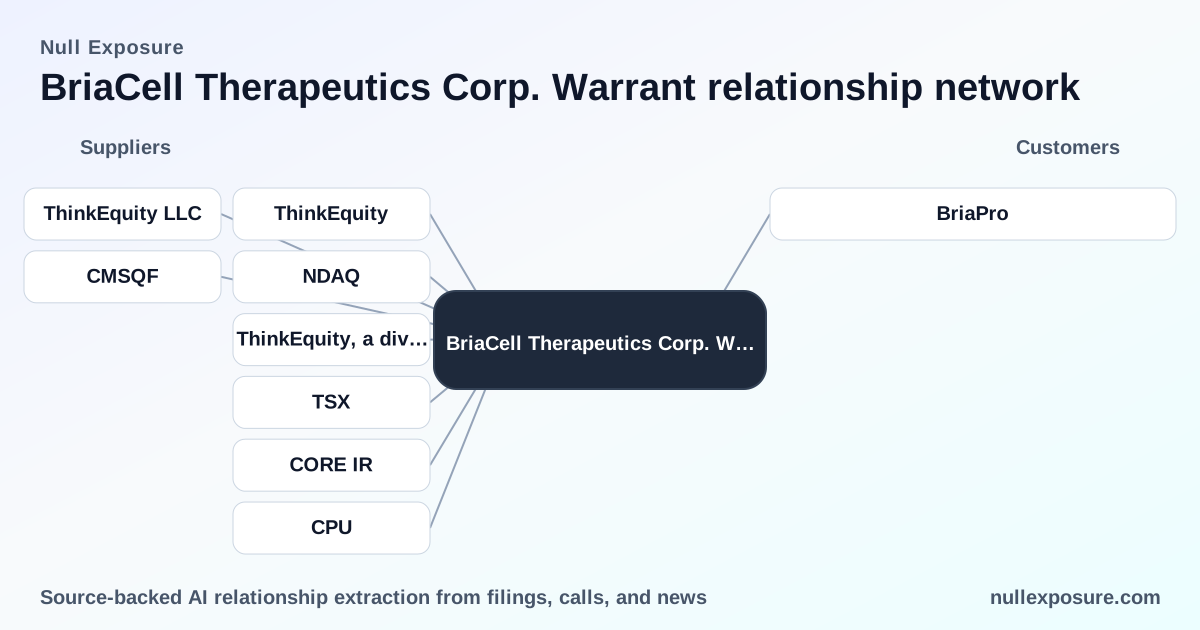
BCTXZ (BriaCell Therapeutics Warrant): Customer relationships, commercial posture, and what the BriaPro deal means for investors
BriaCell Therapeutics operates as a clinical-stage immuno-oncology developer that monetizes through asset licensing, strategic partnerships, and eventual product commercialization rather than through current product sales. The company advances therapeutic candidates — most notably Bria-IMT and sCD80-related assets — through clinical development and captures value by out-licensing rights, entering purchase agreements, and securing financing tied to those transactions. For investors and operators, the critical lens is how customer and partner relationships convert R&D progress into non-dilutive cash and de-risked commercial pathways.
For a concise, structured view of customer ties and public filings, visit https://nullexposure.com/.
How BriaCell’s customer relationships shape the business model
BriaCell’s operating model is partner- and licensor-driven. With reported Revenue TTM = 0 and negative operating performance (EBITDA = -30,630,110), the company relies on transactions that transfer development and commercial responsibilities to counterparties while generating near-term funding or milestone economics. This creates several defining business-model characteristics:
- Contracting posture: BriaCell executes purchase and license agreements that transfer rights to third parties; contracts are structured to move program risk off BriaCell’s balance sheet and capture value through up-front payments, milestones, and royalties.
- Concentration and counterparty importance: As a clinical-stage biotech, few counterparties will account for the majority of commercialization exposure, making each partner relationship strategically critical to near-term liquidity and long-term value realization.
- Relationship criticality and maturity: The company’s relationships are high-impact but early-stage — they are about transferring development/commercial risk rather than delivering recurring product revenue. That elevates the importance of deal terms and counterparty capability.
- Regulatory and contracting constraints: Company risk disclosures highlight U.S. pricing, reimbursement pressures and HIPAA-related contracting obligations that will shape commercial negotiations and scope of customers in the health-care ecosystem.
These signals are company-level and reflect corporate contracting posture and exposure; they are not tied to a single disclosed counterparty unless explicitly stated in a filing.
The recorded customer relationship: BriaPro deal and what it means
BriaPro — a rights acquisition for sCD80
BriaPro entered into a purchase agreement with BriaCell to acquire worldwide rights to develop and commercialize sCD80, with the transaction noted to close around March 12, 2026. This transaction transfers the development and commercialization rights for the sCD80 program to BriaPro and represents a strategic realization event for BriaCell. (News report, March 9, 2026: https://intellectia.ai/news/stock/briacell-prices-public-offering-at-559-per-unit-raising-30-million)
This is the sole publicly reported customer/partner relationship in the dataset; investors should treat the BriaPro transaction as a primary conduit for near-term value capture.
Contracting and regulatory constraints investors must price in
Two firm company-level constraints emerge from BriaCell’s disclosures and shape contract negotiations and downstream commercialization economics:
- Government and payer pressure is an active commercial constraint. A company filing warns that in the U.S., BriaCell faces “substantial pricing, reimbursement, and access pressures from state Medicaid programs, private insurance programs and pharmacy benefit managers,” and that U.S. health-care reform has increased these pressures. This is a structural force that will influence partner negotiations, pricing floors, and launch market access strategies (company filing, FY2026).
- Seller obligations and HIPAA exposure shape customer contracts. Management states BriaCell expects many of its customers to be covered entities under HIPAA and that such customers will require business-associate agreements to safeguard health information; these obligations impose contractual liabilities and operational controls on BriaCell as it sells programs or services to covered entities (company filing, FY2026).
These excerpts are company-level signals. They demand that deal terms with partners (including BriaPro) accommodate payer and privacy dynamics: milestone economics, indemnities, data-handling clauses, and pricing provisions will be negotiated against that background.
Commercial and financial implications for investors
The BriaPro rights transfer is consistent with a capital- and risk-management playbook that clinical biotechs use to convert pipeline value into liquidity. For investors evaluating BCTXZ exposures, key implications are:
- Up-front vs. contingent economics: Transactions that assign worldwide rights usually include a mix of up-front payments and contingent milestones or royalties. The cash impact depends on the documented deal economics and whether the company receives meaningful up-front consideration.
- Counterparty execution risk replaces internal development risk: By shifting development responsibility to BriaPro, BriaCell reduces its direct clinical execution burden while substituting counterparty performance risk — investors must assess BriaPro’s capacity to advance sCD80 through regulatory and commercial stages.
- Regulatory and commercial layering: Government payment pressure and HIPAA-related contracting obligations will influence timeline to revenue and net present value of future royalties; pricing and access constraints will shape ultimate market returns.
Key takeaway: The BriaPro transaction is a material commercial step that monetizes an asset and reallocates program risk, but it does not eliminate downstream payer or privacy-related constraints that will affect ultimate economics.
What investors and operators should monitor next
- Confirmation that the BriaPro purchase agreement closed on or near March 12, 2026, and the detailed economics of the deal (up-front payment, milestone schedule, and royalty structure) as disclosed in company releases or regulatory filings.
- BriaPro’s initial development plan and regulatory milestones for sCD80, which determine timing and probability of contingent payments.
- Any amendments or addenda that address U.S. pricing, reimbursement strategies, and data-protection provisions; these contractual elements materially affect net economics.
- BriaCell’s capital position and how proceeds from the transaction (if any) are allocated between operations, pipeline advancement, and shareholder value initiatives.
For a consolidated view of counterparties and the contract-level signals that drive valuation, review our platform at https://nullexposure.com/.
Bottom line
BriaCell’s business model centers on advancing immuno-oncology assets and capturing value through partnerships and asset sales. The BriaPro purchase agreement for sCD80 is the principal recorded customer relationship in the current public corpus and represents a deliberate monetization of pipeline value. Investors must underwrite the economics of that deal against enduring commercial constraints — notably U.S. payer pressure and HIPAA-related contracting obligations — and closely monitor closing confirmations and the counterparty’s execution plan to convert the transaction into realized value.