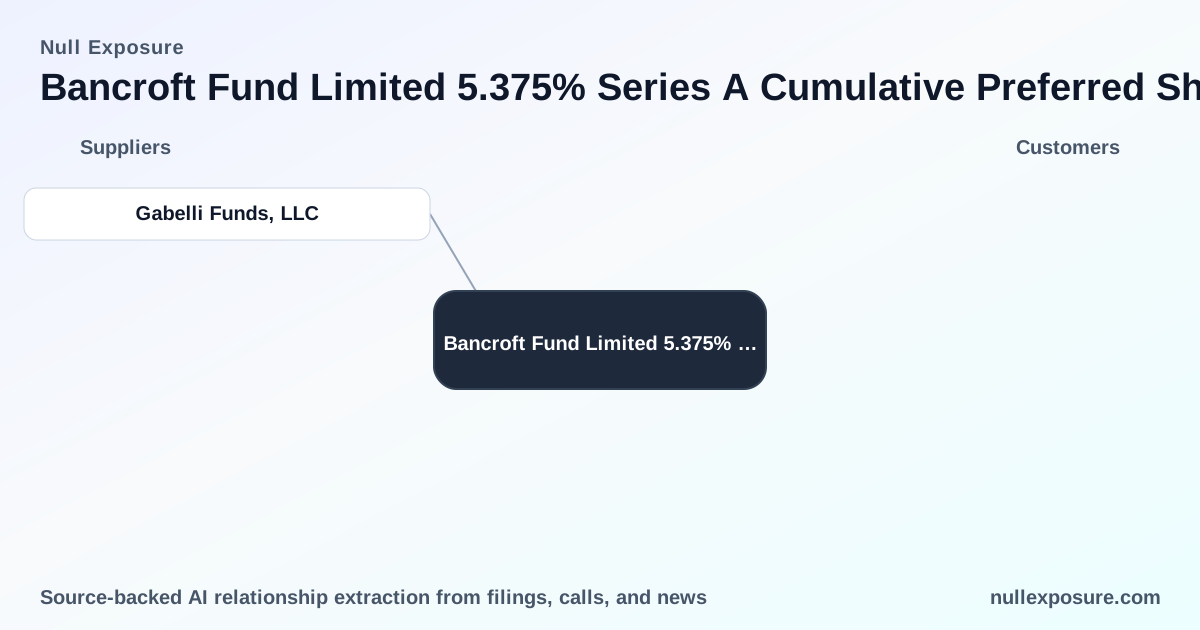
BCV-P-A: Income-first preferred shares facing underwriter reputational noise
Bancroft Fund Limited’s 5.375% Series A cumulative preferred shares (BCV-P-A) monetize through a fixed, cumulative dividend that takes priority over common distributions, making this a pure income instrument inside a closed‑end fund wrapper. For yield‑seeking portfolios this security offers stable cash flow and structural payment priority, while market price and NAV dynamics determine capital returns; investors should weigh that steady coupon against liquidity and counterparty reputational exposures. For more detailed counterparty and relationship intelligence, visit https://nullexposure.com/.
How this preferred share actually earns its keep
BCV-P-A is a traditional closed‑end fund preferred: investors buy a security that delivers a fixed 5.375% dividend, cumulative if unpaid, which creates a reliable payout profile that institutional allocators prize. The fund generates cash to service that coupon through its portfolio income and capital realization; however, publicly available corporate financial disclosures for this series are sparse, so trade price and discount‑to‑NAV behavior are the primary drivers of total return beyond the coupon.
Because the instrument is a preferred equity within a closed‑end vehicle, liquidity and market sentiment — not operating cashflows alone — determine realized investor outcomes. The issuer’s public record in the reviewed materials shows limited operational metrics (many fields report zeros or “None”), which underscores that credit‑style analysis must focus on the fund’s asset composition and event risk rather than traditional income statement ratios.
Relationship spotlight: the FCHL underwriting allegations
The only counterparty relationship surfaced in the review is with FCHL (Fitness Champs Holdings Ltd.), tied to reporting that referenced Bancroft as the sole IPO underwriter. Multiple press releases in April–May 2026 asserted that Bancroft “had conducted numerous microcap IPOs that suffered volatility‑induced declines resulting from market manipulation schemes.” This reporting was published via GlobeNewswire in late April 2026 and reiterated by AccessNewswire on May 2, 2026.
According to GlobeNewswire press releases in April 2026 and an AccessNewswire release on May 2, 2026, the allegation centers on Bancroft’s underwriting role in a microcap IPO for FCHL and asserts prior underwriting activity that coincided with volatility and declines in similarly small offerings (GlobeNewswire, April 21–30, 2026; AccessNewswire, May 2, 2026).
Why this single counterparty call‑out matters: while the item is a news/legal‑sentiment signal rather than a contractual disclosure, it directly implicates Bancroft’s capital‑markets execution and reputational standing — an input to investor confidence in new issuances and placement of equity that could indirectly affect closed‑end fund NAV volatility.
What the lack of contract constraints tells investors
The reviewed records contain no explicit contract constraints for BCV-P-A — no customer or supplier contracts, no service agreements, and no flagged counterparty exposure in the constraints data. This absence is itself informative: at the company level, it signals no disclosed, material contract concentration or critical‑supplier dependency in the available sources.
From an operating‑model perspective that implies:
- Contracting posture: No public single‑counterparty lock‑ins were identified, suggesting the fund’s cashflow mechanics are not contingent on a named external contract within the visible record.
- Concentration: the lack of disclosed constraints reduces observable concentration risk, but does not eliminate it — absent disclosure, concentration must be inferred from portfolio holdings rather than contract schedules.
- Criticality and maturity: without contract excerpts, there are no recorded multi‑year service dependencies or termination cliffs to model; liquidity and market risk remain the dominant vectors.
Do note that the absence of constraints in the reviewed feed is a company‑level signal and is not being attributed to any single relationship unless explicitly named.
Investment takeaways and a short risk checklist
- Primary investment thesis: BCV-P-A is a yield instrument designed for investors who prioritize predictable distributions and cumulative dividend protection; consider it as an income sleeve rather than a growth vehicle.
- Market risks: the security’s price is sensitive to NAV discount dynamics and market liquidity, not traditional leverage metrics.
- Counterparty risk: the FCHL press coverage introduces reputational and issuance quality risk to Bancroft, which can affect pricing of future equity placements and second‑order NAV volatility. (See GlobeNewswire and AccessNewswire April–May 2026 releases.)
- Disclosure gap: public financial fields for this series are limited; investors must rely on asset‑level transparency and third‑party operational signals rather than conventional issuer financials.
If you want structured counterparty monitoring and a concise dossier on BCV-P-A counterparties, explore our coverage at https://nullexposure.com/.
Practical recommendations for portfolio managers
- Treat BCV-P-A primarily as a fixed‑income proxy inside equities allocations: size positions to expected income needs and tolerate NAV discount swings within your liquidity budget.
- Monitor legal and media developments tied to Bancroft’s underwriting activity; reputational events can widen discounts quickly, compressing total return even when the coupon remains paid.
- Demand underlying asset transparency from the closed‑end fund sponsor and track any future primary issuances where Bancroft acts as underwriter — those offerings will be the first place reputational effects materialize.
Final read: who should own BCV-P-A and what to watch next
BCV-P-A suits institutional investors seeking steady, cumulative income with the discipline to tolerate market‑price variability that closed‑end preferreds entail. Active managers should treat the recent FCHL‑related coverage as a reputational risk factor that increases event risk around issuance and secondary market pricing; passive holders with a long horizon and high tolerance for NAV discount volatility will find the coupon attractive.
Key items to monitor in the near term: any regulatory or legal developments stemming from the April–May 2026 press reports and future underwriting assignments involving Bancroft. For targeted counterparty diligence and continuous monitoring of BCV-P-A relationships, visit https://nullexposure.com/ for our analytical tools and updated relationship intelligence.