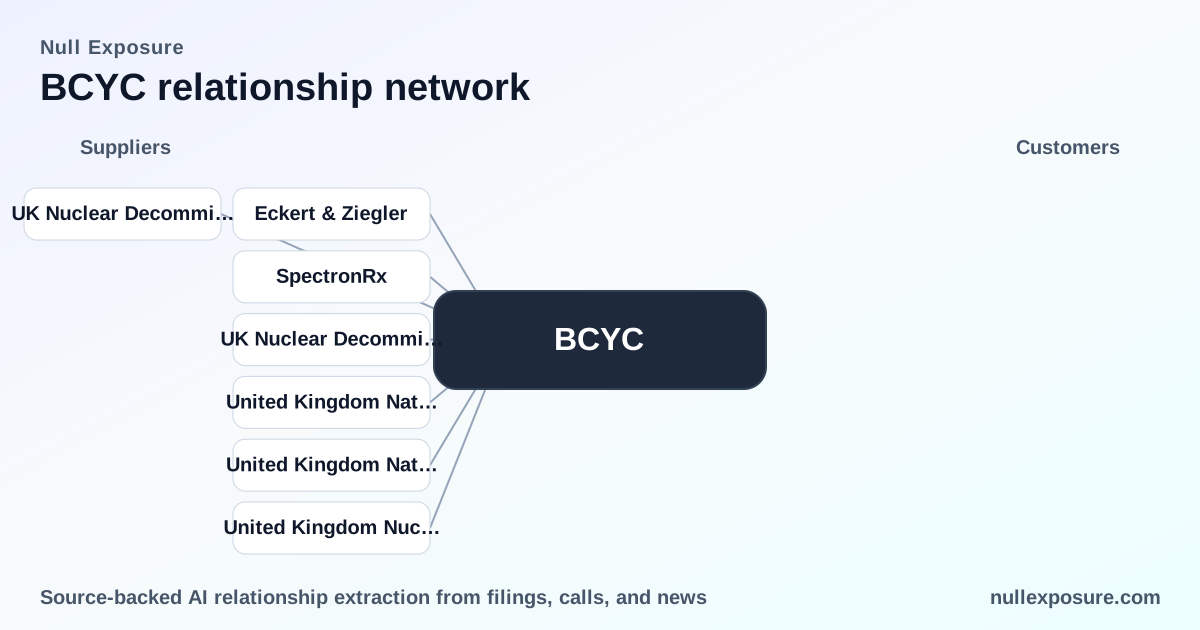
Bicycle Therapeutics (BCYC): How collaboration terminations reshaped customer revenue in FY2025–FY2026
Bicycle Therapeutics commercializes its proprietary cyclic peptide platform primarily through collaborations, licensing agreements, milestone payments and potential tiered royalties, rather than direct product sales today; the company's revenue profile is therefore concentrated and event-driven, with large one‑time revenue recognitions tied to partner decisions. Recent notices of termination from major partners converted deferred collaboration economics into a near-term revenue spike while simultaneously reducing the company’s future recurring collaboration runway, a dynamic that is central to any investor assessment of BCYC’s customer relationships and cash conversion prospects. For a deeper read on counterparties and contractual signals, visit the firm’s intelligence hub at https://nullexposure.com/.
What happened: a one-time revenue conversion and the structural consequences
Bicycle reported a material increase in collaboration revenue in late 2025 driven by recognition of all remaining revenue under terminated collaboration agreements. The company disclosed that roughly $44.3 million (quarter) and $37.3 million (year) of the collaboration revenue increase reflected recognition tied to termination notices, including those from Novartis and a Bayer program. At the same time, first‑quarter commentary for 2026 highlighted an overall decrease in collaboration revenue of $9.1 million attributable to termination of programs with Genentech and Novartis, underscoring that the terminations are already reshaping the top‑line cadence. (Source: Bicycle Therapeutics press releases reported on PharmiWeb and BioSpace, March 17, 2026 and the BioSpace 2026 financial update.)
Key takeaway: Termination events delivered a near‑term accounting benefit but crystallize a lower recurring revenue baseline and increase dependence on new deals and internal pipeline progress.
Provider-by-provider relationship roundup
Novartis / Novartis Pharma AG
Bicycle recognized the full remaining revenue under its collaboration with Novartis after Novartis issued a notice of termination, driving a substantial portion of the late‑2025 collaboration revenue increase. This termination both accelerated revenue recognition in FY2025 and reduced Novartis‑related future revenue potential. (Reported in Bicycle Therapeutics’ FY2025/FY2026 financial commentary; see PharmiWeb press release, March 17, 2026, and company press material republished on BioSpace, May 2026.)
Bayer Consumer Care AG (Bayer)
Bicycle recorded revenue related to a termination of one target program under its collaboration with Bayer Consumer Care AG, contributing to the same revenue lift described above; the disclosure frames that recognition as part of the conversion of deferred collaboration economics to recognized revenue. The company’s statements tie Bayer program termination directly to the FY2025 revenue uptick. (Source: PharmiWeb press release on Bicycle Therapeutics’ FY2025 results, March 17, 2026; corroborated in BioSpace reporting.)
Genentech
Genentech terminated multiple collaboration programs with Bicycle, and the company explicitly allocated a portion of the reduction in collaboration revenue in early 2026 to those terminations; previous program discontinuations generated one‑off revenue recognitions in prior reporting periods as material rights expired. The termination history with Genentech reflects a pattern where program exits generate immediate accounting gains while removing future upside tied to milestones and royalties. (Source: Bicycle Therapeutics’ financial results discussed on BioSpace and historical disclosures cited in the company’s FY2023–FY2025 notes.)
What the contractual signals and constraints reveal about BCYC’s operating model
The company disclosures and extracted constraint signals paint a consistent picture of Bicycle’s business model and counterparty posture:
-
Contracting posture – licensing and milestone‑driven: Bicycle operates as a licensor/licensee in collaborations where it can receive milestone payments and tiered royalties ranging from mid‑single to low‑double digits if partnered candidates are commercialized, a structure explicitly referenced in the Genentech licensing language. This creates asymmetric economics: significant upside on commercialization but uneven, event‑driven cash flows until approvals occur. (Genentech licensing language quoted in company filings.)
-
Revenue concentration and criticality: Collaboration revenue is material to reported revenue volatility, since terminations trigger immediate recognition of deferred amounts while eliminating future milestone streams. The FY2025 recognition event exemplifies both the positive one‑time effect and the negative structural consequence for recurring revenue.
-
Geographic footprint and payor exposure: The company attributes collaboration revenue to UK operations (EMEA) and flags the United States as a potential source of future revenue, indicating a mixed EMEA/NA revenue geography and exposure to U.S. government payors and commercial insurers for downstream product uptake and pricing. (Company filings reference UK operations and U.S. reimbursement dynamics.)
-
Counterparty types and maturity: Bicycle transacts primarily with large pharmaceutical partners rather than retail or direct patients; the disclosures also highlight government payors and managed care organizations as relevant stakeholders for commercialization. Several programs with major partners have already reached termination, so the partnership maturity profile includes both active research collaborations and terminated, legacy arrangements.
-
Relationship role signals: The company is positioned as a licensee / partner in major collaborations, entitled to royalties and milestone receipts if partners advance candidates, while healthcare providers and third‑party payors function as buyers/coverage decision makers in a downstream commercialization scenario.
-
Materiality nuance: Some joint research committee (JRC) participations are described as immaterial to the overall contract economics, a signal that not all governance or research roles materially affect revenue recognition. (Company disclosure language on JRC assessment.)
Investment implications — what investors should watch
Bicycle’s commercial profile creates a distinctive set of investment levers and risks:
- Positive: near‑term cash conversion. Termination notices provided immediate revenue realization and improved cash inflow in FY2025, which can extend runway if preserved.
- Negative: lower recurring revenue. Once deferred collaboration revenue is exhausted, future top‑line depends on new partnerships, milestone realization, or internal product commercialization.
- Counterparty risk concentration. Large partners such as Novartis, Bayer and Genentech account for headline revenue movements; further program exits would repeat the same pattern.
- Geographic and payor uncertainty. Commercial value ultimately depends on successful regulatory and reimbursement outcomes in EMEA and North America, with government payors explicitly called out as pricing gatekeepers.
- Monitor contract disclosures. Future filings should be read for remaining deferred revenue balances, royalty provisions, and any new licensing/milestone arrangements that replace terminated programs.
For practitioners conducting deeper diligence, review the company’s latest financial releases and partner notices to reconcile deferred revenue schedules against the FY2025 one‑time recognition events.
If you’d like a consolidated view of BCYC’s partner network and contract signals updated in real time, visit https://nullexposure.com/ for our partner intelligence and analytical briefings.
Conclusion
Bicycle Therapeutics operates a collaboration‑heavy monetization model where partner decisions materially change near‑term earnings and the long‑term revenue trajectory. The FY2025–FY2026 terminations converted deferred economics into a one‑off boost while lowering the recurring collaboration base, increasing reliance on new deals, internal pipeline progress, or commercialization milestones to sustain revenue growth. Investors should track future partner activity, deferred revenue disclosures, and any new licensing agreements for a clear read on sustainable revenue prospects.
Sources referenced in this commentary include Bicycle Therapeutics’ FY2025/FY2026 financial and business progress releases as reported on PharmiWeb (March 17, 2026), the company press distribution on BioSpace (May 2026), and subsequent market reporting summarized on financial news outlets during the FY2026 reporting cycle.