Belden Inc (BDC): Customer Relationships That Drive Durable Revenue and Distribution Leverage
Belden sells signal transmission and connection solutions to industrial, infrastructure and OEM customers and monetizes through product sales, value-added distribution channels, and recurring support/professional services. Revenue mixes between direct OEM sales, a broad distributor network, and growing services/support revenues create a hybrid commercial model: product-led cash flows with incremental, ratable service income that supports margins and customer stickiness. For investors evaluating counterparty exposure and customer concentration, the company’s recent customer news and its 2024 financial disclosures together reveal a well-defined distribution posture, meaningful concentration with a single large distributor, and a global footprint that shapes risk and opportunity.
Learn more about how we synthesize customer relationships and filing signals at https://nullexposure.com/.
How Belden actually sells and gets paid — the operating model in plain English
Belden’s core go-to-market is manufacture-plus-distribution: the company produces cable and connectivity hardware and sells it through a combination of direct OEM contracts and a network of distributors, value‑added resellers and system integrators. Product sales generate the bulk of revenue, while support and professional services are billed and recognized over contract terms, producing a modest but growing recurring revenue component. The company records deferred revenue and allocates consideration to ratable support performance when contracts include maintenance, which creates predictable short‑to‑medium term cash flows alongside transactional product receipts.
Recent customer news that matters to investors
Belden’s public customer mentions in 2026 highlight two relationship dynamics: distribution partnerships to extend market reach, and automation/IoT integrations that deepen product‑service value. Below I cover each relationship identified in the news record and link to the underlying reports.
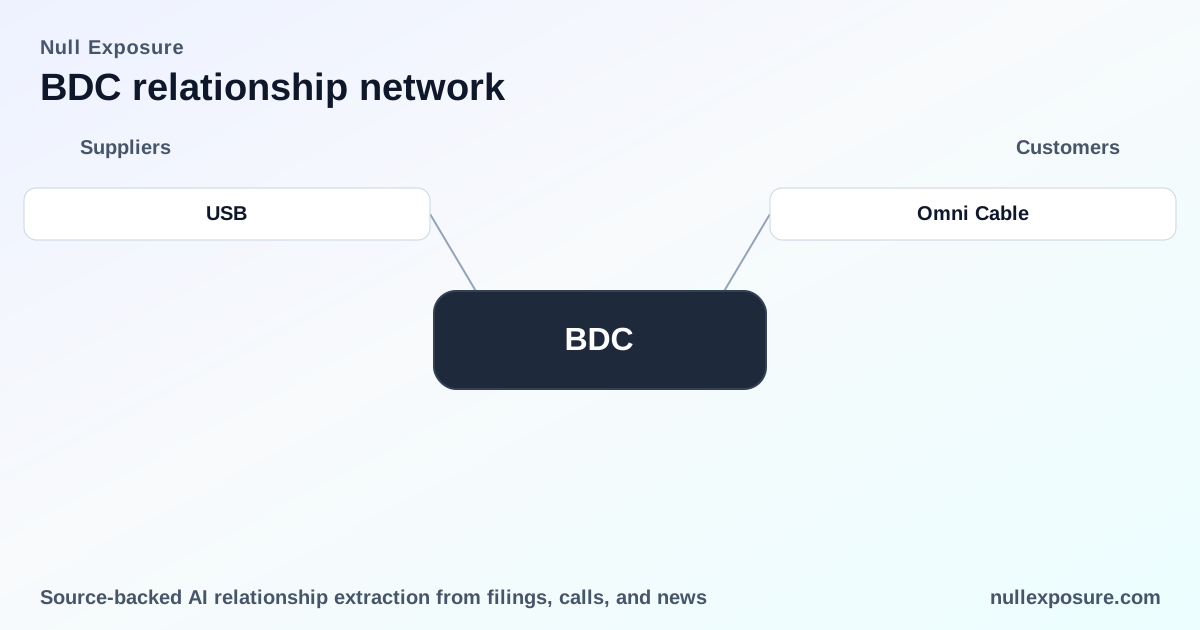
Omni Cable — distribution collaboration to broaden reach
Belden announced a collaboration with Omni Cable focused on leveraging Omni Cable’s distribution network together with Belden’s cable and communications expertise to expand reach and availability. This is a commercial distribution partnership designed to increase channel penetration rather than a strategic acquisition or exclusive supply deal. (Traders Union news, March 9, 2026: https://tradersunion.com/news/companies/show/1321503-belden-omni-cable-partners/)
Kamax — automation integration that reduces operating time
Belden deployed its CloudRail platform and AWS IoT Greengrass to integrate shop‑floor sensors at Kamax, delivering a 3.5% reduction in operator time through cloud analytics. This example illustrates Belden’s ability to sell solutions that combine hardware, edge computing and recurring analytics/service value — increasing customer switching costs and upsell potential. (Traders Union news, May 2, 2026: https://tradersunion.com/news/companies/show/1783360-kamax-cloudrail-integration/)
What the filings and constraints tell us about contract posture and maturity
Belden’s disclosure and the extracted constraint signals describe a mixed contract environment with both short transactional sales and pockets of long‑duration contractual revenue:
- Long-term contractual elements exist. As of December 31, 2024 Belden reported $40.1 million of deferred revenue, of which $10.3 million is classified as long‑term. This indicates a non‑trivial amount of revenue recognized beyond 12 months, consistent with multi‑period service or support arrangements in the business.
- Short-term transactional dynamics persist. The company also states that many supply agreements with distributors and OEMs do not obligate customers to buy exclusively or in minimum amounts; this is a core signal that a substantial portion of product revenue remains purchase‑on‑demand rather than locked by long minimum commitments.
- Ratable subscription-style recognition for support. Consideration for support and maintenance is typically paid in advance and recognized ratably, signaling predictable, recurring revenue flows from service contracts even if those contracts are not large enough to meaningfully change revenue CAGR by themselves.
- Global reach with material non‑US sales. Belden runs two global lines — Smart Infrastructure and Automation Solutions — and reported approximately 43% of sales outside the U.S. in 2024, confirming geographic diversification that moderates single‑market risk but increases exposure to multi‑jurisdiction supply and logistics considerations.
- Maturity and role signals. The company acts as manufacturer, seller and supplier to distributors and OEMs, and uses resellers and system integrators for certain automation products; this demonstrates an established, multi‑channel go‑to‑market with standard industrial maturity rather than an early‑stage direct‑sales model.
Concentration and criticality — where counterparty risk really sits
Belden displays meaningful customer concentration on the distribution side:
- Largest distributor represented ~14% of consolidated revenue in 2024, and the top eight distributors collectively accounted for 33% of revenue. The company also reported roughly $348.1 million of revenue coming from its largest customer across two segments for the last three years — a persistent, material relationship. This is a critical commercial dependency that investors must monitor for renewal terms, pricing pressure, and counterparty credit.
- No other single customer exceeds 10%, indicating that after the largest distributor the revenue base disperses, which moderates catastrophic counterparty concentration risk but preserves notable dependency on distribution channels.
Why the two recent relationships are informative for buy‑side and ops teams
- Omni Cable underscores channel strategy. A distribution collaboration signals that Belden continues to rely on downstream partners to scale product availability and manage inventory, reinforcing the materiality of distributor relationships highlighted in filings.
- Kamax demonstrates product + services economics. The CloudRail/AWS integration shows how Belden converts hardware relationships into recurring service value and operational efficiency improvements for customers, which supports higher lifetime value and potential margin enhancement over pure hardware sales.
Investment implications and operational risks
- Positive: Diversified revenue streams with growing services. Hardware sales provide scale; recurring support and cloud‑enabled solutions add predictable revenue and an upsell vector. This hybrid model supports steady margins and multiple levers for growth.
- Negative: Distributor concentration is a real governance and counterparty risk. With one distributor at ~14% of revenue and the top eight at 33%, changes in distribution terms, inventory allocation or credit stress could materially affect results.
- Operational: Global supply and logistics exposure. Roughly 43% of sales outside the U.S. combined with manufacturing and distribution roles increases complexity and exposure to localized disruptions.
- Contracting posture: Mixed — product sales largely transactional, but support/maintenance adds ratable, long‑dated recognition for a portion of revenue. Investors should track deferred revenue trends and the mix shift toward services over time.
Bottom line — what investors and operators should watch next
Belden operates a mature, channel‑driven business that is balanced between transactional product sales and increasing services-led revenue. The two 2026 customer mentions — Omni Cable and Kamax — expose both sides of that balance: distribution breadth and value‑added service engagements. For investors, the primary monitoring items are renewal dynamics and terms with the largest distributor(s), the pace of services revenue growth (deferred revenue trend), and the company’s ability to monetize IoT/analytics integrations at scale.
If you want a structured, comparable view of Belden’s customer exposure and constraint signals across filings and market mentions, visit https://nullexposure.com/ for deeper analysis and dashboard access.