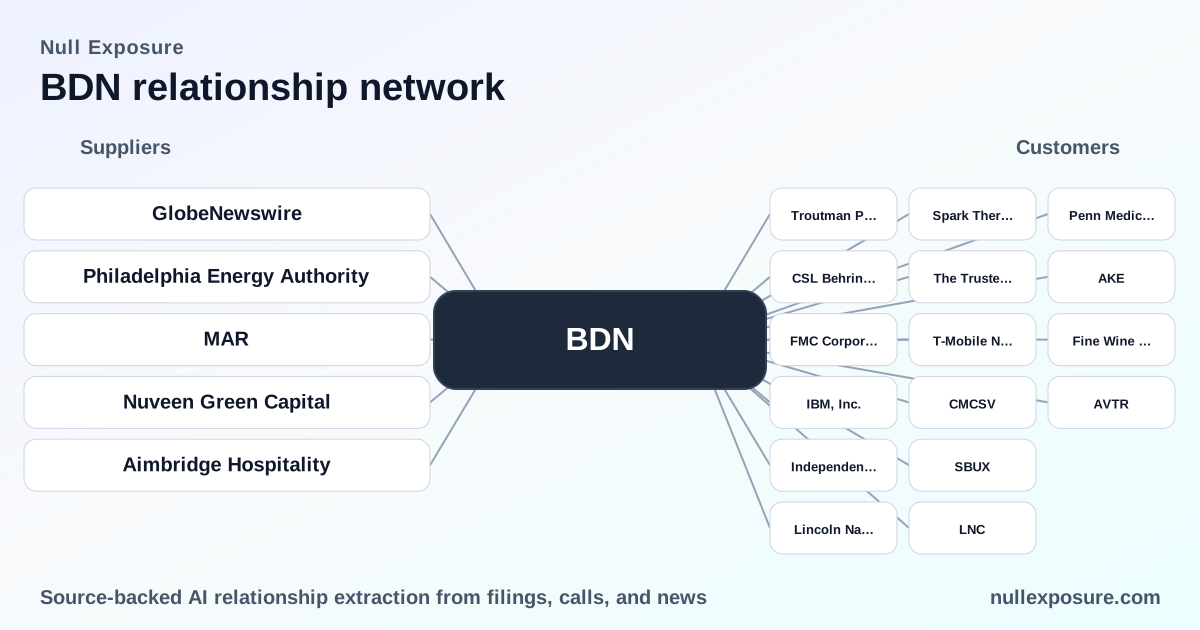
Brandywine Realty Trust (BDN): customer map and commercial implications for investors
Brandywine Realty Trust operates as a self‑administered, self‑managed REIT that monetizes primarily through long‑term office and mixed‑use leases, complemented by property management and development fees. The company’s revenue mix is dominated by tenant rents in core markets (Philadelphia, Pennsylvania suburbs, Austin and the Washington, D.C. area), with incremental cash flow from third‑party management contracts and redevelopment activity that converts underused assets into higher‑yield product. For investors, the cash‑flow durability depends on lease term length, tenant quality and geographic concentration.
Explore a concise dataset of tenant relationships and management partners at https://nullexposure.com/ — useful background for underwriting counterparty concentration and lease roll risk.
How Brandywine runs its customer business: the operating model that matters to valuation
Brandywine is both a landlord and a service provider. Leases are the primary revenue engine, accounted for mostly as operating leases, while management fees and development/redevelopment contracts are a secondary but strategically important revenue stream. The company reports a weighted average lease term of roughly 6.4 years for leases commenced, which signals a materially long contract posture versus short‑term flex office models (source: 2024 Form 10‑K). Geographically, Brandywine’s cash flows concentrate in Philadelphia and its suburbs, Austin and the Washington, D.C. region, which creates both local market exposure and opportunities from large, stable corporate tenants (2024 Form 10‑K).
Because the company is self‑managed, operating control and cost capture reside in‑house, enabling higher capture of development upside but also concentrating execution risk and labor costs on Brandywine’s platform (2024 Form 10‑K). For investors, the critical dimensions to monitor are lease roll schedule, tenant credit mix, and progress on redevelopment projects that are intended to convert marginal assets into stabilized, cash‑flowing properties.
Check the platform for ongoing relationship intelligence and concentration analytics at https://nullexposure.com/.
Every named customer and partner — plain English takeaways
-
Troutman Pepper Hamilton Sanders LLP — Brandywine lists Troutman Pepper as a tenant with lease payments totaling $10,473 (2.5% of a cited line item) in its 2024 Form 10‑K, indicating a meaningful single‑tenant exposure at year‑end 2024 (Brandywine 2024 Form 10‑K).
-
The Trustees of the University of Pennsylvania — Penn’s trustees are reported as a tenant with $7,811 (1.8%) in the same 2024 filing, reflecting institutional tenancy in Brandywine’s Philadelphia assets (Brandywine 2024 Form 10‑K).
-
T‑Mobile Northeast, LLC — T‑Mobile Northeast is listed with $7,380 (1.7%) of tenant receipts in the 2024 Form 10‑K, showing wireless and telecom occupancy within Brandywine’s portfolio (Brandywine 2024 Form 10‑K).
-
CSL Behring, LLC — CSL Behrinig (CSL Behring) appears as a tenant contributor of $7,605 (1.8%), highlighting life‑science tenancy in properties that support lab and specialized office use (Brandywine 2024 Form 10‑K).
-
FMC Corporation — FMC is noted with $12,034 (2.8%) in lease receipts, signaling a sizable corporate presence in Brandywine’s tenant roster (Brandywine 2024 Form 10‑K).
-
IBM, Inc. — IBM accounts for $20,630 (4.9%) in the company’s tenant reporting, making it one of the largest single tenant revenue contributors disclosed in the 2024 10‑K (Brandywine 2024 Form 10‑K).
-
Independence Blue Cross LLC — Independence Blue Cross is recorded at $8,782 (2.1%), representing healthcare‑payer occupancy in Brandywine buildings in the Philadelphia area (Brandywine 2024 Form 10‑K).
-
Lincoln National Management Co. — Lincoln National’s management entity shows $10,372 (2.5%), reflective of the Lincoln Financial Group’s broader footprint within Brandywine’s suburban holdings (Brandywine 2024 Form 10‑K).
-
Spark Therapeutics — Spark Therapeutics is listed at $18,711 (4.4%), a meaningful life‑science tenant concentration disclosed in the 2024 filing (Brandywine 2024 Form 10‑K).
-
CMCSV / Comcast Corporation — Comcast is listed twice in the results (as CMCSV and Comcast Corporation) with $12,462 (3.0%), confirming Comcast as a material tenant and demonstrating a repeatable revenue relationship called out in the Form 10‑K (Brandywine 2024 Form 10‑K).
-
Arkema (AKE) — Local reporting on Brandywine’s Radnor development confirms an office building is fully leased to Arkema, indicating a corporate HQ or large‑scale office tenancy tied to the Radnor complex (delco.today, August 2025).
-
Lincoln Financial Group (LNC) — Local news covering the Radnor hotel and office campus lists Lincoln Financial as a major tenant and source of hotel demand, reinforcing Lincoln’s role as a campus anchor tenant (delco.today, February 2026).
-
Penn Medicine — Coverage of the Radnor campus lists Penn Medicine among major tenants, suggesting healthcare system tenancy that drives ancillary demand for on‑campus services (delco.today, February 2026).
-
Starbucks / SBUX — Local reporting states that retail space in one building is occupied by Starbucks, indicating small‑footprint retail tenancy that supports street‑level revenue and tenant amenity capture (philadelphia.today, January 2026).
-
Fine Wine & Good Spirits — The retail tenant Fine Wine & Good Spirits is cited as occupying ground‑floor retail in a low‑leasing building, illustrating how Brandywine uses retail leases to underpin neighborhood retail income (philadelphia.today, January 2026).
-
Avira — Brandywine announced terms for a 7‑year financing for Avira for up to $100 million, with proceeds intended to repay a construction loan and close in Q2, signaling an active financing and development relationship (Brandywine press release via GlobeNewswire, April 22, 2026).
-
Avantor (AVTR) — Local articles describe Avantor as a headquarters tenant within Brandywine’s 2.1 million square‑foot Radnor complex, underlining life‑science and corporate tenant concentration on that campus (delco.today, August 2025).
Note: several relationships were captured from Brandywine’s 2024 Form 10‑K (tenant payment schedules) and local reporting on Brandywine’s Radnor development and project financing in 2025–2026.
What these relationships imply for valuation and risk
-
Contracting posture — long‑dated cash flow: The weighted average lease term of ~6.4 years signals a business built on multi‑year revenue contracts, which supports income stability but creates sensitivity to macroeconomic cycles at major roll dates (Brandywine 2024 Form 10‑K).
-
Concentration — regional and tenant anchors: The tenant list includes several large corporate and institutional anchors (IBM, Comcast, Spark Therapeutics, Lincoln Financial, Penn Medicine), and the portfolio is geographically concentrated in the Philadelphia metro, Austin and D.C. markets, making local market health a dominant determinant of performance (Brandywine 2024 Form 10‑K).
-
Criticality and tenant mix: Presence of healthcare, life‑sciences and corporate HQ tenants increases the strategic criticality of Brandywine’s assets to tenants that value stability and specialized space—an advantage in negotiated renewals and redevelopment pricing (Form 10‑K; local Radnor coverage).
-
Maturity and business model: Being self‑administered and self‑managed allows Brandywine to capture development upside and management fees but concentrates execution risk internally; management fees and third‑party development revenue are meaningful secondary cash flows and should be tracked as they can offset office leasing cyclicality (Brandywine 2024 Form 10‑K).
Bottom line for investors
Brandywine’s customer base blends large, creditworthy anchors with retail and life‑science tenants, underpinned by multi‑year leases and a strategy of converting development opportunities into stabilized income. Monitor lease expiries, Radnor campus stabilization, and the company’s execution on Avira financing as leading indicators of near‑term cash‑flow trajectory. For a deeper look at concentration metrics and to track counterparty exposures over time, visit https://nullexposure.com/.
Interested institutional investors can use relationship intelligence to stress test tenant roll risk and cash‑flow concentration; Brandywine’s mix of long leases and self‑managed development creates both durable income and execution risk that will determine upside from current market pricing.