Biodesix (BDSX): Customer Concentration Defines Revenue Stability — and Risk
Biodesix operates a dual revenue model: clinical lung diagnostic testing for providers (Nodify and related blood tests) and development services selling diagnostic and testing capabilities to biopharma partners. The company monetizes by billing third‑party payers for clinical tests and by contracting with large life‑science customers for development work; Medicare and large commercial insurers provide the bulk of reimbursement, while a handful of enterprise partners represent meaningful receivables. For investors and operators, the key investment thesis is straightforward: Biodesix’s growth and margin trajectory is tightly coupled to reimbursement flows and a small set of high‑value customers, so underwriting must weigh concentration-driven revenue resilience against contract and payer risk. For more structured relationship intelligence, visit https://nullexposure.com/.
Why customer relationships matter more than product launches
Biodesix’s offering is not a SaaS license you can swap overnight; it is a reimbursed clinical service plus bespoke development work. Revenue realization and collectability depend on payer policies, receivable profiles, and contract cadence. That makes each named customer or payer more than just a logo — they are a cash flow node whose behavior directly impacts quarterly results and cash conversion.
Relationship roster: who pays Biodesix and why it matters
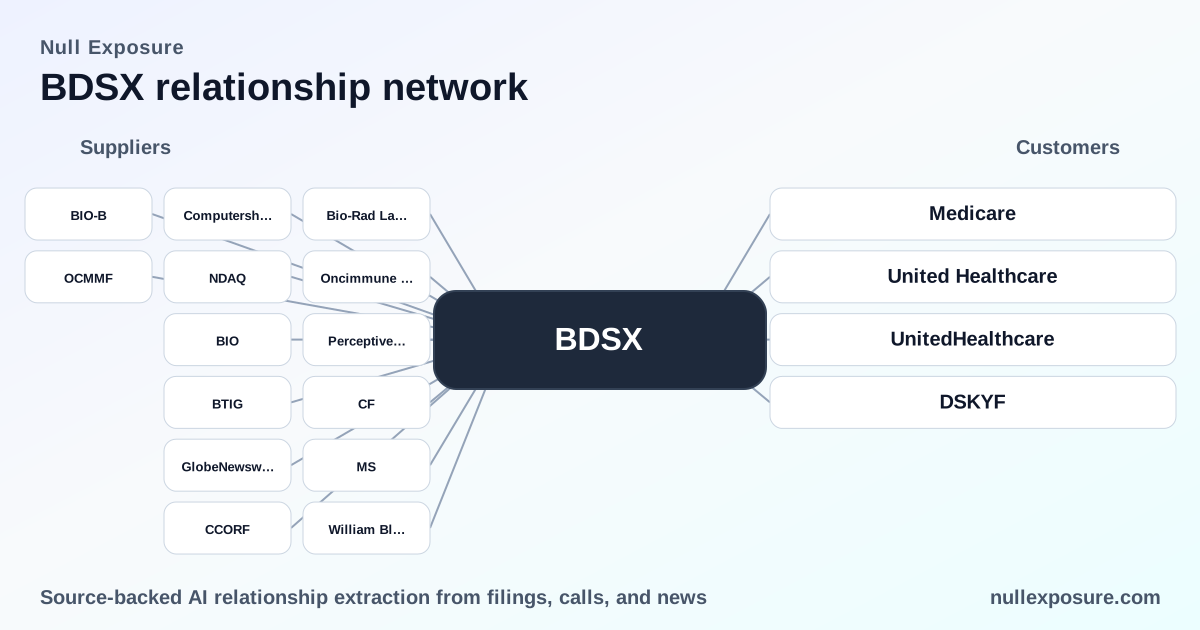
Below are the company’s disclosed customer relationships and the public evidence supporting their relevance.
-
Medicare — For FY2024, Medicare reimbursed 39% of Biodesix’s total revenue, down from 43% in FY2023, highlighting Medicare as the single largest payer and a critical source of cash flow. According to Biodesix’s FY2024 10‑K filing, Medicare’s contribution to revenue is explicitly quantified, underlining material dependence on government reimbursement (FY2024 10‑K).
-
United Healthcare — United Healthcare accounted for 7% of total revenue in 2024 (10% in 2023), a material commercial payer relationship that influences reimbursement mix and pricing dynamics. This disclosure is noted in the FY2024 10‑K’s customer concentration table (FY2024 10‑K).
-
UnitedHealthcare — The company’s reporting also lists UnitedHealthcare in account classifications used for revenue disclosure and concentration analysis; the FY2024 10‑K includes UnitedHealthcare in revenue/member mappings used to disclose customers over 10% (FY2024 10‑K).
-
Daiichi Sankyo (DSKYF) — Daiichi Sankyo appears in receivables concentration schedules, accounting for 14% of accounts receivable as of December 31, 2024 (up from 8% in 2023), identifying it as a meaningful development‑services counterparty and a material balance sheet exposure. This is disclosed in Biodesix’s FY2024 10‑K accounts receivable breakdown (FY2024 10‑K).
-
DSKYF — The same receivable line is reported under the ticker/inferred symbol DSKYF in the FY2024 10‑K, reinforcing that Daiichi Sankyo is a named enterprise counterparty with elevated accounts receivable seasoning and materiality (FY2024 10‑K).
-
Fort Walton‑Destin Hospital — Clinical users and hospital systems such as Fort Walton‑Destin Hospital publicly endorse the Nodify CDT lung‑nodule test following Biodesix’s large clinical validation study, commenting that the test reduces false positives and aids clinical decision‑making for nodules 4–30 mm. These endorsements are recorded in March–May 2026 press coverage, including a GlobeNewswire release and subsequent reposts (GlobeNewswire, March 20, 2026; QuiverQuant and ManilaTimes coverage, March–May 2026).
-
Fort Walton‑Destin Hospital (duplicate press mentions) — Multiple media outlets repeated the same clinical endorsement and study results in spring 2026, underscoring market reception among pulmonologists and community hospitals for the Nodify Lung test (GlobeNewswire / QuiverQuant / ManilaTimes, March–May 2026).
Each of the above relationships is documented in Biodesix’s SEC filing or in public press releases and industry coverage cited in the company’s public disclosures and PR cycle (FY2024 10‑K; press releases March–May 2026).
How the operating model and contract constraints shape valuation
Biodesix’s customer and contract profile produce several clear operating characteristics you must model into forecasts and scenario analysis:
-
Short-term contracting posture — The company states that test services are generally completed or recognized within a year, and GPO/IDN contracts are typically terminable on 60–90 days’ notice; this produces limited revenue visibility beyond the current quarter and raises churn sensitivity. Treat near‑term revenue as service‑based with modest long‑dated contractual lock‑in.
-
Payer concentration and government exposure — Substantially all revenue is U.S.-derived and Medicare represents the single largest payer, giving reimbursement policy shifts immediate impact on top line and margins. This is a company‑level signal supported by the 10‑K disclosure that most revenue is U.S.-based and third‑party payer funded.
-
Large enterprise counterparty dynamics — Biodesix markets development services to large biopharma partners where collectability is generally strong and revenue is recognized upon completion of performance obligations; this supports higher‑value, lump‑sum billings but can create episodic receivable concentrations (Daiichi Sankyo receivable example in FY2024 10‑K).
-
Geographic concentration — The business is primarily U.S. focused for both revenue and long‑lived assets, meaning macro healthcare policy and U.S. payer mix drive the risk/return profile.
-
Service segment economics — Revenue comes from clinical testing and development services; both are service lines with project completion timing and payer negotiation as primary value levers rather than high‑margin recurring licensing.
Together these constraints imply that valuation should emphasize cash‑flow scenario modeling, receivable aging sensitivity, and implied reimbursement risk more than product pipeline discounting.
Key takeaways for investors and operators
- Concentration equals leverage: Medicare’s 39% share in 2024 is both a stability anchor and a single‑point systemic risk; reimbursement policy shifts will move the needle materially.
- Receivables require active management: Enterprise contracts such as Daiichi Sankyo create meaningful AR exposure that can compress liquidity if not managed.
- Clinical adoption supports growth but is not a substitute for predictable contracts: Hospital endorsements after the large Nodify CDT validation study improve clinical credibility, but adoption still converts into revenue only through payer reimbursement and hospital ordering behavior.
For further relationship intelligence and data‑driven customer analysis on Biodesix, explore structured signals and filings at https://nullexposure.com/.
Investors should incorporate these customer dynamics explicitly into scenario analyses, stress testing Medicare reimbursement and receivable concentrations to estimate cash runway and valuation sensitivity.