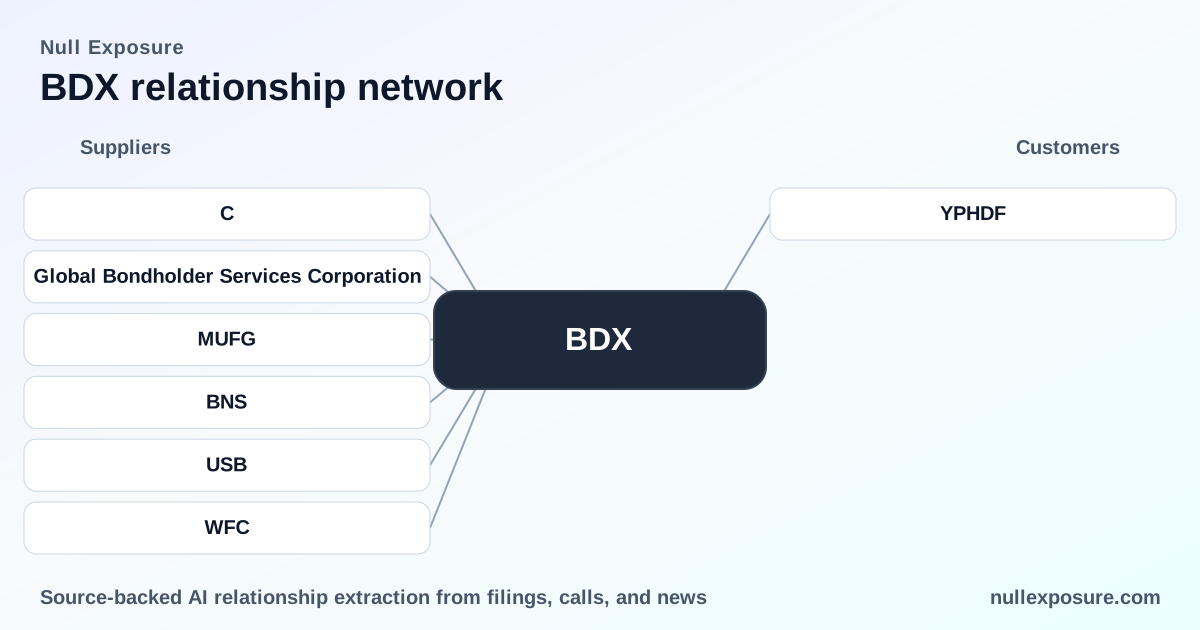
BDX customer map: what counterparty signals tell investors about revenue durability and operational leverage
Becton, Dickinson and Company (BDX) operates as a global medical-technology manufacturer and distributor that monetizes through the sale of devices, consumables and instrument systems, recurring reagent and consumables revenue, and selective services/analytics contracts. Revenue is driven by durable hospital and laboratory demand, recurring consumables tied to installed systems, and a broad geographic footprint that insulates top-line volatility. For investors evaluating counterparty exposure, the relationships in market filings and press releases highlight both BD’s critical supplier role to carved‑out businesses and its continuing manufacturing and OEM links following strategic divestitures.
If you want a consolidated view of these customer signals and how they affect credit and revenue risk, see our research hub: https://nullexposure.com/
What the relationship set reveals about BD’s operating model
BD’s customer relationships present a consistent commercial posture: manufacturer + direct seller + channel distributor. The evidence collected from filings and press captures three meaningful operating characteristics:
- Contracting posture and criticality: Several counterparties have contractual dependencies on BD services and systems, creating switching risk and embedded revenue streams.
- Geographic diversification with concentration: BD is truly global—United States is the largest market—reducing single-country revenue concentration but leaving exposure to region-specific supply chains.
- Maturity and supplier role: BD functions both as a strategic supplier (OEM/manufacturer) and as a distributor through independent channels, which supports stable gross margins but creates third‑party supplier risk for customers.
Company-level constraints and what they signal for customers
- Global scale and regional mix. BD reported FY2025 regional revenues with the United States at approximately $12.8 billion, EMEA around $4.7 billion, and Greater Asia about $3.1 billion, indicating a North America‑heavy revenue base alongside meaningful EMEA/Asia diversification (company regional table, FY2025).
- Role breadth. BD is documented as a manufacturer, seller, and distributor—it builds products, sells direct to hospitals and labs, and routes product through independent channels, which explains both recurring consumables revenue and complex third‑party dependencies (company description and distribution statements).
- Counterparty mix. Evidence suggests BD engages with institutional healthcare buyers, specialty diagnostic firms, and spun‑off businesses that retain transitional service agreements—this raises contractual concentration and replacement risk when BD supports legacy systems or transitional services.
For deeper context on our approach to counterparty mapping, visit our site: https://nullexposure.com/
Relationship map: every counterparty you should know
Below are the counterparties captured in recent public disclosures and press coverage, with a concise plain‑English take and the source for investor due diligence.
-
Embecta Corp (EMBC) — Embecta reported specific amounts due to Becton, Dickinson and Company in its FY2025 reporting, signaling an active receivable/payable relationship and cash flow linkage between the entities (Embecta FY2025 release, GlobeNewswire, Aug 8, 2025).
Source: Embecta FY2025 third-quarter release and FY2025 full-year results on GlobeNewswire (Aug 2025; Nov 25, 2025). -
Embecta Corp (EMBC) — In its fiscal disclosures, Embecta explicitly noted contractual dependency on services provided by BD and flagged the company’s inability to replace those services as a risk in its transition documents, which indicates transition service agreements or similar arrangements are material to Embecta’s operations (Embecta FY2025 financial results and guidance).
Source: Embecta FY2025 filings and investor release (GlobeNewswire Nov 25, 2025; Yahoo Finance coverage of FY2025 filing). -
Embecta Corp (EMBC) — Management commentary around ERP and shared services described completing implementation work that removed the last market operating on BD systems, highlighting a historical operational integration between the companies and the residual importance of BD systems during carve‑outs (earnings call transcript, Q3 FY2025).
Source: Embecta Q3 FY2025 earnings call transcript (InsiderMonkey / earnings coverage, Q3 FY2025). -
Embecta Corp (EMBC) — Embecta’s public risk disclosures also list supply‑chain disruption risk from third‑party suppliers like BD as a possible adverse factor for operations, underscoring the supplier‑side concentration risk for certain product lines (MD&A and risk factors commentary).
Source: Embecta SEC notes and earnings commentary as summarized on financial news sites (TradingView coverage of Embecta SEC 10‑K, FY2025). -
UNC Health Blue Ridge — UNC Health Blue Ridge is among the first health systems to pilot BD’s CentroVena One™ vascular access system as part of an initial clinical evaluation, showing BD’s go‑to‑market approach of early adopter hospital pilots to drive clinical adoption for new devices (BD press release, Apr 29, 2026).
Source: BD corporate news release (BD News, Apr 29, 2026). -
Waters Corporation (WAT) — Multiple reports document that BD executed a spin‑off of its biosciences and diagnostics business with legal and advisory support that culminated in an ultimate sale to Waters Corporation, indicating a structural transfer of product lines and customer relationships to Waters (legal industry coverage of the transaction).
Source: Legal industry coverage of BD’s spin‑off and sale to Waters (Economic Times legal column, May 2026). -
Waters Corporation (WAT) — Product-level reporting shows the Onclarity HPV Self‑Collection Kit, Onclarity HPV Assay, and BD COR System are made by BD or affiliates, which implies ongoing OEM/manufacturing ties or transitional supply arrangements even after portfolio transactions (corporate product announcement coverage).
Source: Waters and industry press noting manufacturing provenance and FDA clearance (Finviz / company coverage May 2026). -
Waters / market context — Coverage of the microbiology and diagnostics market frames Waters as a buyer of BD’s biosciences assets and a competitor in clinical microbiology, confirming that the spin‑off materially reshapes BD’s counterparty landscape in diagnostics (industry reporting on the asset sale and market consolidation).
Source: MedTech Dive coverage on market activity and transactions (May 2026). -
Ypsomed (YPHDF) — BD announced an expanded collaboration with Ypsomed to co‑develop a 5.5 mL version of the BD Neopak XtraFlow glass prefillable syringe, signaling BD’s continued OEM/co‑development relationships with device partners to capture biologics and large‑volume prefilled syringe demand.
Source: TradingView summary of the BD–Ypsomed collaboration (Mar 2026).
Investment implications: revenue durability, supplier risk, and strategic re‑mixing
- Embedded contractual reliance is a double‑edged sword. Contracts that make BD critical to a customer’s operations (for example, Embecta’s transitional services and amounts due) support recurring revenue but create replacement risk and counterparty credit linkage that investors should monitor.
- Divestitures recompose exposure. The spin‑off and sale of BD’s biosciences and diagnostics business to Waters shifts where certain product revenues sit and creates short‑ to medium‑term OEM and transitional supply arrangements that complicate revenue forecasting. Coverage shows BD continues to be listed as a manufacturer for some assay components, which supports near‑term revenue streams even as ownership changes (Waters transactional coverage, May 2026).
- Geography and channel mitigate but don’t eliminate risk. BD’s US‑centric revenue base (~$12.8B FY2025) combined with robust EMEA and Greater Asia sales reduces single‑market risk, yet global manufacturing/distribution networks introduce supply‑chain vulnerability for customers dependent on BD as a third‑party supplier.
Bottom line: what to watch next
- Monitor Embecta transitional arrangements and receivables for signs of payment or replacement‑service stress; these are direct indicators of BD’s contractual leverage.
- Watch the cadence of OEM/transitional supply disclosures with Waters to determine how much diagnostic revenue remains tied to BD manufacturing after the sale.
- Track product pilot rollouts (CentroVena One™ and prefillable‑syringe collaborations) as leading indicators for adoption and consumables attach rates.
Key takeaway: BD’s role as manufacturer, distributor and service provider creates revenue stability through recurring consumables but introduces concentrated supplier relationships and transitional contract risk following divestitures—these are the counterparty dynamics investors must model into revenue and credit scenarios.
For ongoing signal tracking and a consolidated counterparty view, visit https://nullexposure.com/