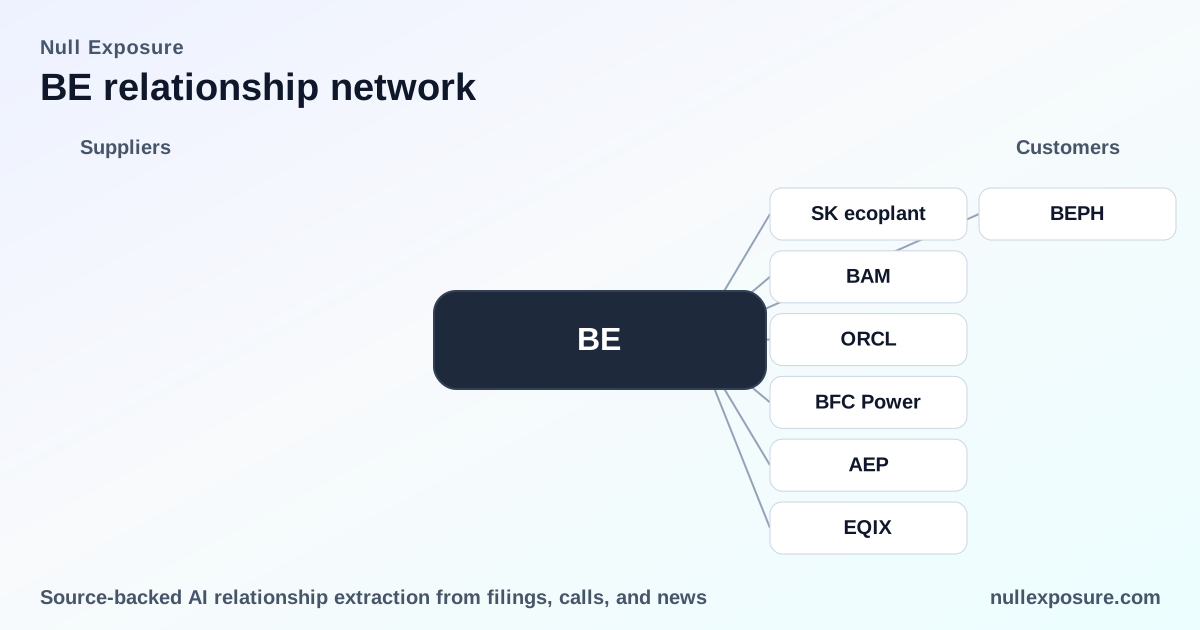
Bloom Energy’s customer map: how on-site fuel cells turned enterprise contracts into a growth thesis
Bloom Energy designs, manufactures and sells solid oxide fuel cell systems that generate on-site electricity and sell power and services under long-term, usage-based contracts to large enterprise customers and utilities. Revenue streams split between hardware sales and recurring service/PPA income, with customers ranging from utilities to hyperscale data-center operators; recent multi‑billion dollar frameworks with infrastructure investors and utilities materially expand Bloom’s addressable market and revenue visibility. For a concise portfolio view and data-driven signals on counterparties, visit https://nullexposure.com/.
Business model in a sentence — the economics that matter to investors
Bloom monetizes through two complementary channels: product sales of Energy Servers (capital revenue) and ongoing electricity/service contracts (usage-based, recurring revenue). The company increasingly leverages third‑party capital and partners to de‑risk large installations, turning capital‑intensive deployments into fee and generation revenue streams while retaining service contracts and performance guarantees.
Company‑level constraints and what they imply for operators and investors
- Contracting posture: Bloom executes long‑term Power Purchase Agreements (PPAs) and usage‑based contracts, with terms referenced up to 10–21 years and revenue recognized as electricity is generated. This structure aligns Bloom with recurring cash flows but also locks the company into long horizon delivery and performance obligations.
- Counterparty profile and concentration: The customer base skews large enterprise and investment‑grade counterparties across utilities, data centers, and infrastructure owners; three customers accounted for ~53% of 2024 revenue, highlighting concentration risk alongside strategic depth.
- Geographic footprint and maturity: The business is U.S.-centric (roughly 70–74% of revenue) but active globally (APAC footprint including South Korea, Japan, India). Scale in the U.S. drives near‑term revenue, while international markets are a high‑growth runway.
- Criticality and service model: Bloom provides service and O&M for every installed system worldwide, guaranteeing output and efficiency — a revenue stream that is contractually sticky and operationally intensive.
- Capital intensity and partner financing: Large deployments increasingly involve third‑party investors and utility partners, reducing Bloom’s capital burden but creating dependencies on partner timelines and capital commitments.
- Material spend signals: Company disclosures reference $100M+ contractual commitments (letter of credit and large supply agreements), which underscores the enterprise scale of several engagements.
These characteristics translate to highly visible recurring revenue underpinned by concentrated, strategic counterparties, but elevated execution and delivery risk tied to manufacturing cadence and partner funding.
Counterparty map — each customer relationship recorded (plain English, with sources)
Below are discrete summaries of every counterparty listed in the records, each with a concise source reference.
-
BAM (Brookfield Asset Management) — Bloom signed a framework under which Brookfield will invest up to $5 billion to deploy Bloom’s fuel‑cell technology and designated Bloom as the preferred on‑site power provider for Brookfield’s global AI factories. Source: Bloom Energy press release (Mar 9, 2026). https://www.bloomenergy.com/news/brookfield-and-bloom-energy-announce-5-billion-strategic-ai-infrastructure-partnership/
-
Brookfield Asset Management — The same Brookfield press release framed Brookfield as a strategic investor/operator that will fund deployment of Bloom Energy servers across AI infrastructure projects. Source: The Globe and Mail / Bloom press release (Mar 2026). https://www.theglobeandmail.com/investing/markets/stocks/BAM-N/pressreleases/35404199/brookfield-and-bloom-energy-announce-5-billion-strategic-ai-infrastructure-partnership/
-
Brookfield (general references) — Multiple market reports and commentary treat Brookfield’s involvement as a validation event that accelerates Bloom’s position in the data‑center power market. Source: TradingView commentary and Marketscreener coverage (Mar–May 2026). https://www.marketscreener.com/news/brookfield-bloom-energy-form-5-billion-ai-infrastructure-partnership-ce7d5ad8df8cfe23
-
Brookfield Renewable Partners (BEP) — Coverage notes Brookfield Renewable will not simply buy Bloom servers; the partnership contemplates Brookfield providing capital and an ownership model where a separate entity purchases Bloom Energy Servers, shifting capital exposure away from Bloom. Source: MarketBeat analysis (May 2026). https://www.marketbeat.com/stock-ideas/bloom-energys-game-changing-ai-deal-why-the-rally-has-legs/
-
BEPH / Brookfield variants — Hydrogen‑industry outlets and secondary press used alternate Brookfield tickers (BEPH) when reporting the deal; the substance remains Brookfield’s multi‑billion deployment commitment. Source: Hydrogen‑Central (Mar 2026). https://hydrogen-central.com/brookfield-and-bloom-energy-announce-5-billion-strategic-ai-infrastructure-data-center-partnership/
-
BIP (Brookfield Infrastructure Partners) — Brookfield Infrastructure completed the inaugural project under the $5B framework by installing 55 MW of behind‑the‑meter power at a U.S. data center, evidencing rapid execution under the framework. Source: Brookfield Infrastructure earnings release (FY2026). https://www.theglobeandmail.com/investing/markets/stocks/BIP-N/pressreleases/36473405/brookfield-infrastructure-reports-solid-2025-year-end-results-declares-17th-consecutive-distribution-increase/
-
SK ecoplant — SK ecoplant executed a contract for a minimum of 500 MW through 2024, representing roughly $4.5 billion in equipment and services revenue under earlier commercial arrangements. Source: Bloom Energy press release on expanded partnership (filed 2026 referencing FY2021 arrangement). https://www.bloomenergy.com/news/bloom-energy-and-sk-ecoplant-expand-highly-successful-power-generation-partnership-and-invest-to-establish-market-leadership-in-the-hydrogen-economy/
-
AEP / AEPPZ / American Electric Power — AEP filed to purchase 100 MW with an option up to 1 GW, and referenced a separate $2.65B purchase commitment for fuel cells tied to a generation facility near Cheyenne, Wyoming — a major utility‑scale order that repositions Bloom in regulated generation projects. Sources: Utility Dive (May 2026) and AEP earnings call transcript (Q4 2025). https://www.utilitydive.com/news/aep-data-centers-texas-ercot-crypto-pjm/756491/ and aep‑2025q4‑earnings‑call
-
Equinix — Bloom has deployed fuel‑cell capacity to data centers in partnership with Equinix as part of its data‑center customer base, indicating traction with colocation providers that require resilient on‑site power. Source: Bloom Energy press release (Mar 9, 2026). https://www.bloomenergy.com/news/brookfield-and-bloom-energy-announce-5-billion-strategic-ai-infrastructure-partnership/
-
Oracle / ORCL / Oracle Corporation / Oracle Corp — Oracle contracted Bloom to power select Oracle Cloud Infrastructure data centers and announced a Project Jupiter data center that will run entirely on Bloom fuel cells; filings note Bloom agreed to issue a warrant to Oracle in connection with the partnership. Source: multiple filings and market coverage (Mar–May 2026), including Bloom press materials and a StockTitan 8‑K summary. https://www.stocktitan.net/sec-filings/BE/8-k-bloom-energy-corp-reports-material-event-ebe53150e15a.html and media coverage on Project Jupiter.
-
BFC Power — Reports indicate BFC Power filed regulatory notices to build a 900 MW fuel‑cell facility near Cheyenne using Bloom’s solid oxide fuel cells, suggesting third‑party developers are using Bloom’s technology at utility scale. Source: AOL news summary (Mar 2026). https://www.aol.com/articles/heres-why-bloom-energy-surged-155100779.html
-
Other ticker variants and duplicates recorded (AEPPZ, ORCL variants, Brookfield variants) — The record includes multiple ticker and nomenclature variants used by different outlets; each points back to the same core relationships with AEP, Oracle, Brookfield and Brookfield subsidiaries, as detailed above. Representative source: Marketscreener and Finviz coverage (Mar–May 2026). https://finviz.com/news/296935/the-under-the-radar-ai-infrastructure-stock-you-wont-want-to-miss
Investment takeaways and operational watchlist
- Growth vector: Large framework agreements (Brookfield) and utility-scale orders (AEP) convert Bloom’s manufacturing scale into multi‑year revenue cadence and recurring service contracts; these deals materially increase revenue visibility.
- Execution risk: The business is manufacturing and delivery‑constrained; investor returns depend on production cadence and partner capital deployment.
- Concentration: A small number of large counterparties drive a sizable share of revenue; customer concentration elevates single‑counterparty execution risk.
- Operational leverage: Service and O&M contracts provide high‑margin recurring revenue if Bloom sustains uptime and renewals.
For detailed counterparty signals, partner timelines, and to monitor how these relationships affect Bloom’s revenue mix and risk profile, see the analytical hub at https://nullexposure.com/.
Bold claim summary: Bloom’s multi‑GW partnerships with Brookfield, AEP and Oracle reframe the company from niche hardware vendor to core supplier for resilient AI and data‑center power, but that reclassification hinges on successful ramp of manufacturing and partner‑funded deployments.