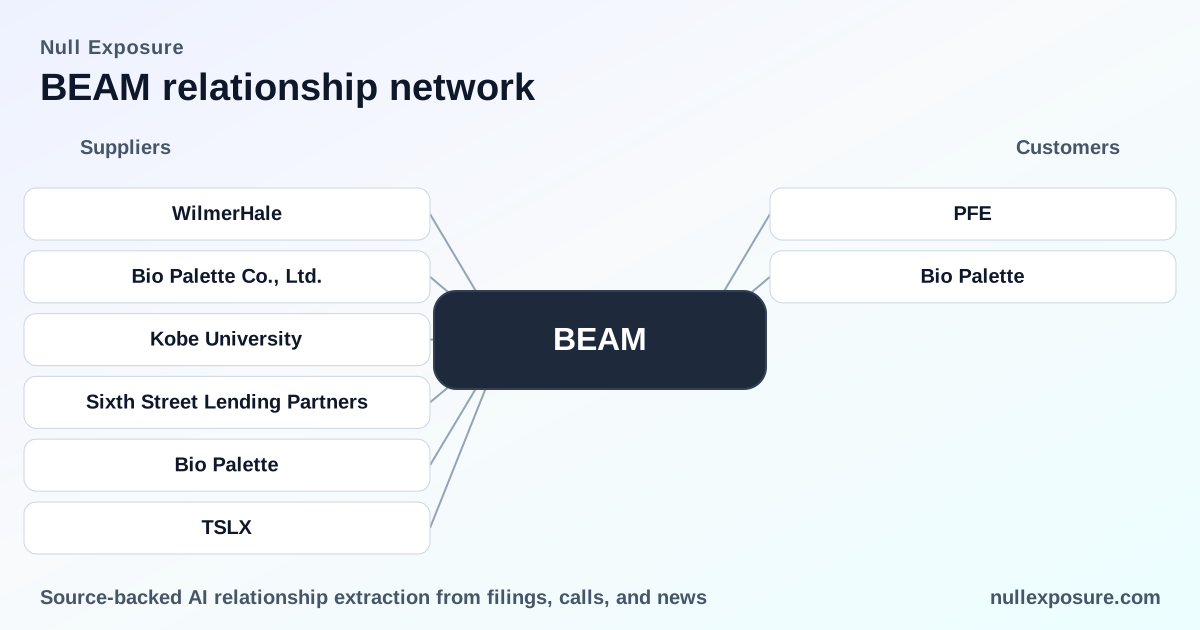
Beam Therapeutics: customer relationships that drive near-term revenue and long-term optionality
Beam Therapeutics monetizes its base-editing platform primarily through strategic licensing and collaboration agreements with large pharmaceutical partners and select biotechs. The company generates near-term revenue via upfront payments and staged milestones while retaining upside through licensed targets and program economics; this hybrid model reduces immediate capital burn risk but shifts commercial and regulatory execution to partners. For investors, the key questions are counterparty quality, contract structure, and the company's exposure to payer and geographic reimbursement dynamics.
For broader research and relationship tracking, visit https://nullexposure.com/ for regularly updated coverage.
Why partnerships are Beam's revenue engine today
Beam operates as a seller of platform access and program rights rather than a commercial-stage product company. The firm structures deals that transfer development, manufacturing, and commercialization responsibilities to partners in exchange for upfront cash, milestone potential, and, in some cases, royalties. License and collaboration revenue — $139.7 million in the most recent reported period — was driven primarily by the completion of a collaboration deal with Pfizer, highlighting how partner opt‑ins convert R&D relationships into recognized revenue (FY2026). (Source: TradingView summary of Beam SEC 10‑K / FY2026.)
This model delivers three investment implications: (1) near-term revenue visibility tied to partner decisions, (2) concentration risk toward a small number of large biopharma counterparties, and (3) longer‑term upside remaining contingent on partners’ development and commercialization success.
Deals that matter — a transaction-by-transaction read
Below are the named counterparties in Beam's disclosed customer/collaboration universe and what each relationship concretely contributes.
Pfizer — converting collaboration into licensed revenue
Pfizer completed a four‑year research collaboration focused on in vivo base editing and in December 2025 opted in to an exclusive worldwide license for a liver‑targeted development candidate, taking responsibility for development, regulatory approval, manufacturing, and commercialization. That opt‑in materially drove higher license and collaboration revenue for Beam in FY2026. (Source: GlobeNewswire press release, Feb 24, 2026; TradingView reporting on Beam SEC 10‑K, FY2026.)
Lilly — strategic partner expanding commercial optionality
Lilly is one of several strategic partners that participated in multi‑party collaborations with Beam; together with Pfizer, Apellis, and Sana, these deals generated $675 million in upfront payments and structured over $1 billion in potential milestones, illustrating how Beam converts platform value into immediate non‑dilutive financing and milestone‑backed upside. (Source: Quartr status update on Beam, May 2, 2026.)
Apellis — targeted partnership as demand signal
Apellis appears among the strategic collaborators referenced by Beam and its external reporting; inclusion in the same cohort of agreements that produced meaningful upfront consideration signals commercial interest in Beam’s in vivo capabilities across specialty indications. (Source: Quartr status update on Beam, May 2, 2026.)
Sana — strategic alliance inside the same funding cluster
Sana is also listed alongside other commercial partners in the set of deals that delivered the $675 million upfront figure and milestone potential, reinforcing that Beam’s partner strategy spans both large pharma and next‑generation cell/gene companies. (Source: Quartr status update on Beam, May 2, 2026.)
Bio Palette — a terminated licensing arrangement
Beam and Bio Palette agreed to terminate a licensing agreement that originally dated from March 27, 2019; the termination was disclosed in a filing submitted to the U.S. Securities and Exchange Commission on March 2, 2026. This outcome removes a legacy licensing relationship from Beam’s active portfolio but also clarifies commercial scope going forward. (Source: Bitget reporting on SEC filing, Mar 2, 2026.)
What these relationships collectively tell investors
- Revenue conversion is partnership-driven. The Pfizer opt‑in demonstrates how a successful collaboration transitions to license revenue recognized on Beam’s income statement, as reflected in FY2026 license and collaboration revenue of $139.7 million. (Source: TradingView / Beam SEC 10‑K, FY2026.)
- Upfront cash and milestone architecture are central to capital efficiency. The cited $675 million in upfront funding across partners provides non‑equity financing that lengthens the company’s runway while preserving upside through contingent payments. (Source: Quartr, May 2, 2026.)
- Concentration and counterparty execution are the core risks. A small number of large collaborators account for the majority of commercial validation and near‑term revenue realization; partner decisions to opt‑in or terminate programs directly shift Beam’s recognized revenue profile.
For a deeper dive into counterparty dynamics and ongoing updates, see https://nullexposure.com/.
Constraints and structural business signals investors should factor in
Beam’s disclosed materials and relationship reporting embed several company‑level operating model characteristics that determine risk and upside.
- Contracting posture — seller. Beam structures deals that license program rights and transfer downstream development, manufacturing, and commercialization responsibilities to partners; this reduces Beam’s commercial execution requirements but also limits direct control over ultimate product economics. (Company disclosures on commercialization responsibilities.)
- Geographic scope — global exposure. Beam and its partners are positioned to operate in multiple jurisdictions; regulatory, reimbursement, and pricing variability outside the U.S. will be material to commercial outcomes. (Company filings on international regulatory and reimbursement risk.)
- Payer dependence — critical. Coverage and reimbursement by government and private payors are essential for patient access and revenue realization, making payor strategy and pricing a critical element of deal economics once products reach market. (Company commentary on reimbursement importance.)
- Maturity — partnership‑driven commercialization stage. Beam remains a clinical‑stage biotechnology company that converts platform value through collaborations rather than direct product sales; its maturity profile means near‑term revenue is partner‑dependent while long‑term upside is contingent on clinical and regulatory milestones.
These constraints are company‑level signals; they shape how investors should evaluate partner quality, contract terms, and the timeline from collaboration to commercial payoff.
Bottom line for investors
Beam’s model is a capital‑efficient, partnership‑led commercialization strategy that delivers upfront cash and milestone exposure while ceding downstream commercialization execution. The Pfizer opt‑in and the cluster of strategic collaborations (including Lilly, Apellis, and Sana) materially underpin FY2026 revenue and validate the platform, while the Bio Palette termination underscores active portfolio pruning. The principal investment risks are counterparty concentration, execution dependence on partners, and reimbursement complexity across global markets.
For ongoing monitoring of Beam’s partner activity and revenue recognition events, maintain a tracking cadence around partner opt‑ins, milestone realizations, and SEC disclosures at https://nullexposure.com/.